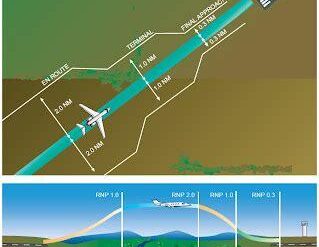
Performance-Based Navigation (PBN) is an innovative approach to standardizing navigation specifications across the globe. It aims to reduce the number of different navigation systems in use worldwide. At its core, PBN utilizes Area Navigation (RNAV) systems. This represents a significant shift from merely stating required performance accuracy to a more comprehensive definition. The ICAO PBN Manual (Doc 9613) defines it as area navigation based on performance requirements for aircraft operating along ATS routes, instrument approaches, or within designated airspace. These airborne performance requirements focus on accuracy, integrity, continuity, and functionality necessary for safe operations.
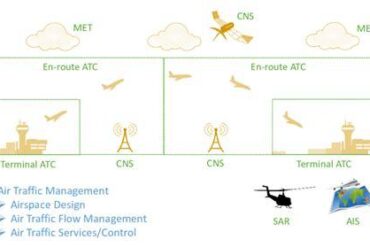
When considering PBN, it’s important to account for the availability of GNSS Signal-In-Space (SIS) or other navigation infrastructure. This is essential for effective navigation applications. The concept of PBN includes RNAV and RNP applications, which detail the operations that fall under this framework. PBN acts as a key enabler of an Airspace Concept, working alongside Communications, ATS Surveillance, and ATM.
The PBN framework consists of three main components: the Navigation Specification, the Navaid Infrastructure, and the Navigation Application. The Navigation Specification outlines performance requirements regarding accuracy, integrity, and continuity for specific operations in the airspace. It also defines how these standards are to be achieved, including the necessary navigation functionalities. Additionally, the Navigation Specification encompasses pilot knowledge and training requirements, as well as operational approvals. It can either be an RNP specification, which requires on-board performance monitoring and alerting, or an RNAV specification, which does not.
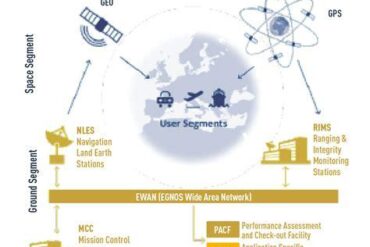
The Navaid Infrastructure includes the ground or space-based navigation aids referenced in each Navigation Specification. The presence and reliability of this infrastructure are crucial for enabling navigation applications. Meanwhile, the Navigation Application applies the Navigation Specification and Navaid Infrastructure within an airspace context, covering ATS routes and instrument flight procedures.
It’s worth noting that precision approach and landing systems like the Instrument Landing System (ILS) and Microwave Landing System (MLS) are part of the broader navigation suite but are not categorized under Performance-Based Navigation. These systems differ as they do not utilize area navigation techniques.
The PBN Manual (ICAO Doc 9613) is divided into two volumes. Volume I contains two parts: Part A explains the PBN Concept and its practical application, while Part B offers guidance for ANSPs through three processes. Volume II further breaks down into three parts, detailing on-board performance monitoring, safety assessments, and ICAO’s RNAV and RNP specifications for state certification and operational approval.
PBN brings about a fundamental transition from sensor-based navigation to a performance-based model, presenting numerous advantages. It reduces the need for maintaining sensor-specific routes, which lowers associated costs. Moreover, it avoids the complexities of developing sensor-specific operations with each advancement in navigation technology, promoting efficiency in airspace use. By clarifying the usage of RNAV and RNP systems, it also streamlines the operational approval process for operators with a limited set of globally applicable navigation specifications. Ultimately, PBN has the potential to enhance safety, flight efficiency, airspace capacity, and environmental sustainability.
Currently, there is no standardized naming convention for PBN approach procedures worldwide, leading to inconsistencies. Different states may use various names, such as RNAV (GPS) RWY XX or RNAV (RNP) RWY XX. ICAO Circular 336 offers guidance for states transitioning from RNAV to RNP approach chart identification. Starting from December 1, 2022, only the term RNP will be accepted, simplifying the naming process during the transition.
In terms of pilot licensing, new provisions were introduced with Regulation (EU) 2016/539, effective from August 25, 2018. Pilots must now obtain a PBN endorsement for their instrument rating (IR) to fly using PBN procedures. Initially, those without PBN privileges could only operate on non-PBN routes, but after August 25, 2020, PBN privileges became mandatory for all IR holders. To gain PBN endorsement, pilots must complete theoretical knowledge and flying training focused on PBN, along with a skill test or proficiency check.
However, implementing PBN comes with challenges. One major issue is the disparity in pilot training globally. Without standardization, training scope, duration, and methods can vary widely. Aircraft systems also pose challenges, as increasing automation leads to complex user platforms depending on the operator’s avionics. It’s essential for these systems to be intuitive and upgradeable. Furthermore, the evolution of definitions and criteria related to PBN can create confusion among pilots and regulators. Finally, global harmonization remains a challenge, as differing implementation approaches exist in various countries due to the absence of standardized ICAO SARPs.