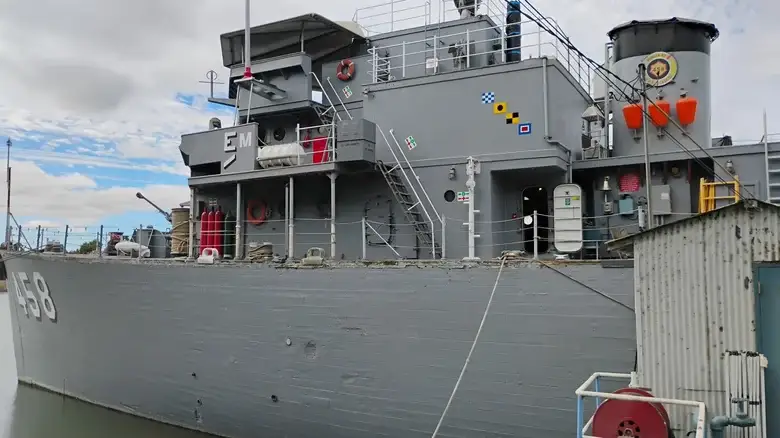
California’s maritime story hides a quiet anomaly: a Vietnam War–era Navy minesweeper resting far from the open Pacific, preserved in an inland port city few outsiders expect. In 2026, that anomaly becomes a headline act as a very rare U.S. Navy ship begins a major facelift, transforming from weathered survivor into a rigorously authentic floating museum. The vessel is the USS Lucid (MSO-458), and its restoration is less cosmetic upgrade than historical resurrection.
Stockton, California, seems an unlikely host for naval heritage, yet the city’s relationship with water runs deep. The Port of Stockton connects to the Pacific via the San Joaquin River, threading oceangoing ships into the Central Valley. That watery corridor now anchors one of the most unusual preservation projects in the American West, led by the Stockton Maritime Museum, an institution founded to safeguard a regional maritime legacy often overshadowed by coastal giants.
The USS Lucid’s path to Stockton is as eccentric as its construction. Built in New Orleans and commissioned during the Cold War, the ship later drifted into civilian obscurity after decommissioning in 1976. It spent years repurposed as a floating home in the Sacramento–San Joaquin Delta, complete with domestic comforts utterly foreign to its original mission. That improbable afterlife makes its coming restoration all the more dramatic.
What makes the Lucid truly exceptional is not nostalgia, but engineering. Unlike steel-hulled warships, this Aggressive-class minesweeper was constructed almost entirely of wood. The choice was deliberate and lifesaving. Magnetic naval mines, designed to detonate near metal hulls, ignored wooden vessels like the Lucid. This allowed MSO, or Minesweeping, Oceangoing, ships to lead fleets through dangerous waters, locating and neutralizing underwater explosives before larger vessels advanced.
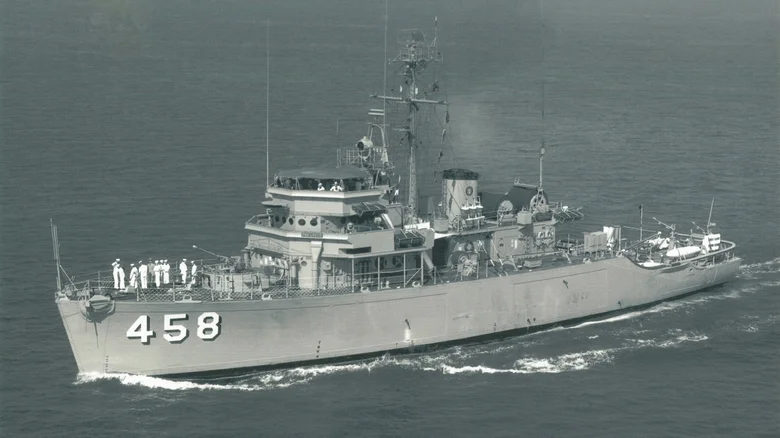
A Warship Designed to Be Invisible
The Lucid’s wooden hull was paired with low-magnetic equipment and specialized sonar, enabling it to hunt mines rather than trigger them. Crewed by eight officers and roughly 70 enlisted sailors, the ship also handled search and rescue operations, towing duties, and fleet support missions during the Vietnam War era. Its work was methodical, tense, and largely unseen, a quiet discipline essential to naval mobility.
A Restoration Measured in Years, Not Paint
The 2026 facelift is the most visible phase of a multi-year effort already underway. This is not a superficial refurbishment. Museum leadership, including president David Rajkovich, has emphasized historical accuracy down to individual fittings. Many original components were stripped and sold decades ago, forcing the restoration team into a global scavenger hunt for authenticity.
After three years of negotiation, the museum secured access to surplus equipment from the Taiwanese Navy, returning with 40 shipping containers filled with parts used exclusively on Aggressive-class minesweepers. Additional permission was granted to search mothballed U.S. Navy vessels at Suisun Bay, allowing volunteers to reclaim era-correct brass, stainless steel, and mechanical components otherwise lost to history.
Volunteers, Memory, and Maritime Patience
The project’s human element is as compelling as its technical one. Volunteers include former sailors who once served aboard similar ships, bringing lived experience to the restoration. Among them is Jack Frost, a former corpsman now in his seventies, whose hands-on work bridges generations of naval service. Funding comes from a patchwork of private donations and state grants, stretching timelines but preserving independence.
Before the Lucid can welcome visitors, critical structural work remains. The ship must be removed from the water so its hull can be fully inspected and repaired where necessary. Only then can it take its intended place along Stockton’s historic downtown waterfront.
Why the USS Lucid Matters Now
As the last surviving U.S. example of its class, the USS Lucid occupies a singular place in American naval heritage. Its 2026 restoration is not merely about preservation, but about visibility, bringing an often-overlooked chapter of maritime warfare into public view. This wooden warship reminds visitors that sometimes survival depended on staying unseen at sea.