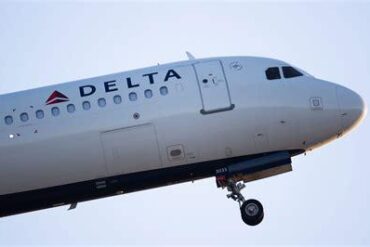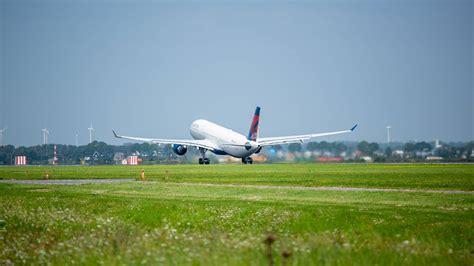
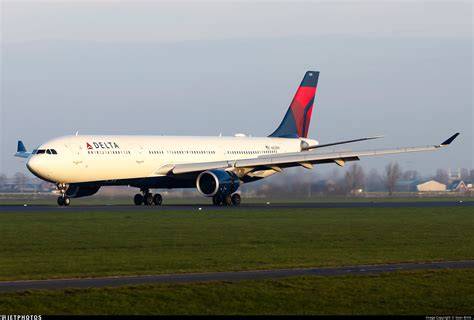
A Delta Air Lines Airbus A330-300 flying from New York to Rome was forced to divert to Canada after an engine-related mechanical issue developed over the North Atlantic. Delta flight DL182, carrying 267 passengers and 13 crew members, landed safely at St. John’s International Airport in Newfoundland after roughly four hours of flight, turning an overnight transatlantic journey into an unexpected trip back across the Atlantic.
The aircraft, registered N823NW, departed New York John F. Kennedy International Airport at approximately 5:43 p.m. on Sunday, August 23. Its scheduled destination was Rome Fiumicino Airport, with the flight expected to take around eight and a half hours. Instead, the crew turned toward St. John’s after determining that continuing toward Europe was not the prudent option following the mechanical problem.
The decision highlights the importance of St. John’s International Airport (YYT) within North Atlantic aviation. Positioned on Canada’s eastern edge, the airport is a frequent diversion point for aircraft crossing between North America and Europe. When an aircraft encounters an engine problem, medical emergency, or another serious issue over the Atlantic, having a suitable airport within reach can provide pilots with a critical safety option.
Delta Flight 182 Diverts to St. John’s
According to Delta, the aircraft experienced a mechanical issue involving one of its engines. The airline said the flight crew followed standard procedures and diverted to St. John’s as a precaution, emphasizing that passenger and crew safety remained the priority.
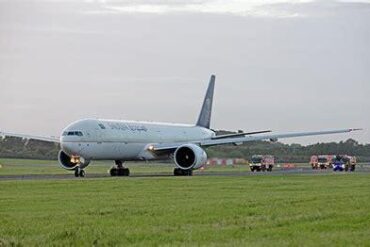
Initial reports described the situation as a “mechanical emergency,” and emergency services were waiting for the A330 when it arrived in Newfoundland. Despite the seriousness implied by the emergency declaration, the aircraft completed its diversion without incident. All 267 passengers and 13 crew members were able to leave the aircraft safely.
The A330 landed at St. John’s at approximately 11:15 p.m. local time, around four hours after leaving New York. Rather than attempting to continue the original flight to Rome, Delta arranged hotel accommodation and meal vouchers for those affected by the diversion.
The disruption was significant because passengers were already several hours into an international overnight journey. However, the safe landing meant the immediate operational priority had been successfully achieved. The airline subsequently arranged a replacement aircraft to return the passengers and crew to New York.
280 Passengers and Crew Returned to New York
Delta deployed another aircraft, registered N428DX, to St. John’s on August 24. The replacement flight departed Newfoundland at approximately 9:50 a.m. and arrived back at JFK at 11:07 a.m.
Returning to New York allowed Delta to reorganize the disrupted itinerary and rebook passengers onto new services bound for Italy. The airline confirmed that passengers were subsequently rebooked on flights to Rome, although the original schedule was inevitably disrupted by the unexpected overnight stop.
For travelers, the experience represented considerably more than a delayed arrival. A flight that was supposed to connect New York and Rome nonstop instead involved an emergency diversion, a hotel stay in Canada, a replacement aircraft, a return to New York, and another flight to Italy. Nevertheless, the sequence also demonstrates how airlines manage irregular operations after an aircraft develops a potentially serious technical problem far from its scheduled destination.
N823NW: The Airbus A330-300 Involved
The aircraft at the center of the incident was N823NW, an Airbus A330-300 delivered to Delta in August 2015. The widebody was approximately 11 years old at the time of the diversion and forms part of Delta’s substantial long-haul fleet.
The aircraft is identified as an Airbus A330-302, with manufacturer serial number 1628. It first flew on January 12, 2015, before being delivered to Delta later that year. Power comes from two General Electric CF6-80E1A4 engines, the same engine type installed on numerous A330 aircraft worldwide.
N823NW has a published maximum configuration of 293 passengers across three cabins, including 34 Business Class seats, 40 Premium seats, and 219 Economy seats. With 267 passengers aboard DL182, the aircraft was carrying a substantial load while still having 26 seats available.
That combination made the diversion particularly notable. An A330 crossing the North Atlantic must have sufficient operational planning for fuel, weather, air traffic conditions, and potential alternate airports. When an engine-related problem occurs, however, safety considerations take precedence over the original flight plan.
Why St. John’s Is Important for Atlantic Diversions
St. John’s has long served as an important North Atlantic diversion airport. Its geographic position makes it particularly valuable for aircraft operating between eastern North America and Europe. A transatlantic aircraft experiencing a technical or medical emergency may be able to reach Newfoundland much sooner than it could reach its intended destination.
For DL182, St. John’s offered a suitable destination after the crew identified the mechanical issue. The airport’s emergency response capability also allowed local services to meet the aircraft after landing.
The incident therefore illustrates an often-overlooked part of long-haul aviation: a nonstop route does not mean an aircraft is committed to flying directly between its two scheduled airports. Crews continuously monitor aircraft systems and operating conditions, while dispatchers and air traffic controllers support decisions when circumstances change.
Delta Emphasizes Safety After the Diversion
Delta said its crew followed standard procedures during the incident and apologized to passengers for the disruption. The airline also praised the flight crew and ground teams for their professionalism and assistance.
Although the mechanical issue caused substantial inconvenience, the outcome was ultimately positive. The aircraft reached the ground safely, everyone onboard was unharmed, and Delta arranged accommodation, transportation, and onward rebooking.
For the 280 people aboard DL182, the journey to Rome became an unexpected North Atlantic detour. For aviation observers, however, the incident offers a clear example of how diversion airports, trained flight crews, emergency services, and airline recovery operations work together when a long-haul aircraft encounters a mechanical problem far from home.