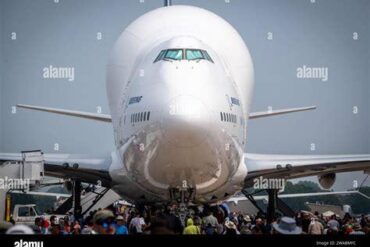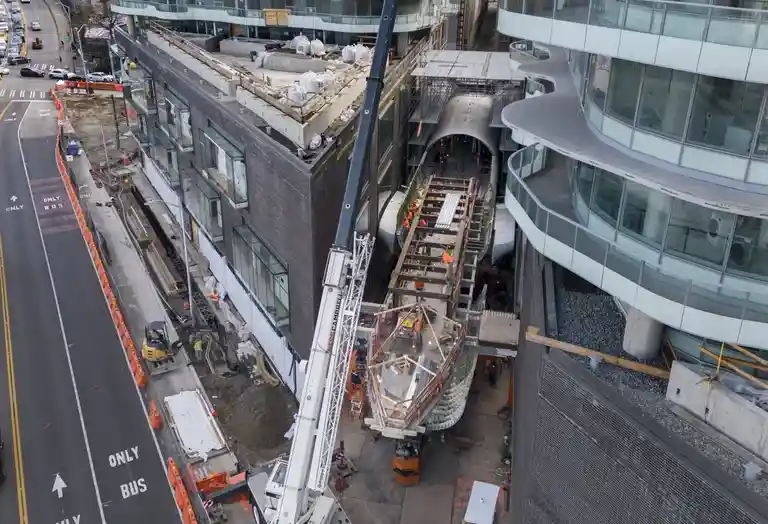
Seattle, the birthplace of Boeing and one of the world’s most influential aviation cities, is preparing to unveil one of the most unusual architectural installations ever attempted with a commercial airliner. A retired United Airlines Boeing 747-400—once a long-haul workhorse crossing oceans—will soon hover dramatically between two high-rise residential towers in the city’s rapidly transforming Denny Triangle district. Suspended approximately 14 feet above the ground, the aircraft will become a permanent centerpiece of the ambitious WB 1200 Project at 1200 Stewart Street, blending aviation heritage, urban design, and public space into a single unforgettable landmark.
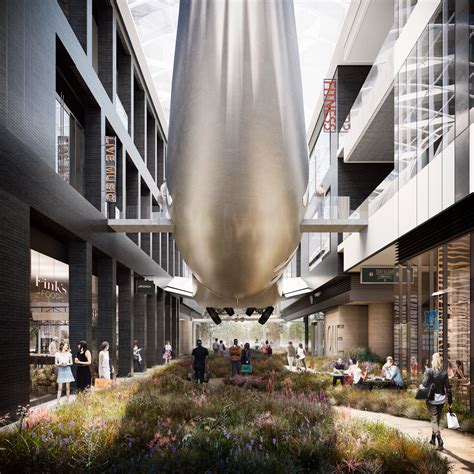
Rather than being displayed in a museum or scrapped for parts, this jumbo jet is being reborn as an architectural sculpture embedded directly into the city’s fabric. Positioned between two 47-story residential towers, the aircraft will sit within a multi-level galleria that connects retail, entertainment, and office spaces. Residents and visitors will be able to walk beneath the aircraft’s fuselage and landing gear, creating an immersive experience that celebrates Seattle’s deep roots in aerospace innovation.
The project is already generating intense interest among architects, aviation enthusiasts, and city planners. It represents a striking example of adaptive reuse, transforming an aircraft that once transported hundreds of passengers across continents into a public gathering space in the heart of one of America’s fastest-growing urban neighborhoods.
The Vision Behind the WB 1200 Aviation Installation
The idea of suspending a full-size Boeing 747 inside an urban development might sound like something from science fiction, but it is central to the identity of the WB 1200 complex. Located on a triangular block bordered by Denny Way, Minor Avenue, and Stewart Street, the site previously housed low-rise structures and a surface parking lot. As Seattle’s tech sector expanded—particularly with nearby growth in South Lake Union and downtown technology offices—developers began envisioning a project that could stand out in an increasingly crowded skyline.
The result is a mixed-use development designed as a gateway into downtown Seattle. Instead of relying solely on conventional design features, the developers opted for a bold symbol tied directly to the city’s legacy: the Boeing 747, often called the “Queen of the Skies.”
The aircraft will rest within a three-story podium galleria, surrounded by commercial and cultural spaces. Plans for the complex include a 40,000-square-foot Live Nation performance venue, a 16,000-square-foot Trader Joe’s grocery store, and tens of thousands of square feet dedicated to retail and offices. Above the podium rise the two residential towers that frame the aircraft, turning the jumbo jet into a suspended urban sculpture visible from multiple vantage points.
The Aircraft: United Airlines’ Historic Boeing 747-422
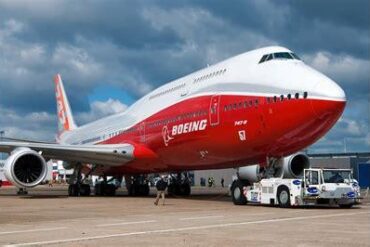
At the center of the installation is Boeing 747-422 registration N178UA, an aircraft that spent nearly three decades flying passengers across the globe for United Airlines. Built as part of Boeing’s highly successful 747-400 series, the aircraft conducted its first test flight on October 23, 1990, before entering service with United just weeks later.
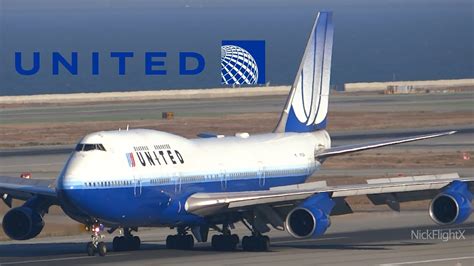
During its career, N178UA carried travelers on some of the airline’s most iconic international routes. Configured in a three-class layout accommodating 374 passengers, it embodied the long-haul luxury and capacity that made the 747 a legend of commercial aviation.
The aircraft’s cabin layout included:
- 12 First Class seats
- 52 Business Class seats
- 310 Economy Class seats
Powering the massive jet were four Pratt & Whitney PW4056 turbofan engines, providing the thrust necessary for intercontinental flights linking the United States with Europe and Asia. United Airlines once operated 44 Boeing 747s, making it one of the aircraft’s most prominent operators in North America until the type was retired in October 2017.
The airline ultimately replaced the 747 fleet with newer twin-engine aircraft such as the Boeing 777-300ER and Boeing 787 Dreamliner, reflecting industry trends toward more fuel-efficient long-haul jets.
From Desert Storage to Downtown Seattle
After retirement, N178UA was transferred to storage facilities in Victorville, California, a location well known for housing decommissioned aircraft in the dry Mojave climate. Eventually, the jet was acquired through aviation asset company ComAv, which supplied the aircraft for its new architectural life.
Transforming a 231-foot-long jumbo jet into a building installation required extraordinary logistical planning. The aircraft was carefully dismantled into 39 separate sections, allowing the massive components to be transported from Southern California to Seattle by truck. Once on site, construction teams began the painstaking process of reassembling the fuselage panels and structural components within the podium framework.
More than half of the aircraft’s external fuselage panels have already been installed, gradually restoring the recognizable silhouette of the jumbo jet—although in a dramatically altered form.
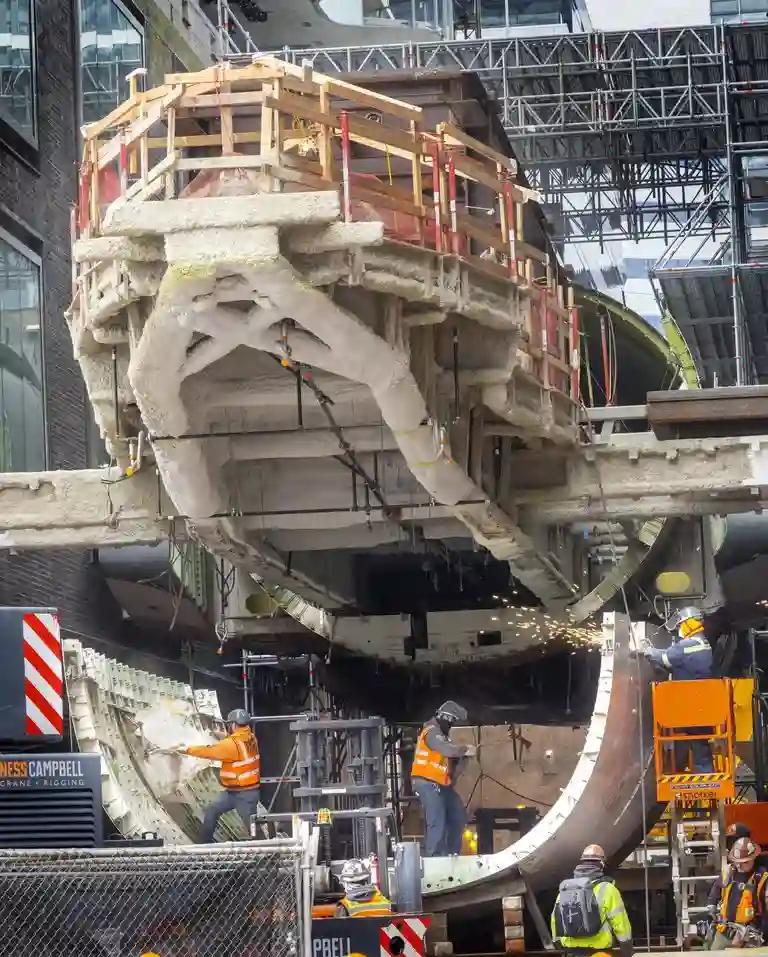
To emphasize the aircraft’s sculptural qualities, much of its original airline paint has been removed. The plane now features a raw aluminum finish, highlighting the industrial textures of its structure while preserving key elements such as the nose section, tail, and landing gear.
Engineering the Impossible: Supporting a Suspended Jumbo Jet
Suspending an aircraft weighing tens of thousands of pounds within a building requires far more than creative design—it demands precise structural engineering. The WB 1200 project incorporates a network of reinforced podium framing designed to distribute the jet’s vertical loads safely into the building’s structural system.
Engineers also had to account for dynamic movement, ensuring that the aircraft remains stable despite wind forces, pedestrian movement, or seismic activity. Seattle sits in a region with measurable earthquake risk, so the structure includes mechanisms to control swing and vibration, preventing the suspended aircraft from shifting under stress.
The result is a carefully balanced installation where the aircraft appears almost weightless despite its enormous size.
Inside the Aircraft: A Workspace in the Sky
Rather than leaving the interior empty, designers plan to convert the aircraft’s cabin into unique collaborative workspace areas integrated with the surrounding commercial spaces. The idea is to preserve the feeling of being inside a historic airliner while adapting the interior for modern use.
Visitors entering the fuselage will experience a blend of aviation history and contemporary design. Original structural ribs, window lines, and cabin curvature will remain visible, while new lighting, flooring, and seating transform the space into a functional environment for meetings, creative work, or events.
The surrounding galleria will function as a year-round gathering space, complete with landscaped walkways and garden elements. Residents of the towers above will have direct access to this area, reinforcing the concept that the aircraft is not merely a display piece but an integral component of daily life within the development.
Architecture That Reflects Seattle’s Identity
The ambitious design comes from Henriquez Partners Architects, a Vancouver-based firm known for experimental urban projects. According to the firm, the development is intended to act as a symbolic gateway into downtown Seattle, merging architectural form with local history.
The residential towers themselves feature sculptural balconies with layered, geological forms that appear carved rather than constructed. These balconies cascade down the façade, giving the towers a textured appearance that contrasts with the smooth metallic surfaces of the suspended aircraft below.
Henriquez Partners describes the towers as “timeless, weathered sentinels in the skyline,” a design philosophy that frames the aircraft not just as a novelty but as a central artistic element within the cityscape.
A New Chapter for the Queen of the Skies
Although Boeing 747 aircraft continue to fly primarily as cargo carriers, the era of the jumbo jet as a passenger airliner is largely over. Projects like the Seattle installation provide a new way to preserve the legacy of the aircraft that revolutionized global travel for more than half a century.
Interestingly, this is not the first time a 747 has been elevated into a building structure. One of the most famous examples is at Technik Museum Speyer in Germany, where a historic Boeing 747-230 named “Schleswig-Holstein” sits atop towering steel pylons above the museum complex. Visitors there can walk through the aircraft while enjoying panoramic views from its wings.
Seattle’s suspended 747 takes the concept even further by integrating the aircraft directly into a living urban environment, surrounded by homes, shops, and entertainment spaces.
Seattle’s Aviation Legacy Takes Flight Again
Few cities are as closely tied to aviation as Seattle. It was here that William Boeing founded the Boeing Company in 1916, eventually transforming the region into one of the world’s most important aerospace centers. Generations of aircraft—from the Boeing 707 to the 787 Dreamliner—have emerged from factories in the greater Seattle area.
Placing a retired Boeing 747 at the heart of a downtown development is therefore more than a bold architectural experiment. It is a reminder that aviation remains deeply woven into the city’s identity.
When construction is completed, pedestrians walking through the galleria will pass beneath the enormous fuselage of a once-global airliner. For a moment, in the middle of a bustling downtown neighborhood, Seattle’s aviation heritage will quite literally hang in the air.