Definition
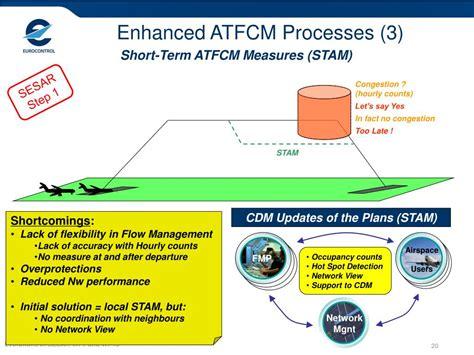
Short Term Air Traffic Flow and Capacity Management (STAM) is a strategy designed to balance sector workloads by managing traffic peaks. It does this through minor ground delays, flight level restrictions, and limited rerouting for selected flights.
Description
Air Traffic Control (ATC) sectors often face overload due to high traffic. To manage this, departures of certain flights may be delayed by the Network Manager (NM) through a Calculated Take Off Time (CTOT). Typically, CTOTs are assigned two hours before the scheduled departure. While helpful, these measures can be less effective due to their advance planning requirements. Another method involves route availability restrictions, which separate traffic flows to ease complexity. For instance, some routes or waypoints might be restricted based on specific conditions like departure and destination points. Although this improves safety, it can reduce efficiency, especially since such restrictions may be imposed well in advance of the flight.
The introduction of STAMs allows for greater flexibility in managing traffic overload, as these measures can be implemented closer to the time of departure. STAMs can target specific flights or entire traffic flows, adjusting ATC sector workloads dynamically. This means redistributing the workload from congested sectors to those that can handle more traffic safely. While some efficiency is sacrificed, the impact is less severe than with other methods since STAMs usually affect only a few flights and are temporary. Efforts are also made to minimize these interventions and remove them when they are no longer necessary.
Local Flow Management Positions (FMPs) implement STAMs, but because they influence the entire network, a Network Impact Assessment must be conducted in coordination with the NM.
Examples of STAMs
-
Level Capping: This restricts flights under certain conditions, such as all departures from EZZZ being limited to FL XXX or below over point ENTRY. This common STAM helps prevent upper sectors from becoming overloaded by temporarily limiting flight levels.
-
Rerouting: This requires mandatory diversions to relieve traffic in congested areas.
-
Alternative Routing: Occasionally, alternative routes are allowed to ease traffic loads, following regulations with low usage rates.
-
Dynamic Routing Restrictions: These are applied to manage traffic flow effectively.
-
Minimum Departure Interval: Sequential departures from specific aerodromes must be spaced by a set number of minutes in a particular direction. This is similar to CTOTs, but it’s a temporary measure.
-
Successive Aircraft Separation: This requires maintaining a minimum distance between successive aircraft on designated routes.