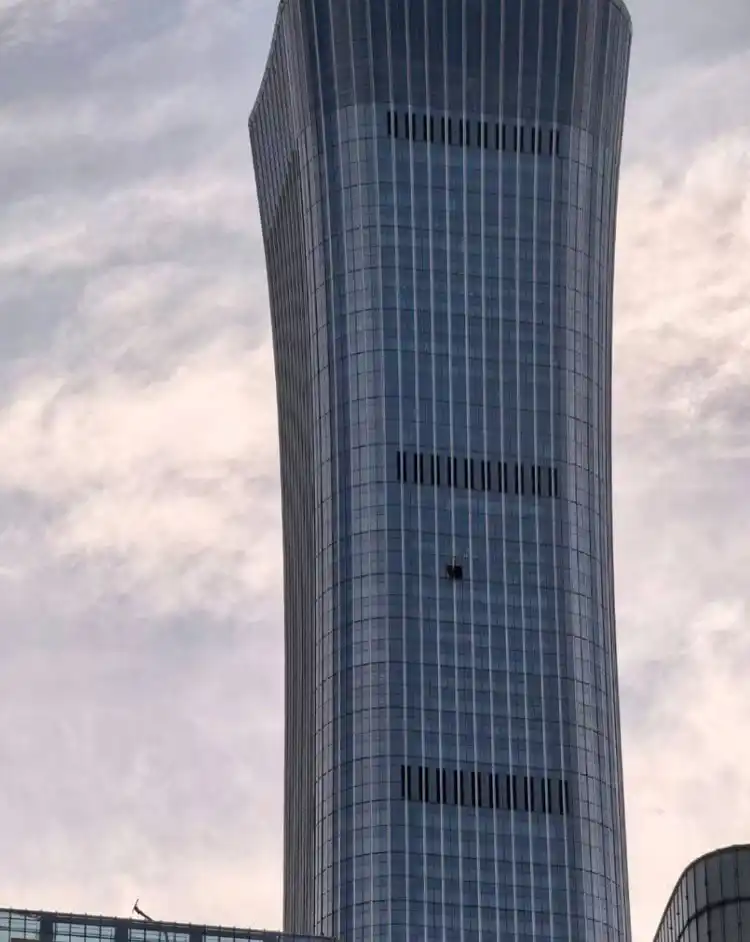
A Sunward SA 60L Aurora light-sport aircraft crashed into CITIC Tower, widely known as China Zun, in Beijing on June 26, sending debris cascading onto streets below and prompting a large-scale emergency response. The dramatic incident unfolded in the heart of the Chinese capital, where civilian aircraft and drones are subject to some of the country’s strictest airspace restrictions. Videos circulating online captured the shocking moment the aircraft struck the side of the 109-story skyscraper, leaving its tail section protruding from the damaged facade while emergency crews rushed to secure the area.
Authorities quickly evacuated the landmark office tower as firefighters, police officers, and medical teams established a safety perimeter around the building. Witnesses described scenes of confusion as thousands of office workers streamed onto surrounding streets while emergency personnel assessed structural damage and searched for potential casualties. At the time of reporting, officials had not confirmed the number of injuries or fatalities resulting from the crash.
The collision immediately raised questions about how a privately operated light aircraft managed to enter one of China’s most heavily protected urban airspaces without being intercepted.
Aircraft Deviated From Planned Flight Before Impact
Preliminary reports indicate the aircraft departed Beijing Shifosi Airport before unexpectedly diverting from its intended route. Instead of following the prescribed traffic pattern for its return to Runway 18, the airplane reportedly turned toward central Beijing, ultimately flying directly into the city’s financial district.
According to aviation tracking information cited by multiple reports, the aircraft may have deviated approximately 270 degrees from its expected heading before reaching the skyscraper. Additional unconfirmed reports suggested that the aircraft’s transponder stopped transmitting shortly before the collision, although investigators have yet to determine whether this resulted from equipment failure, pilot action, or another factor.
The aircraft impacted approximately the 65th floor of the 518-meter (1,699-foot) China Zun tower. The force of the collision tore a visible opening into the building’s exterior while sections of the aircraft and fragments of glass and cladding fell onto roads below, creating additional hazards for pedestrians and first responders.
Beijing’s Strict Airspace Restrictions Under Scrutiny
The accident has intensified scrutiny of Beijing’s tightly controlled airspace. Civilian drone operations and unauthorized aircraft flights over the capital are heavily restricted due to the city’s political importance and concentration of government buildings.
Because of these longstanding restrictions, residents reportedly became alarmed as soon as they observed a small aircraft flying unusually low toward the city center. Aviation experts have questioned how the aircraft remained on course long enough to reach Beijing’s tallest skyscraper despite existing monitoring systems designed to detect unauthorized flights.
The incident is expected to prompt a comprehensive review of local air traffic monitoring procedures, pilot compliance requirements, and emergency response coordination for low-altitude aircraft operating near restricted zones.
Pilot Identity and Aircraft Ownership Become Focus of Investigation
Investigators believe the aircraft may have been flown by Captain Liu Junhua, although authorities had not officially confirmed the pilot’s identity at the time of reporting. Police reportedly located a vehicle believed to be connected to the suspected pilot and conducted a search as part of the ongoing investigation.
Reports have also noted that Liu’s name appears in corporate records associated with a subsidiary of CITIC Bank, the organization whose name the skyscraper carries. Authorities have not indicated whether this connection bears any relevance to the accident, and investigators continue gathering evidence before drawing conclusions.
The aircraft involved, registered as B-12PP, is reportedly owned by Pioneer Flying School at Shifosi Airfield. Investigators are expected to examine maintenance records, flight planning documentation, pilot qualifications, and communications leading up to the crash.
Sunward SA 60L Aurora: China’s Homegrown Light-Sport Aircraft
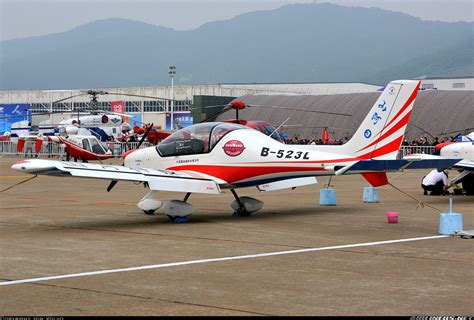
The Sunward SA 60L Aurora is a Chinese-designed, two-seat light-sport aircraft manufactured by Sunward Aircraft, a subsidiary of Hunan Science and Technology Co., Ltd. Developed for recreational flying and pilot training, the aircraft complies with international light-sport standards and received certification from the Civil Aviation Administration of China (CAAC) in 2013.
Featuring a low-wing configuration, fixed tricycle landing gear, and a single-engine tractor layout, the SA 60L was designed to offer economical flight operations while maintaining straightforward handling characteristics. The enclosed bubble canopy provides excellent visibility for pilots during visual flight operations.
An upgraded variant, the SA 60V, incorporates improvements including enhanced engine installation and instrument flight capability, broadening the aircraft’s operational flexibility.
Commercial Air Traffic Also Affected
The unexpected incursion into restricted airspace disrupted commercial aviation operations as well. Flight tracking information indicated that Hainan Airlines Flight HU7146, an Airbus A330-800 operating from Urumqi to Beijing Capital International Airport, was forced to perform a go-around because of the developing situation involving the small aircraft.
Although no collision risk between the commercial jet and the light aircraft has been confirmed, the event illustrates how a single unauthorized aircraft movement can rapidly affect air traffic across one of Asia’s busiest aviation hubs.
Investigation Expected to Focus on Multiple Critical Questions
As investigators continue examining flight data, wreckage, surveillance footage, and witness statements, several key questions remain unanswered. Authorities will seek to determine why the aircraft departed its intended route, whether mechanical failure or pilot incapacitation contributed to the accident, why the aircraft entered restricted airspace undetected, and whether existing monitoring procedures require significant enhancement.
Beyond the immediate tragedy, the crash represents one of the most unusual aviation incidents ever recorded in central Beijing. Its implications extend beyond structural damage to one of China’s most recognizable skyscrapers, raising broader concerns about urban airspace management, pilot oversight, emergency preparedness, and the resilience of aviation security systems protecting one of the world’s most tightly controlled capitals.