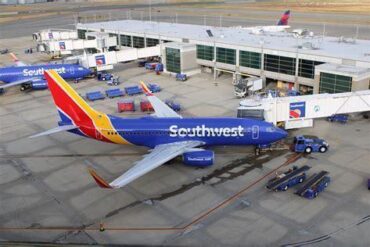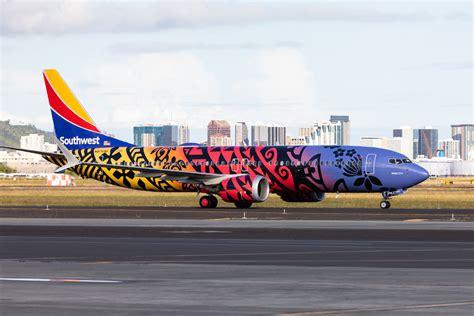
Southwest Airlines Co., headquartered at Dallas Love Field, stands as one of the most iconic carriers in U.S. aviation history. Operating an all-Boeing 737 fleet of 801 aircraft across over 100 destinations, it has firmly cemented its place as the fourth-largest U.S. airline by passengers carried. From its humble beginnings to its profound impact on global low-cost aviation, Southwest’s journey reflects a dynamic blend of innovation, resilience, and adaptability.
The Origins and Early Expansion of Southwest Airlines
Founded as Air Southwest on March 9, 1967, by Herb Kelleher and Rollin King, the airline was originally envisioned to connect the Texas Triangle of Dallas, Houston, and San Antonio under intrastate regulations to avoid federal aviation controls. After a series of legal battles, it emerged in 1971 as Southwest Airlines, launching service with a modest fleet of three Boeing 737-200s. This early focus on short-haul, high-frequency routes established the core operational ethos of the airline.
Through the 1970s, Southwest expanded within Texas, but the Airline Deregulation Act of 1978 opened the floodgates for interstate expansion. By 1979, Southwest began extending service beyond Texas, paving the way for new routes into the Southeastern and Eastern United States throughout the 1990s. The launch of service into Denver in 2006 further reinforced its nationwide footprint, transforming it into a major player across domestic skies.
A Business Model That Redefined Aviation
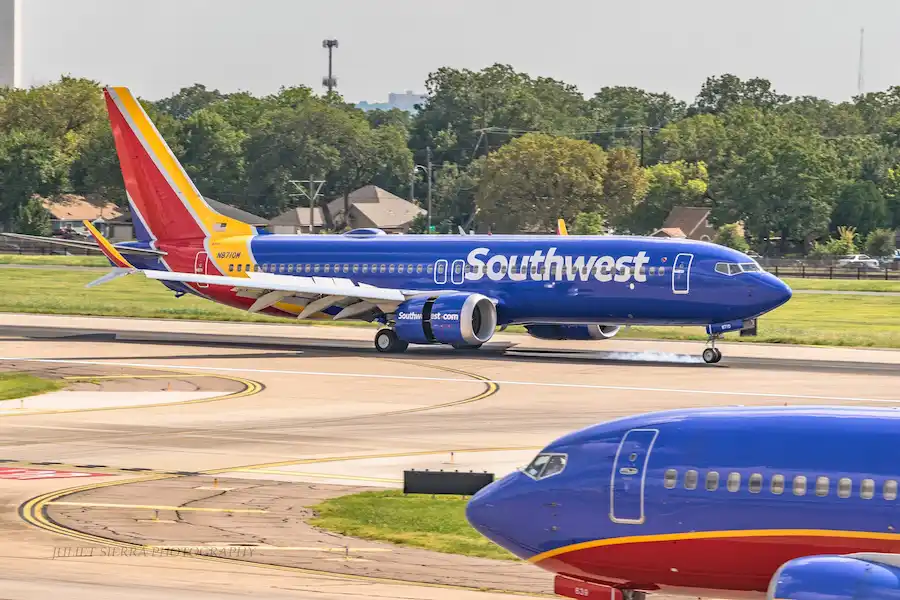
Central to Southwest’s success is its commitment to a single-type fleet strategy, operating exclusively Boeing 737 aircraft. This approach streamlines maintenance, training, and operations, enabling lower costs and higher aircraft utilization. Southwest’s point-to-point network contrasts the traditional hub-and-spoke models, reducing connection delays and improving aircraft turnaround times. With rolling hubs in key airports, it has developed a high-frequency service model catering to business and leisure travelers alike.
This low-cost strategy inspired a wave of global low-cost carriers such as Ryanair, EasyJet, WestJet, and AirAsia, many of whom emulated its lean operations and quick-turnaround techniques. The Southwest blueprint became the global benchmark for low-fare, high-efficiency airline operations.
The Passenger Experience: Simplicity Meets Service
Southwest maintains an economy-only cabin across its entire fleet, offering passengers free snacks and non-alcoholic beverages, while alcoholic drinks are available for a modest $7–$9 charge (and occasionally complimentary during holidays). Its hallmark open seating policy, managed through boarding groups A, B, or C and numbered positions 1–60, enables one of the fastest boarding processes in the industry—a fact even validated by MythBusters.
In response to evolving market demands, Southwest announced that starting May 1, 2025, it will introduce extra-legroom seating in the first five rows and at exit rows at no extra charge initially. By the end of 2025, it plans to implement assigned seating and tiered fare structures, signaling a strategic pivot from its traditional uniform offering toward a more segmented product lineup.
Innovation in In-Flight Connectivity
In the digital age, Southwest’s in-flight entertainment program has emerged as a competitive differentiator. Passengers enjoy free Wi-Fi streaming of live television, movies, music, in-app messaging, and flight tracking on personal devices. For full Internet access, a nominal $8 fee applies, with complimentary access provided to Business Select and A-List Preferred members. In a move to enhance reliability and bandwidth, Southwest began transitioning from Anuvu to Viasat hardware on March 9, 2023, ushering in improved connectivity performance.
The Loyalty Engine: Rapid Rewards
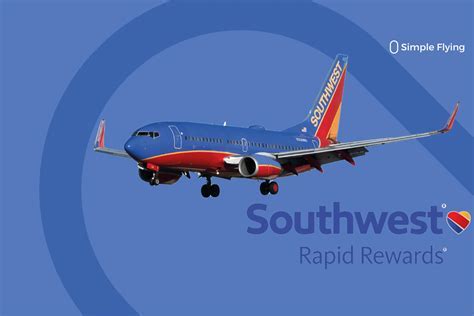
Southwest’s frequent flyer program, Rapid Rewards, launched on June 18, 1987, as The Company Club and was rebranded in 1996. Initially structured around earning credits redeemable for free flights, it transitioned in 2011 to a revenue-based points system that eliminated blackout dates, increasing redemption flexibility. Since October 18, 2019, points earned under Rapid Rewards never expire, reinforcing loyalty while simplifying program management for customers.
Corporate Culture and Leadership Philosophy
Headquartered at Dallas Love Field, Southwest’s corporate ethos is encapsulated in its motto: “Servant’s Heart, Warrior Spirit, Fun-LUVing Attitude.” The airline’s vibrant culture is showcased at its headquarters museum, complemented by state-of-the-art facilities like the Network Operations Control center (2013) and the Wings & LEAD training complex (2018), with expansions completed through 2020.
With 72,450 full-time equivalent employees as of January 2025, approximately 83% unionized across multiple labor groups, Southwest continues to balance labor relations with operational needs. Under CEO Bob Jordan, who took the helm on February 1, 2022, and Chairman Gary Kelly, the airline navigated significant structural changes, including the January 2024 pilot contract ratification and the February 2025 layoff of 1,750 non-contract staff.
Turbulence: Controversies and Operational Challenges
Despite its strong reputation, Southwest has faced a series of controversies over the years. Incidents ranging from the 2011 pilot’s obscene radio transmission, 2017 passenger removals over alleged allergies and lice, to a 2020 DOT Inspector General report questioning safety oversight have occasionally marred its image. A particularly egregious case involved a 2020 pilot pornography incident in the cockpit, raising public and regulatory concerns.
Operationally, Southwest endured a major setback during the December 2022 holiday meltdown, when a combination of a historic winter storm and an outdated crew scheduling system triggered cascading delays and over 15,000 flight cancellations. The airline initiated a system “reset” on December 26, 2022, halting ticket sales to regain control. The aftermath included a record $140 million fine from the U.S. Department of Transportation and over $1.1 billion in financial losses.
Strategic Shifts and Competitive Adaptations
In response to activist pressure, notably from Elliott Investment Management, which secured board seats in October 2024, Southwest announced sweeping changes. These included laying off roughly 15% of its workforce, eliminating the two free checked bags policy, and introducing assigned seating, premium and basic fare classes, as well as red-eye flights. Additionally, Southwest enhanced its distribution strategy by listing inventory on Expedia and Google Flights and forged a codeshare agreement with Icelandair, expanding transatlantic connectivity.
Safety Record and Resilience
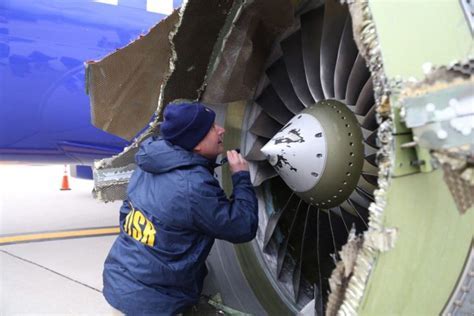
Southwest maintains one of the safest operational records globally, despite a handful of notable incidents. Across its history, it has experienced 11 accidents, three hull losses, and four fatalities, none resulting from a crash. Key events include Flight 1455’s runway overrun in 2000, the air rage cockpit breach on Flight 1763 in 2000, the 2018 Flight 1380 engine failure resulting in one fatality, and a 2024 bullet strike on an aircraft at Dallas Love Field.
This safety legacy, coupled with its operational resilience, has reinforced customer trust and brand loyalty even amidst challenging episodes.
Looking Ahead: The Next Chapter for Southwest Airlines
As Southwest Airlines navigates an increasingly competitive and evolving aviation landscape, its ability to balance cost leadership with product enhancement will be pivotal. The planned transition to assigned seating, the introduction of fare segmentation, and the enhancement of onboard amenities reflect a strategic recalibration aimed at retaining price-sensitive travelers while courting premium segments.
Yet, the challenge remains: preserving the unique Southwest spirit that has endeared the brand to millions while embracing the structural shifts necessary for long-term sustainability. With a storied past and an ambitious roadmap ahead, Southwest Airlines continues to write one of the most compelling narratives in commercial aviation today.