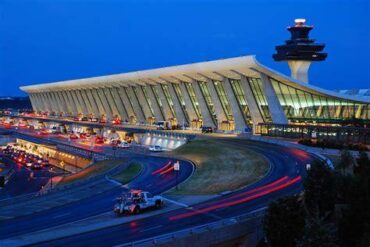
Southwest Airlines has completed a major network change at one of the Washington region’s largest airports, ending all flights from Washington Dulles International Airport (IAD) after nearly 20 years of service. The move eliminates every remaining Southwest route from Dulles, but the airline is not abandoning the Washington-Baltimore market. Instead, it is concentrating its schedule at Baltimore/Washington International Thurgood Marshall Airport (BWI) and Ronald Reagan Washington National Airport (DCA), where it already has much larger operations.
The Dulles shutdown is part of a broader effort by Southwest to reshape its network and improve financial performance. The airline has been making several significant commercial changes, including assigned seating, extra-legroom seats and checked bag fees, while seeking additional revenue and reviewing routes that do not fit its long-term strategy. Rather than maintaining smaller operations at multiple airports within the same metropolitan area, Southwest is increasingly focusing its aircraft and schedules where it has stronger market positions.
Southwest’s Dulles operation officially ended on June 4, 2026, the same date the carrier also left Chicago O’Hare International Airport. The two airport exits followed a similar strategy: Southwest reduced service at an airport where its presence had become relatively small while maintaining or expanding service from another nearby airport with a much larger network. For travelers, the change means fewer Southwest departure points, but many affected city pairs remain available through another airport.
Southwest Airlines Dulles Routes Ended Completely
Southwest first began flying from Washington Dulles on October 5, 2006, launching 12 daily nonstop flights to Chicago Midway, Las Vegas, Orlando and Tampa. Over the following years, the airline expanded its Dulles network with destinations such as Denver, Phoenix and Atlanta. At various times, Southwest also operated flights to Fort Lauderdale and San Diego, creating a considerably larger network than the one that existed immediately before the airport exit.
By the beginning of 2026, however, the operation had been reduced to only two destinations: Denver and Phoenix. Southwest operated two daily flights to Denver and one daily flight to Phoenix before ending the entire Dulles operation. According to U.S. Department of Transportation data, Southwest’s Dulles operation recorded an average 77.2% load factor from the beginning of service through the end of 2025.
The reduction highlights how dramatically the role of Dulles had changed for Southwest. The airline once used the airport as an important part of its Washington network, but its position became much smaller as its operations at BWI and DCA grew. Maintaining a separate base of flights at Dulles increasingly meant dividing aircraft, crews and passenger demand among three airports serving the same broad metropolitan region.
Affected Southwest Flights From Washington Dulles
The closure affects every Southwest route that remained at Dulles, although passengers traveling to many of those destinations can still use another Washington-area airport. Denver and Phoenix were the final two Southwest destinations at IAD, and both remain available from BWI.
The broader history of Southwest’s Dulles network shows how the carrier has progressively transferred routes elsewhere. Chicago Midway was last served from Dulles in 2024, while Atlanta ended in 2025. Orlando service ended in 2023, and Tampa was last served in 2011. Las Vegas and San Diego were also discontinued from Dulles years before the final shutdown.
This means the June 2026 closure did not suddenly erase a large collection of established Southwest routes. Instead, it represented the final step in a long-term reduction of the airline’s Dulles presence. Most of the markets that once operated from IAD had already been moved, discontinued or replaced by stronger schedules at BWI or DCA.
Southwest Consolidates Washington Flights at BWI and DCA
Southwest has pointed to its ongoing efforts to refine its network as the reason for leaving Dulles. The strategy is especially significant because the airline already has a powerful position at BWI and a substantial presence at DCA.
BWI is by far Southwest’s largest operation in the Washington area. According to OAG data cited by Aviation Week, the airline held approximately 76.7% of two-way weekly seats at BWI. At DCA, Southwest was the second-largest carrier behind American Airlines, holding about 15.2% of seats.
That makes Dulles a very different proposition. Instead of maintaining three separate airport operations, Southwest can focus its aircraft on the two airports where it already carries substantially more passengers and offers more destinations. The carrier has said that its Dulles departure would not significantly alter its overall service to the Washington-Baltimore market, with up to 271 daily departures to 79 nonstop destinations from BWI and DCA combined.
Where Dulles Passengers Can Fly Instead
Several former Dulles markets remain accessible from BWI or DCA, giving Southwest passengers alternative departure points. Chicago Midway, for example, can receive up to seven daily flights from BWI and up to six from DCA. Las Vegas has three to four daily flights from BWI and one from DCA, while Orlando can receive up to 11 daily flights from BWI and three from DCA.
Tampa is served with up to seven daily flights from BWI and one to two from DCA. Atlanta has up to five daily departures from BWI and three from DCA, while Fort Lauderdale has up to five from BWI and one from DCA. San Diego remains available with up to three daily flights from BWI.
The pattern is clear: Southwest is replacing airport coverage with network concentration. Passengers may have to drive farther or choose a different Washington-area airport, but the airline can operate larger and more efficient schedules from its strongest facilities.
Southwest’s Dulles Exit Mirrors Chicago O’Hare Strategy
Southwest’s decision at Dulles closely resembles its June 4, 2026 exit from Chicago O’Hare. The airline described its O’Hare operation as challenging and emphasized its much larger presence at Chicago Midway.
Before leaving O’Hare, Southwest served around 15 destinations there, including Orlando, Las Vegas, Phoenix, Austin, Nashville, Cancun, Dallas Love Field, Denver, Fort Lauderdale, Fort Myers and Tampa. Yet the carrier held only about 1.7% of O’Hare’s seats. Midway, by contrast, remains a major Southwest stronghold with more than 240 daily departures and a network covering more than 80 destinations.
The parallel between Chicago and Washington is important. Southwest is not simply eliminating markets; it is reducing duplication between airports and concentrating capacity where its existing network is considerably stronger.
For travelers, that means the headline that Southwest has “canceled all routes” from Dulles is technically accurate, but it does not mean the airline has abandoned Washington. Instead, the carrier is betting on BWI and DCA as the core of its regional operation, while Dulles joins O’Hare as another airport removed from its network. The change reflects one of Southwest’s clearest recent strategies: fewer airports, concentrated capacity and a more tightly focused route network.