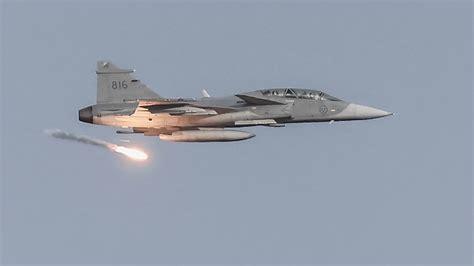
The joint Viking Flame campaign brought Sweden and the United Kingdom together from November 10 to 14, 2025, at the Donna Nook Air Weapons Range in Lincolnshire for one of the most advanced aircraft self-protection tests conducted in Europe. The exercise delivered a focused, data-rich evaluation of next-generation fighter jet survivability systems, feeding directly into NATO’s drive to strengthen airpower resilience against rapidly evolving multi-domain threats. Running under unforgiving weather conditions, the week-long operation generated unprecedented insights into radar, electronic warfare, and live threat-simulation performance, marking a decisive step toward preparing allied air forces for higher-intensity conflict environments.
The trials were jointly confirmed by Sweden’s Defence Materiel Administration (FMV) and British defence authorities, who emphasized the strategic significance of the test data. These evaluations were not routine procedural checks. They formed a highly controlled, operationally realistic assessment designed to push modern fighter platforms to their defensive limits. At the heart of the exercise was a fusion of science and combat readiness, blending meticulous threat-emulation architecture with the kind of rapid-response engineering that defines future air warfare.
Operating out of RAF Coningsby, two Saab JAS 39 Gripen fighters from FMV Test & Evaluation (FMV T&E Luft) were central to the mission. The Gripen’s modular engineering made it possible to integrate experimental countermeasure suites with remarkable speed—precisely the level of adaptability NATO wants for the next generation of defensive systems.
The Viking Flame campaign is integrated into Project Easyrider, a classified, fast-moving initiative led by the Royal Air Force’s Air and Space Warfare Centre (ASWC) and the UK’s Defence Science and Technology Laboratory (DSTL). Easyrider aims to circumvent the sluggish pace of traditional procurement by accelerating field testing and operational validation of advanced aircraft-protection technologies. Its foundation lies in speed, modularity, and coalition-based experimentation—elements that help modern air forces outpace the evolution of SAM systems, infrared-guided missiles, and integrated air defense networks.
Instead of conventional long-cycle development, Project Easyrider leverages a hybrid architecture that mixes ground-based threat emulators with instrumented airborne trials. This experimental ecosystem replicates near-peer threat environments with high fidelity, ensuring survivability technologies can be validated well before entering mass production. Viking Flame is among the flagship test events within this framework, providing cross-national access to emerging electronic warfare tools, expendables, and countermeasure logic designed to keep fighters alive in the world’s most contested airspaces.
Advanced Gripen Test Operations Under Realistic Threat Conditions
During the Viking Flame campaign, the Gripen aircraft executed six thoroughly instrumented sorties, each shaped to simulate a different type of operational engagement. These included electronic attack maneuvers, coordinated countermeasure releases, dynamic threat evasion, and real-time jamming evaluations. Every flight collected high-resolution radar and EW data to analyze how new defensive systems respond under escalating threat pressures.
Live threat simulation was a defining feature, utilizing the Donna Nook range’s modernized radar emitters and multi-vector threat generators. This infrastructure allowed Swedish and British teams to test configurable EW pods, expendable decoys, digital countermeasure management software, and next-gen fusion sensors in tightly choreographed scenarios.
A Coalition Engineering Effort With Tactical Interoperability at Its Core
Planning and execution were spearheaded by ASWC and DSTL, working closely with FMV, the Swedish Air Force, and the Swedish Defence Research Institute (FOI). This partnership exemplified the type of interoperability NATO must achieve to maintain synchronized survivability across allied fighter fleets. Sweden’s contribution—leveraging the Gripen’s role as a modular, export-ready European fighter—paired seamlessly with the UK’s advanced testbed capabilities.
The collaboration demonstrated more than teamwork. It validated how nations with distinct aircraft platforms can integrate rapidly evolving survivability technology through shared test architectures, harmonized data formats, and cooperative doctrine development. These elements ensure that the resulting defensive systems can be rolled out across multiple NATO fleets, including legacy jets and upcoming sixth-generation platforms.
Strengthening Air Superiority Against A2/AD and Peer-Level Threats
The Viking Flame exercise arrives at a pivotal moment, as NATO nations confront the resurgence of peer-level adversaries and the tightening web of anti-access/area-denial (A2/AD) environments. The rise of longer-range SAMs, advanced infrared seekers, AI-driven radar networks, and hyperspectral tracking means modern fighters must rely on far more than maneuverability or stealth. Survivability now demands an ecosystem of adaptable countermeasures, predictive electronic warfare, and cross-domain sensor fusion.
By validating these next-generation systems on the Gripen platform—already widely recognized for its reliability, electronic warfare strength, and NATO compatibility—Sweden and the UK established a data-driven baseline for future modernization. This benchmark will ripple through alliance planning, acquisition cycles, and survivability upgrades for years to come.
A Blueprint for Future Allied Testing and Rapid Innovation
Viking Flame serves as a model for how NATO should approach aircraft survivability development in the coming decade. Instead of siloed national programs, the results show the power of multinational test campaigns, shared data pools, and agile engineering cycles. The campaign delivers lessons not only in technology integration but in the scalability of joint defensive innovation—proof that coalition testing can compress timelines, enhance interoperability, and create unified standards for air defense in contested skies.
The data gathered in Lincolnshire will now feed directly into NATO’s evolving airpower strategy, guiding upgrades to electronic warfare suites, expendables, software-defined defensive logic, and cross-platform countermeasure coordination. These advancements reinforce the alliance’s long-term commitment to air superiority and ensure its fighter fleets remain survivable in rapidly shifting threat landscapes.
The Viking Flame campaign marks a significant milestone in the joint evolution of European airpower protection. Through operational realism, scientific precision, and coalition-driven innovation, Sweden and the UK have delivered a forward-looking blueprint for protecting future NATO aircraft—and for keeping aircrews safe in the face of increasingly complex global threats.