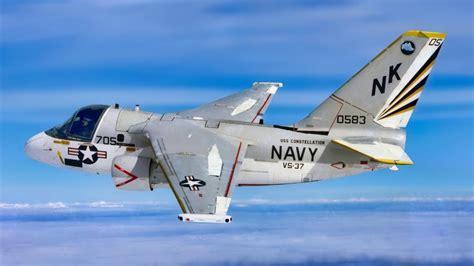
The retirement of the U.S. Navy’s most capable carrier-based submarine-hunting aircraft marked a quiet but profound shift in naval warfare doctrine. What once represented a tightly integrated airborne shield against hostile submarines has been fragmented across multiple platforms, each carrying only part of the original mission. The result is a capability landscape that is more distributed, more complex, and arguably less decisive than the system it replaced.
Cold War Pressure and the Birth of a Carrier-Based Submarine Hunter
The origins of this story lie in the Cold War’s escalating undersea contest. As Soviet naval power expanded rapidly from the 1960s onward, U.S. carrier strike groups faced a new kind of threat—fast, quiet, nuclear-powered submarines capable of launching torpedoes and cruise missiles from beyond the horizon. These submarines were not merely tactical nuisances; they were designed to dismantle the carrier-centered strategy that defined American naval dominance.
By the late 1960s, U.S. planners recognized that existing platforms like the Grumman S-2 Tracker were no longer sufficient. The Navy required a faster, longer-range, jet-powered aircraft that could operate ahead of carrier groups, detect submarines across vast ocean areas, and prosecute them before they closed within striking distance. This requirement led to the VSX program and ultimately to the development of what would become the definitive carrier-based anti-submarine warfare aircraft of its era.
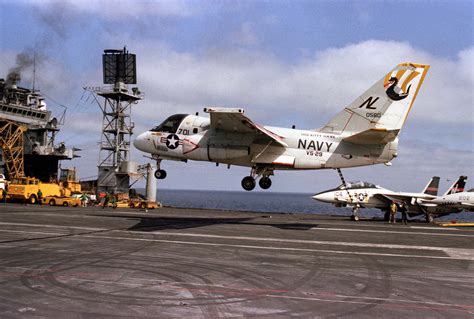
The result of this program was the Lockheed S-3 Viking, introduced in the mid-1970s as a purpose-built solution to a rapidly evolving undersea threat. It was not just an incremental upgrade—it represented a doctrinal leap in how carrier groups defended themselves against submerged adversaries operating at standoff ranges.
The S-3 Viking as a Multi-Mission Carrier Asset
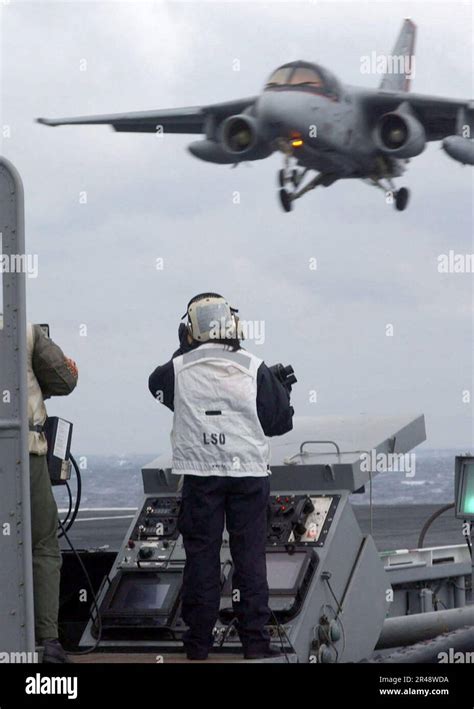
From the moment it entered service, the S-3 Viking became one of the most versatile aircraft ever fielded aboard a U.S. carrier. Powered by twin turbofan engines, it combined long endurance with jet-speed responsiveness, allowing it to patrol far beyond the immediate defensive perimeter of the fleet. With a range exceeding 2,300 nautical miles, it could sweep vast ocean sectors, deploy sonobuoy fields, and maintain persistent contact with submerged targets in ways earlier propeller-driven aircraft could not match.
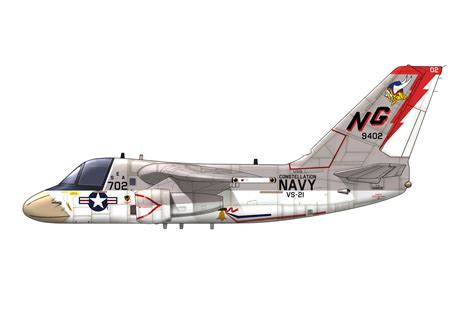
The aircraft typically operated with a four-person crew, reflecting the complexity of its mission systems. Its sensor suite included surface search radar, electronic support measures for passive detection, and a magnetic anomaly detection system that could pinpoint submarines at close range. This combination allowed it to move seamlessly between wide-area search and precise targeting, a balance few aircraft have achieved since.
In operational practice, the Viking functioned as the forward sensor of the carrier strike group. It extended the fleet’s awareness hundreds of miles outward, creating a moving antisubmarine barrier that forced adversaries to operate at greater distances or risk detection. When contact was established, it could prosecute targets with lightweight torpedoes or coordinate attacks with surface combatants.
Its flexibility extended beyond submarine hunting. Over time, it was adapted into roles including aerial refueling, electronic intelligence collection, and even light cargo transport. This adaptability earned it a reputation as the “Swiss Army knife” of carrier aviation, a designation that reflected both its engineering elegance and the Navy’s evolving operational demands.
From Peak Cold War Capability to Post–Cold War Retrenchment
The end of the Cold War fundamentally altered how the United States viewed maritime threats. With the dissolution of the Soviet Union, the large-scale submarine contest that had justified specialized platforms appeared to recede. Soviet naval forces, once numbering in the hundreds of submarines, declined sharply during the 1990s due to budget collapse and fleet attrition.
In this environment, maintaining a dedicated carrier-based ASW aircraft began to appear increasingly difficult to justify. The Viking’s specialized logistics chain, training pipeline, and maintenance infrastructure required sustained investment for a mission that appeared less urgent than before. As defense priorities shifted toward regional conflicts and expeditionary operations, the Navy began consolidating capabilities into fewer platforms.
The retirement process unfolded gradually, concluding in 2009 when the final Viking squadron was deactivated. By that point, its roles had already begun migrating to other assets. The land-based Boeing P-8A Poseidon assumed long-range ASW responsibilities, while shipborne helicopters such as the Sikorsky SH-60 Seahawk handled localized submarine detection and engagement.
The carrier air wing also absorbed fragments of the Viking’s mission. The McDonnell Douglas F/A-18E/F Super Hornet was modified with buddy refueling pods to take over airborne tanker duties, while logistical transport was increasingly handled by newer platforms such as the CMV-22B. Each of these systems performed a portion of the Viking’s former responsibilities, but none replicated its integrated ASW architecture.
The Fragmentation of Carrier-Based ASW Capability
The most significant consequence of the Viking’s retirement was not simply the loss of an aircraft, but the fragmentation of a system. The original concept behind carrier-based ASW relied on tight integration: one platform detecting, tracking, and engaging submarines while operating directly from the carrier deck. This created a rapid-response loop that minimized delays between detection and action.
With the Viking gone, that loop was broken into separate segments. Land-based aircraft like the P-8 Poseidon provide exceptional coverage but require forward basing and cannot always be positioned close enough to respond instantly. Helicopters offer organic carrier-based ASW capability but lack the speed and range needed for deep-water search operations. Surface ships contribute additional sensors, yet their detection range is limited by horizon constraints and acoustic conditions.
This distributed architecture is effective in many scenarios, but it lacks the immediacy and autonomy of a dedicated carrier-based jet-powered sub-hunter. In high-end conflict scenarios, particularly in contested maritime environments, the absence of a single platform capable of independently executing the full detection-to-engagement chain becomes more significant.
The Navy’s approach reflects a broader doctrinal shift toward networked warfare. Instead of relying on a single platform to perform a complex mission, multiple assets now share responsibilities through data links and coordinated operations. While this increases redundancy, it also introduces dependencies that can slow reaction times and complicate command structures.
Rising Submarine Threats and Renewed Strategic Pressure
The decision to retire the Viking appeared reasonable in the context of the 1990s, but the strategic environment has changed dramatically since then. Both Russia and China have invested heavily in modern submarine fleets, with quieter propulsion systems, improved sonar evasion technologies, and increasingly capable weapons systems.
China in particular has emerged as a major submarine producer, expanding both its attack and ballistic missile submarine fleets. These developments are part of a broader naval modernization effort aimed at extending operational reach across the Western Pacific and beyond. As submarine numbers grow, so too does the challenge of maintaining continuous surveillance across vast ocean areas.
In this environment, the absence of a dedicated carrier-based ASW aircraft becomes more noticeable. Carrier strike groups operating in contested waters must now rely on a combination of helicopters, surface ships, and coordination with distant maritime patrol aircraft. While effective under many conditions, this layered system can be strained in fast-moving or communications-degraded environments.
The Idea of Replacing the Viking and Its Modern Challenges
There have been periodic discussions about whether the Navy could restore or replace the capabilities once provided by the Viking. In theory, reactivating stored airframes is possible, but in practice it would require rebuilding an entire ecosystem that no longer exists. Maintenance infrastructure, trained personnel, and production pipelines for spare parts have all largely disappeared.
Modern alternatives have also been explored. One concept involves adapting the Boeing MQ-25 Stingray into a multi-role platform capable of carrying sensors and anti-submarine warfare systems. While its airframe offers endurance and carrier compatibility, its current design is focused on aerial refueling, meaning significant redesign would be required to transform it into a true ASW asset.
The challenge is not simply technological but doctrinal. Modern naval aviation has moved away from single-mission aircraft toward multi-platform integration. Introducing a new dedicated ASW aircraft would require not only engineering development but also a shift in how carrier air wings allocate roles and responsibilities.
Operational Consequences of a Distributed ASW Model
The current ASW framework provides flexibility, but it also introduces limitations in tempo and autonomy. Helicopters operating from carriers can detect and engage submarines within a limited radius, typically constrained by fuel endurance and speed. Land-based aircraft provide broader coverage but cannot guarantee immediate availability in all theaters.
This means that in certain scenarios, particularly those involving rapidly moving submarine threats or contested communication environments, response times may be slower than they were during the Viking era. The integrated airborne screen that once extended far ahead of carrier groups has been replaced by a patchwork of overlapping but separate systems.
At the same time, modern sensors, data fusion networks, and satellite-supported tracking have improved overall maritime awareness. The Navy now relies heavily on information sharing across platforms, allowing helicopters, ships, and fixed-wing aircraft to operate as part of a broader detection network. This evolution reflects the changing nature of naval warfare, where information dominance is often as important as platform capability.
Conclusion: A Capability Lost or a System Evolved
The retirement of the S-3 Viking represents a turning point in naval aviation history. It marked the end of an era in which a single aircraft could independently execute the full spectrum of carrier-based submarine warfare. In its place, a distributed system has emerged—more flexible, more technologically interconnected, but also more dependent on coordination and external assets.
Whether this change constitutes a step backward depends on the operational context. In peacetime and low-intensity environments, the current system is efficient and cost-effective. In high-end maritime conflict scenarios, however, the absence of a dedicated, long-range carrier-based ASW aircraft may prove to be a significant limitation.
What remains clear is that the Viking was more than just an aircraft. It was a concept of operations embodied in metal and sensors—a self-contained underwater surveillance and strike system that extended the reach of the carrier fleet deep into the ocean environment. Its retirement did not eliminate the submarine threat. It simply redistributed the burden of countering it across a more complex and less centralized architecture.