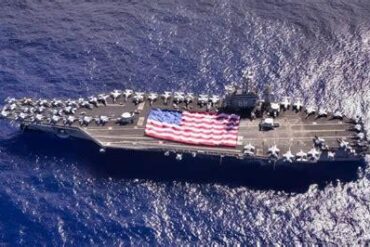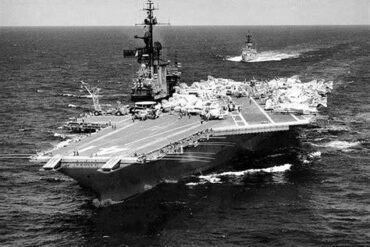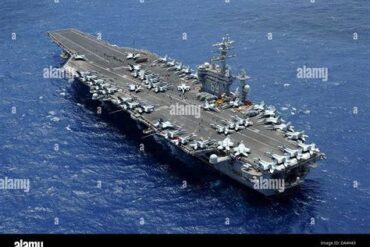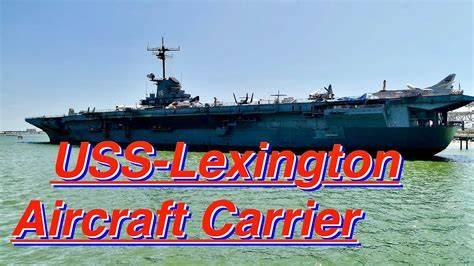
The United States Navy commissioned a staggering number of aircraft carriers across the 20th century, but no class left a deeper imprint on the fleet than the Essex-class. By 1950, American shipyards had completed 24 Essex-class carriers, a total that made it not only the most numerous carrier class in naval history but the single largest run of capital ships ever built to one design. These flattops carried the Pacific war to Japan’s doorstep, absorbing punishing losses while grinding down an empire. Several American carriers went to the bottom during the conflict, yet many more survived, and a handful of those survivors never truly left service. Among the 24 Essex-class hulls, four endure today as functioning museum ships, and one of them served the Navy longer than any other: the USS Lexington (CV-16).
The Lexington carries a name steeped in American memory, honoring the Battle of Lexington that ignited the Revolutionary War, and it is the fifth U.S. Navy vessel to bear it. Commissioned in 1943, the ship entered a Pacific Fleet hungry for flight decks after the carnage of 1942. Its crew, watching the carrier vanish from Japanese reconnaissance reports and then reappear to strike again, gave it a nickname that stuck: “The Blue Ghost.” That ghostly reputation was no accident. The ship took ferocious punishment, endured repeated repairs, and lost men in combat, yet it always returned to the fight, fulfilling its own prophecy with uncanny precision.
A Warship Born From the Ashes of the Coral Sea
The Lexington’s story begins with tragedy. The hull was originally laid down as the USS Cabot, but the Navy renamed it in 1942 after the USS Lexington (CV-2) was lost at the Battle of the Coral Sea, the first naval engagement in history fought entirely by aircraft. The new Lexington inherited not just a name but a burden of expectation. Joining the Pacific Fleet, it opened its combat career with a raid on Tarawa Atoll, then followed with strikes against Wake Island, the Marshall Islands, and Kwajalein Atoll. Its aircraft drew first blood by destroying the SS Kembu Maru, though the victory came at a price when a Japanese torpedo slammed into the ship and inflicted severe damage.
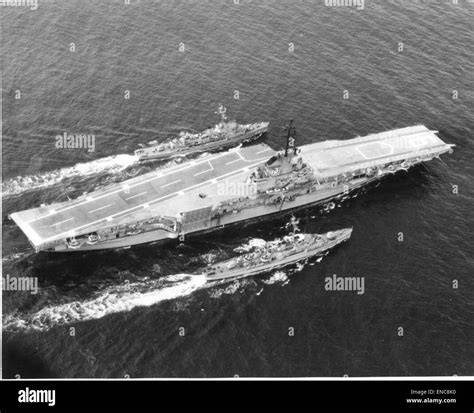
Rather than retreat, the carrier’s air wing became a weapon of relentless escalation. The Lexington fought through the Battle of the Philippine Sea, the enormous carrier clash remembered as the “Great Marianas Turkey Shoot,” and the sprawling Battle of Leyte Gulf, the largest naval battle in history. Its planes helped send the giant battleship Musashi to the bottom, and they also claimed the carriers Zuikaku, Chitose, and Zuibo, along with the battleship Ise. Toward the war’s end, Lexington aircraft pounded the Japanese home islands directly. For its combat service, the ship earned 11 battle stars and a collection of additional awards, a record that placed it among the most decorated carriers of the war. Japanese propagandists famously reported the Lexington sunk four separate times, and each time the ship surfaced to launch another strike.
Modernization and the Jet Age Transformation
Peace did not retire the Lexington. Like many Navy ships after 1945, it was decommissioned and placed in the Reserve Fleet, its future uncertain as budgets shrank and technology raced ahead. Beginning in 1953, the carrier underwent a sweeping modernization that rebuilt it almost from the keel up. The most consequential change was the replacement of its straight WWII flight deck with an angled flight deck, the innovation that let jets land and launch without blocking the bow. Recommissioned in 1955, the Lexington rejoined the 7th Fleet as a platform capable of handling heavier, faster, and far deadlier aircraft, keeping a wartime hull relevant in an age of jet engines and nuclear weapons.
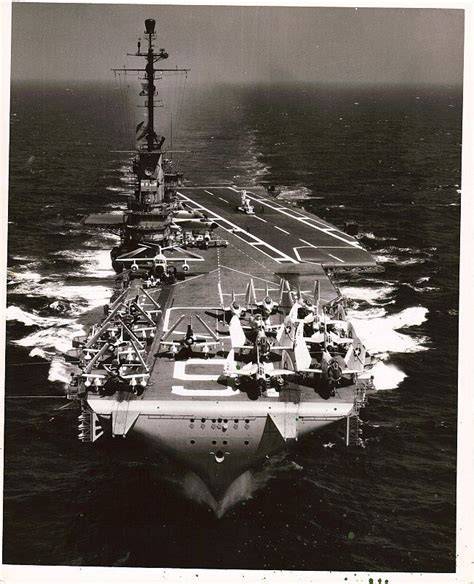
Further refits followed, and during the Cuban Missile Crisis the ship briefly carried the designation of attack carrier, a pointed reminder of how quickly a training deck could become a combat asset. For most of the remainder of the century, however, the Lexington served as a training carrier (CVT), a floating classroom where thousands of pilots learned the unforgiving craft of carrier aviation. It also earned a quieter distinction: in 1980 it became the first aircraft carrier to station women aboard, a milestone that reshaped naval culture long before the rest of the fleet caught up.
The Final Voyage to Corpus Christi
As nuclear-powered giants like the USS Enterprise and the Nimitz-class carriers filled the fleet, the Lexington could no longer compete in frontline service. After recording more than 493,000 training arrested landings, it ended active fleet duty on March 9, 1991, closing roughly five decades of continuous service. Rather than face the scrapyard or be sunk as an artificial reef, the ship found a second life as a museum in Corpus Christi, Texas, where it remains permanently moored. Designated a National Historic Landmark in 2003, the Lexington is now managed by the National Park Service and draws visitors who walk its steel decks and stand where history was made. For a vessel the Japanese “sank” four times, the Blue Ghost has proven remarkably difficult to kill.