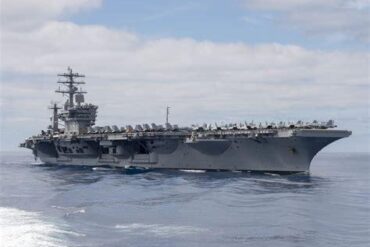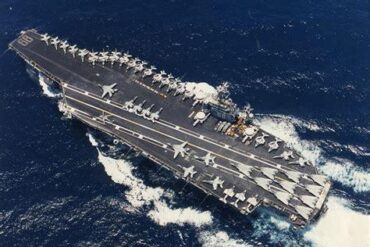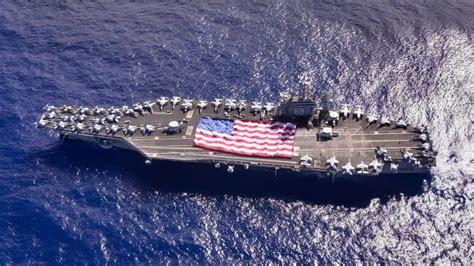
The USS Nimitz (CVN-68) was expected to sail quietly into history, closing out a nearly five-decade career that defined American naval power. Commissioned in 1975, the lead ship of its class became more than just a warship—it evolved into a floating symbol of U.S. strategic reach. Yet just as the timeline for its retirement seemed fixed, the U.S. Navy altered course, extending its service in a decision driven not by nostalgia, but by necessity.
A Storied Legacy of Combat and Commitment
Few vessels in modern naval history carry the operational weight of the USS Nimitz. From its early deployments during the Cold War to its presence in some of the most pivotal military campaigns of the late 20th and early 21st centuries, the carrier has repeatedly proven its strategic value. It played a role in Operation Eagle Claw, the failed 1980 hostage rescue mission in Iran, and later contributed to decisive air operations during Operation Desert Storm (1991) and Operation Iraqi Freedom (2003).
The ship’s history is not without tragedy. In 1981, a catastrophic crash involving an EA-6B Prowler during landing operations claimed the lives of 14 crew members and injured dozens more. Such incidents underscore the ever-present risks aboard aircraft carriers, even outside of combat scenarios. Despite these challenges, the Nimitz endured, continuing to project power across global theaters.
Retirement Postponed: Strategic Reality Overrides Ceremony
Time, however, spares no machine. The Navy initially planned to retire the USS Nimitz in May 2026, marking the end of its operational life. But that plan has shifted. The carrier will now remain active until March 2027, extending its service by roughly ten months.
This change is not symbolic—it is rooted in Congressional requirements. U.S. law mandates that the Navy maintain a fleet of at least 11 operational aircraft carriers. Retiring the Nimitz on schedule would have reduced the fleet to ten, creating a capability gap at a time when global tensions demand consistent naval presence.
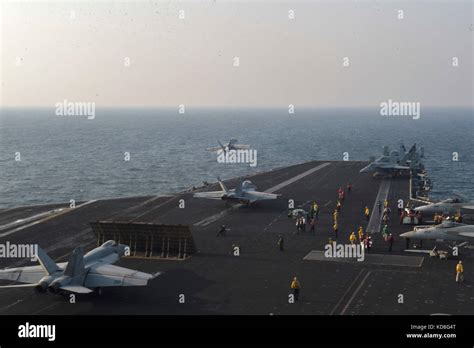
Carrier Fleet Numbers vs. Real-World Availability
Maintaining eleven carriers on paper does not equate to eleven carriers ready for immediate deployment. Aircraft carriers undergo extensive maintenance cycles, including refueling and overhauls that can span several years. As a result, only a portion of the fleet is available at any given time.
Typically, the Navy operates with:
- A handful of carriers actively deployed
- Several in a ready reserve state
- Others undergoing deep maintenance or modernization
This delicate balance becomes increasingly strained during periods of heightened geopolitical tension. The ongoing extended deployment of the USS Gerald R. Ford, now exceeding 300 days, illustrates the operational pressure facing the fleet. Such prolonged missions are rare and signal a demand that outpaces available resources.
Global Tensions Driving Operational Decisions
The extension of the Nimitz’s service life reflects more than internal logistics—it mirrors the current global security environment. Regions like the Middle East continue to demand a persistent U.S. naval presence, with carriers serving as mobile airbases capable of rapid response.
In this context, retiring a fully operational carrier—even one approaching the end of its lifespan—would introduce unnecessary risk. The Nimitz, despite its age, remains a capable platform, bridging the gap until newer assets are ready to assume its role.
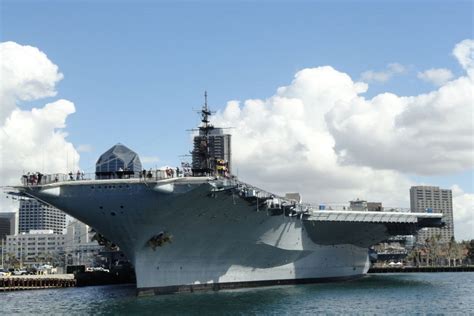
USS John F. Kennedy: The Successor Waiting in the Wings
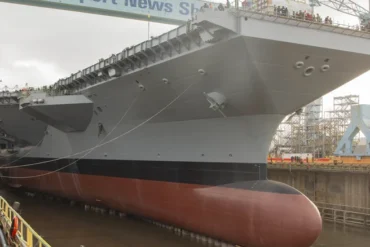
Relief is on the horizon. The USS John F. Kennedy (CVN-79), a next-generation Ford-class aircraft carrier, is progressing toward operational readiness. Expected to join the fleet in March 2027, it will restore the Navy’s carrier count and allow the Nimitz to finally retire without compromising force structure.
The Kennedy represents a technological leap forward, featuring advanced systems designed to increase sortie rates, reduce crew requirements, and enhance overall combat efficiency. Until it is fully commissioned, however, the Navy must rely on proven platforms like the Nimitz to uphold its global commitments.
An Extended Farewell for a Naval Icon
The decision to delay the retirement of the USS Nimitz is a reminder that military planning rarely follows a neat script. Strategic demands, legal mandates, and evolving global threats often reshape even the most carefully laid timelines.
For the Nimitz, this extension is less a delay and more a final chapter—an opportunity to continue serving in a world that still depends on its presence. When it eventually leaves active duty in 2027, it will do so not as a relic of the past, but as a vessel that remained relevant until the very end.