Modern rocket launches look almost unreal from the ground. A launch vehicle ignites with explosive force, climbs through the atmosphere, and then appears to rotate or twist moments after liftoff. To many viewers, the rolling motion can seem unstable or even accidental. In reality, this maneuver is one of the most carefully controlled parts of a rocket’s ascent, designed to improve navigation, conserve fuel, and place spacecraft on an exact flight path toward orbit.
Rocket engineers refer to this controlled movement as a roll program. It is not a sign of imbalance. Instead, it is an intentional aerodynamic and navigational adjustment that allows the rocket to align itself correctly for the remainder of the mission. Without it, orbital launches would become significantly less efficient and far more difficult to control with precision.
Every flying vehicle moves through three rotational axes: roll, pitch, and yaw. Roll rotates the vehicle around its centerline, pitch changes the nose up or down, and yaw turns it left or right. Airplanes use wings, rudders, and control surfaces to manage these motions, but rockets operate under completely different conditions. Since rockets lack conventional wings and spend much of their flight outside the atmosphere, they rely on engine control systems and carefully programmed guidance computers instead.
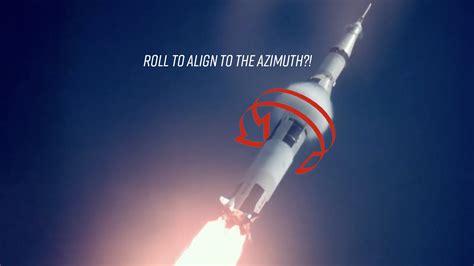
During the first phase of launch, rockets ascend vertically to clear the launch tower and avoid nearby structures. Shortly afterward, onboard computers initiate the roll maneuver. The rocket slowly rotates until it reaches the correct orientation for its planned trajectory. Once aligned, the vehicle can perform its gravity turn and continue accelerating toward orbit with maximum efficiency.
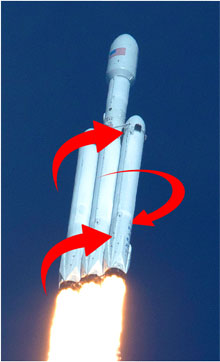
The reason this rolling motion matters so much comes down to navigation simplicity. By rotating into a preferred orientation early in the flight, mission controllers effectively reduce the complexity of later steering corrections. After the roll is complete, the rocket can focus primarily on pitch adjustments to maintain the correct azimuth, or horizontal flight direction relative to Earth.
This process dramatically improves fuel efficiency. Rockets carry limited propellant, and every unnecessary correction consumes valuable reserves that could otherwise be used for payload capacity or orbital insertion. Even tiny steering inefficiencies become critical when launching satellites, cargo, or astronauts into space. A properly executed roll program minimizes wasted motion and allows the vehicle to follow a cleaner ascent path.
The maneuver also helps optimize communication, thermal exposure, and structural loading. Certain parts of the rocket may need to face away from direct sunlight or maintain alignment with tracking antennas during ascent. Rolling allows engineers to position the vehicle in the most favorable orientation before it reaches high speeds and thinner atmospheric layers.
Different rockets achieve roll control using several engineering methods. One common technique involves auxiliary thrusters positioned along the body of the rocket. Unlike the main engines, these thrusters fire at angles that generate rotational force rather than straight-line acceleration. When activated in carefully timed bursts, they produce the torque needed to rotate the vehicle smoothly.
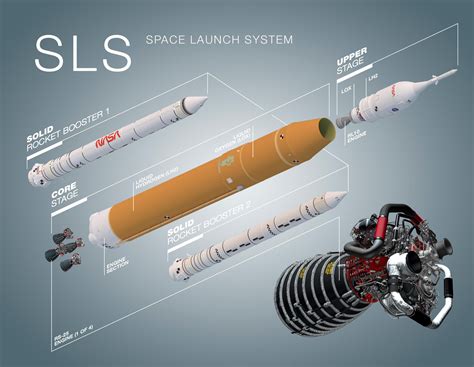
More advanced launch vehicles often rely on gimbaled engines. A gimbal system allows the rocket engine nozzle to pivot slightly while firing. By redirecting the engine’s thrust vector off-center, the rocket generates controlled rotational movement. This technology is now common on modern launch systems such as SpaceX Falcon rockets and NASA deep-space vehicles because it provides extremely accurate steering without adding excessive mechanical complexity.
Earlier rocket designs frequently depended on aerodynamic fins mounted near the base of the vehicle. These fins could deflect airflow and create lift forces that induced rolling motion during atmospheric flight. While less important on today’s computer-guided rockets, fins played a major role in stabilizing early ballistic missiles and experimental launch systems during the dawn of the Space Age.
The rolling motion seen after launch is therefore not an odd visual effect or a symptom of instability. It is a precise maneuver rooted in orbital mechanics, flight dynamics, and fuel conservation. Every rotation is calculated long before ignition, ensuring the rocket follows the safest and most efficient route beyond Earth’s atmosphere.