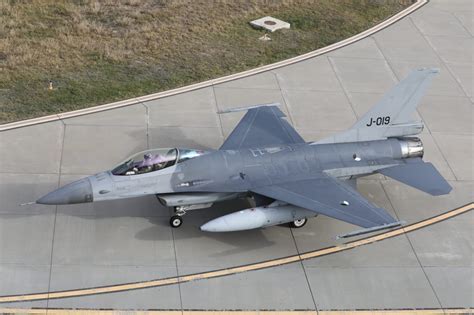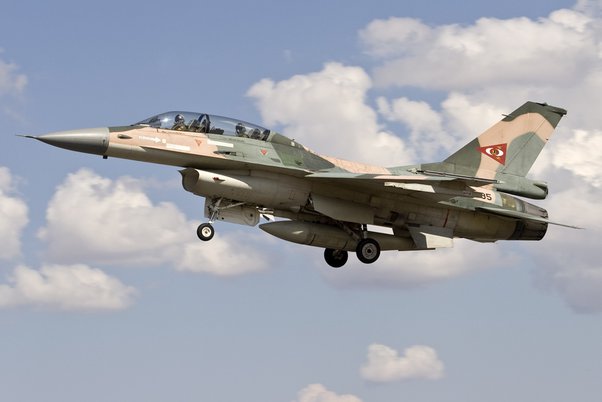
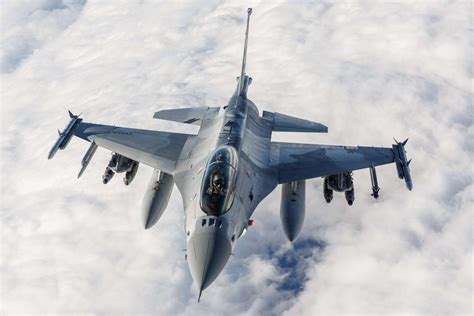
The F-16 Fighting Falcon, one of the most widely used multirole fighter jets in the world, features two primary two-seat variants: the F-16B and F-16D. These models serve as both combat-capable trainers and mission-specific platforms. While retaining the agility and firepower of their single-seat counterparts, they offer additional functionality for pilot training, mission planning, and specialized combat roles.
F-16B: Early Two-Seat Trainer with Combat Capabilities
Design and Purpose
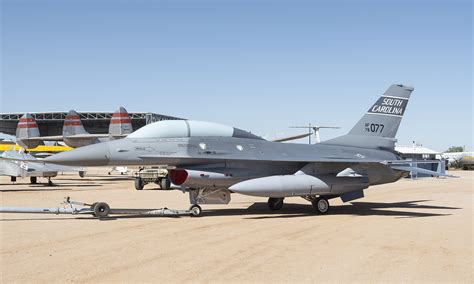
The F-16B is a two-seat version of the F-16A, designed primarily for pilot training while maintaining full combat capability. It features a tandem cockpit, where the second seat allows instructors to closely monitor and guide trainee pilots without compromising operational effectiveness.
Structural Modifications
- Reduced Fuel Capacity: To accommodate the additional seat, the internal fuel tank volume was reduced, impacting its range slightly compared to the single-seat F-16A.
- Retained Core Systems: The AN/APG-66 radar and F100-PW-200 engine from the F-16A were carried over, ensuring familiarity for pilots transitioning to combat roles.
Operational Use and Upgrades
Initially, the F-16B was used for training new pilots before deploying them to front-line squadrons. Over time, many air forces upgraded these models under the Mid-Life Update (MLU) program, enhancing their avionics, radar systems, and mission computers to keep pace with evolving threats.
F-16D: Advanced Combat-Capable Variant
Enhanced Avionics and Sensors
As an evolution of the F-16C, the F-16D offers expanded mission capabilities. It incorporates:
- AN/APG-68(V) radar with an extended detection range of up to 140 km, enabling multi-target tracking.
- Advanced Cockpit Displays, including multifunctional screens for navigation, weapons management, and tactical situational awareness.
- Modern Flight Control Systems, improving precision in high-speed engagements.
Weapon Systems and Combat Role
The F-16D remains a fully combat-ready aircraft, capable of deploying a wide array of modern weapons, including:
- AIM-120 AMRAAM: Beyond-visual-range air-to-air missile for long-distance engagements.
- AGM-65 Maverick: Air-to-ground missile for precision strikes on enemy infrastructure.
- Precision-Guided Bombs: Including JDAMs and Paveway laser-guided bombs for high-accuracy strikes.
Engine Options and Performance
Operators of the F-16D can choose between two powerful engines:
- F110-GE-129: Provides up to 129.6 kN of thrust, enhancing acceleration and climb rate.
- F100-PW-229: A high-performance engine offering improved reliability and fuel efficiency.
These engines allow the F-16D to achieve speeds of Mach 2.0 while maintaining exceptional maneuverability in both air-to-air and air-to-ground missions.
Specialized Two-Seat Variants
F-16I “Sufa” (Israel)
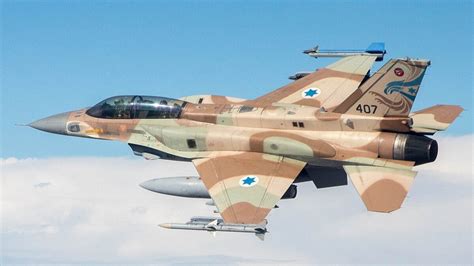
The F-16I, known as the “Sufa”, is a heavily modified F-16D variant tailored for the Israeli Air Force. Key enhancements include:
- Conformal Fuel Tanks (CFTs): Extends operational range for deep-strike missions.
- Advanced Avionics: Features specialized electronic warfare suites and targeting pods.
- Expanded Weapon Compatibility: Integrates Israeli-developed smart munitions.
Block 20/MLU Upgrades (Taiwan)
Taiwan’s F-16B/D aircraft underwent significant modernization under the Block 20/MLU program, which added:
- AN/APG-66(V3) radar: Improved tracking capabilities.
- Compatibility with AIM-120C missiles, enhancing beyond-visual-range combat effectiveness.
Design Features of the Two-Seat Cockpit
Ergonomics and Situational Awareness
- Bubble Canopy: Provides 360-degree visibility, essential for air-to-air combat.
- Side-Stick Control System: Reduces pilot workload during high-G maneuvers.
- Dual Controls: The rear seat includes fully functional flight controls, allowing instructors or mission specialists to assist in operations.
Operational Flexibility and Global Use
The F-16B/D has been adopted by over 20 air forces worldwide, demonstrating its versatility in both training and combat scenarios. Notable operators include:
- United States: Used for both pilot training and combat missions.
- Israel: Specialized F-16I for deep-strike operations.
- Taiwan: Upgraded F-16B/D for modernized air defense.
- NATO Allies: Employed for joint training and multinational operations.
Modernization Programs
- CAPES Initiative (Combat Avionics Programmed Extension Suite)
- Upgraded over 300 U.S. and Taiwanese F-16B/Ds with AN/APG-83 AESA radar.
- Improved electronic warfare systems for enhanced survivability.
- F-16V “Viper” Upgrade
- Features AESA radar, enhanced data links, and cockpit modernization.
- Compatible with both single-seat and two-seat variants.
Performance Comparison: F-16B vs. F-16D
| Metric | F-16B | F-16D |
|---|---|---|
| Max Speed | Mach 2.0 | Mach 2.0 |
| Combat Radius | 550 km (with payload) | 1,200 km (with CFTs) |
| Engine Thrust | 111 kN (F100-PW-200) | 129 kN (F110-GE-129) |
| Radar | AN/APG-66 | AN/APG-68(V) |
The F-16B and F-16D represent the evolution of the Fighting Falcon, proving their continued relevance in modern air forces through continuous upgrades and operational adaptability.
Frequently Asked Questions (FAQ)
1. How does the F-16 two-seater compare to the single-seat version?
The two-seater retains nearly all combat capabilities of the single-seat model but sacrifices some internal fuel capacity. However, it benefits from dual controls, making it ideal for pilot training and specialized missions.
2. Can the F-16D engage in combat missions?
Yes. The F-16D is fully combat-capable, often used for strike missions, electronic warfare, and reconnaissance, with some versions (e.g., F-16I) optimized for long-range operations.
3. Which countries operate the F-16 two-seaters?
More than 20 countries operate F-16B/D variants, including the United States, Israel, Taiwan, Turkey, and NATO allies. Many have modernized their fleets with advanced avionics and weapon systems to extend their service life.