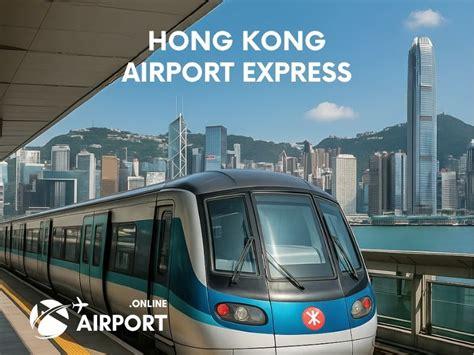
The Airport Express—officially known as 機場快綫—is Hong Kong’s dedicated high-speed rail link connecting the city’s urban core to Hong Kong International Airport (HKIA) and the AsiaWorld–Expo exhibition centre. Operated by the MTR Corporation, this line spans 35.2 kilometers, facilitating swift and reliable airport access within 24 minutes from Hong Kong Station to HKIA, and 28 minutes to AsiaWorld–Expo. As the sole rail link to the airport, its significance in Hong Kong’s transport network cannot be overstated.
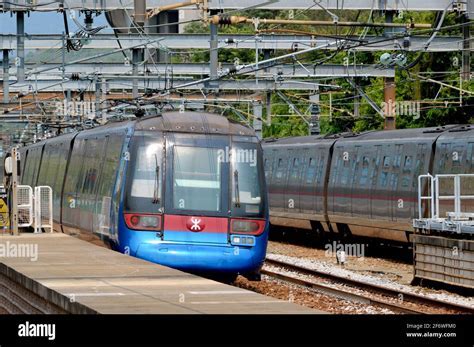
The line runs parallel to the Tung Chung line on some segments but maintains independent platforms and tracks for most of the journey. The Airport Express appears in teal (#00888A) on the official MTR map and features only five stations, ensuring minimal stops and maximum speed.
A Vision Realized: History and Strategic Development
The origin of the Airport Express traces back to 1989, when the Hong Kong government decided to replace the congested Kai Tak Airport with a new aviation hub on Chek Lap Kok island. In November 1994, following financial agreements between the British and Chinese governments, the construction of the Lantau Airport Railway commenced. The project evolved into two separate MTR lines: the Tung Chung line and the Airport Express, with shared track sections.
The initial section opened on 6 July 1998, coinciding with the launch of the new airport. The journey time to HKIA was 23 minutes, slightly extended to 24 minutes following the 2005 opening of Sunny Bay Station. On 20 December 2005, the line was extended to AsiaWorld–Expo, reaching its current 28-minute end-to-end duration.
Route and Infrastructure: A Seamless Urban-Airport Connection
The Airport Express begins at Hong Kong Station (Central), travels under Victoria Harbour, stops at Kowloon Station, continues across the Rambler Channel rail bridge to Tsing Yi, traverses the Lantau Link parallel to the North Lantau Highway, and reaches HKIA before its final terminus at AsiaWorld–Expo.
Although the Airport Express and Tung Chung line share alignment in specific corridors (notably the cross-harbour tunnel and Lantau Link), their track systems and platforms remain distinct at all stations, eliminating bottlenecks during operations.
Passenger Experience and Key Features
Spacious Comfort and Technology Onboard
Every Airport Express train offers enhanced passenger comfort. Cars are equipped with spacious seating, dedicated luggage racks, and LCD screens for announcements, advertisements, and news. Each seat is fitted with in-seat audio to complement screen content.
In-Town Check-In: City Convenience Meets Airport Precision
One of the most lauded features is the In-Town Check-In service, available at Hong Kong Station and Kowloon Station. Passengers flying with major airlines like Cathay Pacific, Hong Kong Airlines, Qantas, and Singapore Airlines can:
- Check in luggage
- Receive boarding passes
- Travel baggage-free to the airport
Luggage is processed through automated explosive detection systems, then seamlessly transferred to the flight.
Wi-Fi and Charging Amenities
Passengers enjoy free Wi-Fi across all train cars, while USB ports and electrical outlets are installed in cars 1 and 7, catering to business travelers and digital nomads alike.
Shuttle Bus Connections to Hotels
Although suspended during the COVID-19 pandemic, the Airport Express Shuttle Bus service resumed in July 2024, offering limited routes to select hotels on Hong Kong Island and Kowloon. Eligibility requires proof of Airport Express travel—tickets, boarding passes, or valid Octopus cards.
Fare Structure and Discount Programs
Due to its premium positioning, the Airport Express uses a distinct fare system separate from the rest of the MTR network. Fares are structured as follows:
- Single Journey (Ticket/Octopus):
- Hong Kong → Airport: HK$130 / HK$120
- Kowloon → Airport: HK$115 / HK$105
- Tsing Yi → Airport: HK$80 / HK$73
- Return (within 30 days):
- Hong Kong: HK$215
- Kowloon: HK$195
- Tsing Yi: HK$130
Passengers must buy valid tickets before boarding; Airport Station has no fare gates, so ticket validation is required either at the Arrivals Hall or the destination platform.
Special Discounts and Offers
- Group Discounts: Available for groups of 2–4 people
- Same-Day Return Discount: If passengers stay at AsiaWorld–Expo for over an hour
- Staff Discounts: Available to HKIA personnel
- Free MTR Connection: Octopus card users can transfer to/from any MTR line within one hour of Airport Express travel
Alternative Routes for Budget Travelers
Despite its speed, the Airport Express faces ridership competition from the Tung Chung Line, especially when paired with bus routes like S1 (jointly operated by LWB and Citybus) or S56 (Citybus-only). These options offer significantly lower fares, appealing to budget-conscious travelers.
Rolling Stock: Engineered for Speed and Space
The Airport Express operates with 11 train sets built by Construcciones y Auxiliar de Ferrocarriles (CAF) in Spain. Initially configured with seven cars (six passenger + one luggage car), an eighth passenger car was added post-2005 to accommodate growing demand.
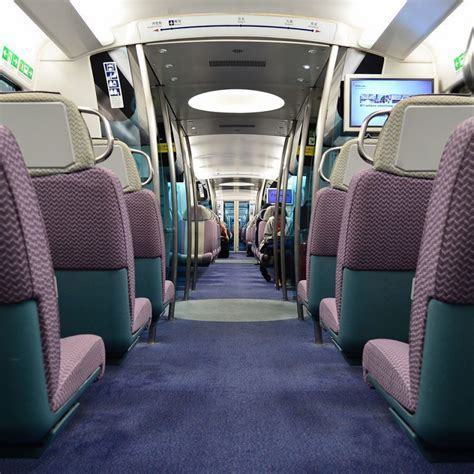
Each train is capable of 135 km/h operating speed (designed for 140 km/h) and is expandable to 10 cars. Interiors were refurbished in 2008 and 2020, now showcasing blue and aquamarine seat covers, synthetic leather headrests, and a sleek wave-pattern carpet.
Station Highlights and Interchanges
Hong Kong Station (Central District)
- Connected to Tung Chung Line, and via Central to Tsuen Wan and Island Lines
Kowloon Station (Yau Tsim Mong District)
- Linked to Austin Station, Tuen Ma Line, and High-Speed Rail (West Kowloon)
Tsing Yi Station (Kwai Tsing District)
- Interchange with Tung Chung Line
Airport Station (Islands District)
- Direct access to HKIA terminals
AsiaWorld–Expo Station
- Serves the exhibition and convention centre
Service Timetable and Evolution
Initially, Airport Express trains ran every 10 minutes during the day and 12 minutes at night. However, the SARS outbreak (2003), protests (2019), and COVID-19 significantly disrupted frequency. During COVID, trains operated every 30 minutes.
From 5 November 2022, frequencies improved to every 15–20 minutes, and by 5 June 2023, pre-SARS schedules were reinstated in celebration of the line’s 25th anniversary.
Train operations are monitored by the Operations Control Centre in Tsing Yi, ensuring real-time adjustments and safety compliance.
Morning Express Service: A Local Perk
For daily commuters, the Morning Express Service offers discounted rides from Tsing Yi or Kowloon to Hong Kong Station on weekdays between 07:00 and 10:00 for just HK$25 (Octopus). This is not eligible for onward MTR transfers, positioning it solely as a work commute benefit.
Limitations in Design and Operational Constraints
Although highly efficient, the Airport Express faces some inherited infrastructure limitations due to budget constraints during British rule. Originally, the system was intended to include four tracks, offering independent paths for both Airport Express and Tung Chung lines. Instead, it was downgraded to two shared tracks in sections.
Notable limitations include:
- Lantau Link allows only one train per direction at a time
- Signalling cannot prioritize Airport Express trains over Tung Chung Line trains
- Power supply limits simultaneous trains between Kowloon and Lai King
These restrictions result in minimum headways of 2 to 3.5 minutes, affecting both service scalability and punctuality.
Cultural Impact and Pop Culture Presence
The Airport Express has also appeared in Hong Kong media. Notably, singer Leon Lai featured the train in his 1998 “Happy 2000” music video. In Shock Wave 2, the train was depicted in a dramatic hijacking and bombing scene, highlighting its prominence in the local psyche.
Conclusion: A Benchmark in Urban-Airport Transit
The Airport Express remains Hong Kong’s flagship airport transport solution, blending speed, convenience, and technological integration. Despite design limitations and evolving travel patterns, it continues to provide world-class service, particularly to business travelers, premium passengers, and exhibition attendees. As urban mobility and aviation demand grow, the Airport Express stands as a critical artery in Hong Kong’s globally connected infrastructure.