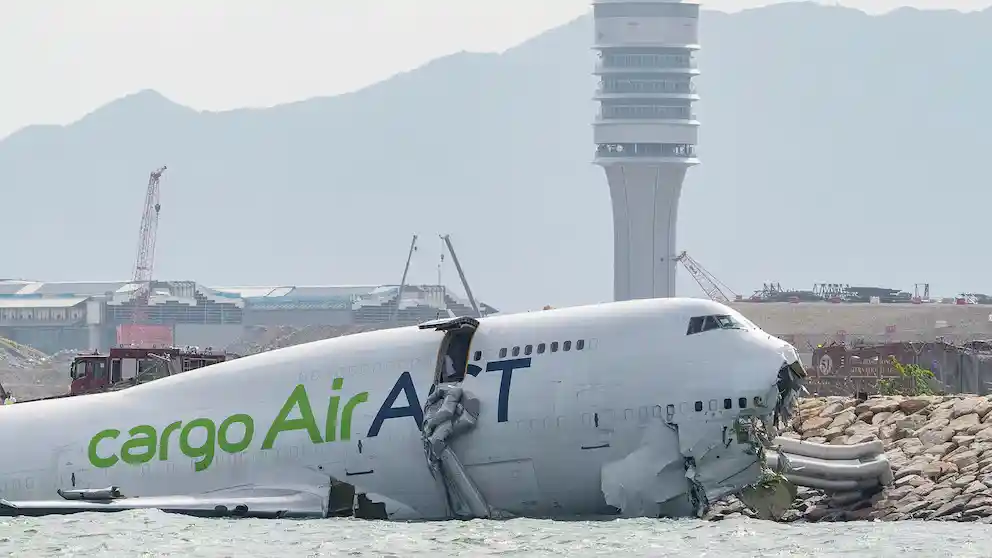
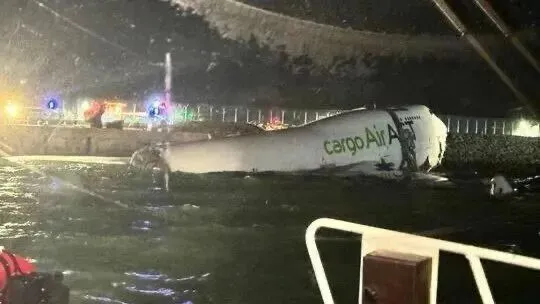
In the early hours of the morning, disaster struck at one of Asia’s busiest aviation hubs, when a Boeing 747 cargo plane operated by Turkish airline ACT Airlines veered off the North Runway of Hong Kong International Airport, skidded across the tarmac, and slammed into a security patrol vehicle before plunging into the sea. The impact left two security personnel dead, and the aircraft partially submerged and broken in two. This incident, unprecedented in the recent history of Hong Kong’s aviation operations, has raised urgent questions about airport safety, runway operations, and aircraft maintenance protocols.
Moments Before Impact: A Timeline of the Crash
At approximately 3:58 AM local time, the Boeing 747 cargo plane, inbound from the United Arab Emirates, was cleared to land on the north runway of Hong Kong International Airport. Weather conditions were reportedly clear and the runway had no reported abnormalities. Airport control confirmed that no distress signal was sent by the crew, and there was nothing unusual in the communication between the cockpit and the tower.
According to eyewitness accounts and official statements, as the aircraft touched down, it began veering off-course, failing to decelerate in the expected manner. The plane skidded across the runway at high speed and collided with a stationary airport security patrol car, parked legally within designated safety margins along the 4-kilometer stretch of tarmac.
The force of the collision pushed the vehicle and the aircraft off the runway and into the sea. Rescue crews responded within minutes, managing to pull the four Turkish crew members to safety. They were taken to hospital with minor injuries. The two men inside the patrol car were not so fortunate. One died at the scene, and the other succumbed to injuries later in hospital after being found submerged 7 meters underwater, a full 40 minutes after the incident.
A Boeing Broken in Two: The Aftermath and Wreckage
The aircraft now lies in the waters just off the northern edge of Hong Kong International Airport, split in two, a grim reminder of the force of the impact.
Emergency response crews have erected containment barriers to prevent fuel leaks and debris from polluting the nearby ocean. While Hong Kong’s Fire Services Department managed to quickly evacuate the survivors, efforts to salvage the wreckage are proving more complicated, as the tail section is submerged and partially twisted, making access and lifting operations risky.
Investigative Focus: Black Boxes, Maintenance, and Operational Protocols
The Air Accident Investigation Authority (AAIA) and Hong Kong Police have launched a full investigation. Though criminal charges are not currently ruled out, the main focus is on retrieving the flight data recorder and cockpit voice recorder — the so-called “black boxes.”
Investigators are looking into multiple areas:
- Mechanical Failure: Maintenance records for the aircraft are under scrutiny to determine whether a technical malfunction caused the pilot to lose control.
- Human Error: Both pilot performance and airport operations will be reviewed in the context of international safety protocols.
- Runway Surface Conditions: Although weather was reported to be clear, possible issues with the surface integrity or unnoticed contamination will be considered.
- Airport Safety Logistics: The positioning of the patrol car, while reportedly within regulations, will be re-examined in light of the tragedy.
Experts point to the lack of a distress signal as a puzzling factor. If the crew was unaware of a malfunction or impending danger, it suggests the issue developed suddenly during or immediately after landing — a sign that mechanical failure or faulty braking systems may have played a significant role.
The Victims: Unseen Casualties of a Global Transport Hub
While aviation disasters often focus on passengers and crew, this incident tragically highlights the often overlooked ground personnel who maintain and secure airport operations. The identities of the two deceased men have not been publicly released pending family notifications, but they are believed to be veteran security personnel with years of service.
Tributes are pouring in from airport staff unions, government officials, and the broader public, who recognize the dangers faced by frontline workers in ensuring the safety of global air travel. The Hong Kong Airport Authority has pledged full cooperation with the investigation and announced compensation and support measures for the victims’ families.
Aviation Safety at Hong Kong International: A History of Excellence Marred by Rare Accidents
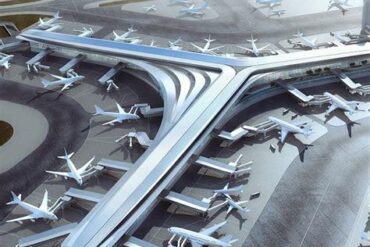
Hong Kong International Airport, built on reclaimed land off Lantau Island, has long been praised for its safety record and efficient operations. With three operational runways, the airport handles over 70 million passengers annually, along with a massive cargo load, making it one of the busiest in Asia.
Yet, its coastal location makes it uniquely vulnerable. As aviation analyst Tom Grundy, Chief Editor of the Hong Kong Free Press, noted, “This airport sits surrounded by sea. So if a plane veers off the runway, there’s a good chance it ends up in the ocean.“
In fact, this is not the first such incident in recent memory. In September, an HK Express passenger flight struck a sign board and veered off the runway during a typhoon landing, though no one was injured. While these incidents remain rare, the visual shock and potential for fatalities serve as reminders that aviation safety is never absolute.
Minimal Disruption, Maximum Impact
Thanks to the airport’s design and infrastructure, including multiple parallel runways, operations at Hong Kong International Airport have continued with minimal disruption. The north runway has been closed, but the south and central runways remain fully operational, maintaining near-normal air traffic flow.
Nevertheless, airlines operating into and out of Hong Kong are closely monitoring the situation, with cargo flight rerouting being implemented temporarily. Turkish ACT Airlines, the operator of the crashed plane, has suspended further flights into Hong Kong until further notice.
Public and Political Reaction: Demands for Accountability
The public response has been swift and emotional. Social media in Hong Kong and across the region has been flooded with images of the wreckage, emotional tributes to the deceased, and mounting calls for a full public accounting of what led to the crash.
Several lawmakers have already demanded:
- A comprehensive safety review of runway protocols
- Increased monitoring of ground vehicle positions during active runway hours
- Enhanced real-time alert systems to detect runway incursions or aircraft veering
In a statement to the press, Hong Kong Chief Executive John Lee expressed his condolences and pledged “a transparent and thorough investigation,” emphasizing that aviation safety must remain a top priority.
Boeing’s Role and the 747’s Legacy
The aircraft involved was a Boeing 747, a model once known as the “Queen of the Skies,” and a staple of both cargo and passenger aviation for decades. While newer models like the 787 Dreamliner and 777X have largely replaced it in passenger service, the 747 remains popular among freight carriers due to its capacity and range.
However, the 747 fleet is aging, and this incident may renew scrutiny over older aircraft models still in operation. Boeing has yet to issue a formal statement but is reportedly cooperating with both Hong Kong and Turkish aviation authorities.
Conclusion: A Wake-Up Call for Global Aviation
The crash of the Turkish-operated Boeing 747 at Hong Kong International Airport is more than a tragic accident — it is a wake-up call to the global aviation industry. In an era where air travel is expected to be safer than ever, the rare but deadly confluence of technical failure, potential human oversight, and operational vulnerabilities demands serious reflection.
As investigators recover the black boxes and reconstruct the final moments of the flight, the world will be watching closely. Not just for answers, but for assurances that tragedies like this can be prevented in the future.
The aviation world prides itself on learning from every incident, no matter how rare. If anything, this crash underscores the eternal truth of air travel: safety is never guaranteed, only earned — again and again, with vigilance, investment, and accountability.