In the unforgiving world of modern warfare, mobility, reliability, and logistical efficiency aren’t just strategic advantages — they’re survival necessities. That’s precisely why the United States Marine Corps needed a motorcycle that could go further, endure more, and operate on the same fuel used by tanks and aircraft. Enter the Kawasaki M1030-M1, a rugged two-wheeler engineered to burn JP-8 jet fuel instead of regular gasoline. Unlike any civilian dirt bike or sportbike, this motorcycle wasn’t just built for adventure — it was built for war.
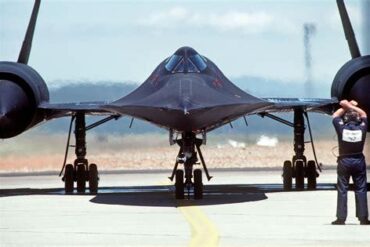
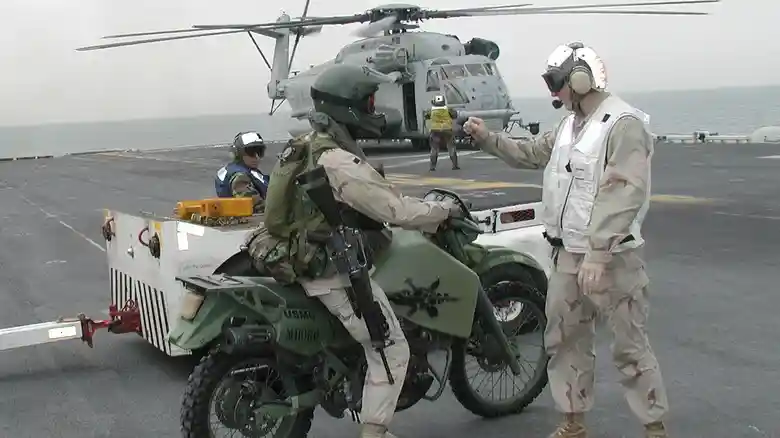
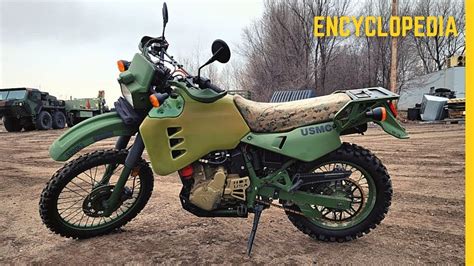
Born from the civilian Kawasaki KLR650, the M1030-M1 started life as a popular dual-sport platform renowned for its durability and off-road prowess. However, once Hayes Diversified Technologies (HDT) modified the frame and replaced the original gasoline engine, the result was something radically different — a military-ready machine aligned with NATO’s Single Fuel Policy. Instead of requiring different fuel types for different vehicles, the M1030-M1 was part of an effort to simplify battlefield logistics by running on the same JP-8 jet fuel used in helicopters, Humvees, and even stealth bombers.
Reinventing a Civilian Icon into a Combat-Ready Beast
The transformation of the KLR650 into the M1030-M1 was not superficial. While it retained the KLR’s frame geometry and rugged bones, HDT overhauled nearly every critical system to meet military-grade expectations. The most significant change was the installation of a 584cc to 611cc single-cylinder diesel engine designed to sip JP-8. Producing roughly 30 horsepower and 33 lb-ft of torque, the engine wasn’t built for speed but for survivability and range.
What makes the M1030-M1 truly unique is its exceptional fuel efficiency. At cruising speeds, it can achieve up to 96 miles per gallon, and with a 6.6-gallon fuel tank, it can push past 500 miles on a single fill-up. In a combat environment where supply chains are vulnerable and fuel stops can be fatal, this range gave Marine recon teams and special forces the autonomy they needed.
Battle-Optimized Features Built for Harsh Terrain
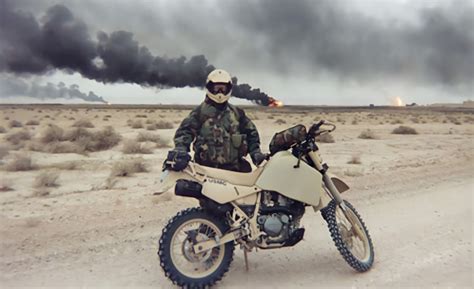
The M1030-M1’s capabilities go beyond the engine. The suspension was reinforced to withstand the punishing demands of tactical riding — from loose desert sand in Afghanistan to the rocky foothills of Iraq. Footpegs were widened to accommodate combat boots and full gear. Blackout switches were added to disable all lights instantly during covert operations, and infrared-compatible lighting systems were introduced for nighttime stealth using night vision gear.
For mission-critical logistics, the M1030-M1 offered a heavy-duty rear rack, often equipped with panniers for carrying ammunition, communication gear, or medical supplies. Every inch of this machine screamed utility over aesthetics. It was loud, heavy, and vibrated like an old jackhammer, but when it came to navigating enemy terrain without backup, there were few tools as reliable.
The Jet Fuel Advantage: Why JP-8 Mattered
The decision to convert the motorcycle to run on jet fuel wasn’t merely about experimentation. In military operations, logistics is often the biggest vulnerability. Transporting multiple types of fuel to distant locations complicates supply chains and creates targets for enemy disruption. NATO’s STANAG 3149 policy demanded a Single Fuel Forward doctrine, and the M1030-M1 answered that call.
JP-8, while more refined than typical diesel, is chemically versatile. It powers everything from the M1 Abrams tank to the F-16 fighter jet, and its availability makes it ideal for forward operations. The diesel engine’s compatibility with JP-8 meant the M1030-M1 could fill up anywhere — from an airbase tanker or a military fuel depot — with no special considerations. This compatibility significantly reduced operational complexity and increased unit cohesion on the field.
Performance Stats That Serve the Mission, Not the Ego
It’s tempting to compare the M1030-M1 to civilian motorcycles based on traditional metrics like top speed or 0-60 times, but that misses the point. This was never a bike for drag races. Its real performance edge came from mission-critical specs:
- Engine: 584cc or 611cc single-cylinder, 4-stroke, diesel
- Horsepower: ~30 hp
- Torque: ~33 lb-ft
- Fuel Type: JP-8 jet fuel (multi-fuel capable)
- Top Speed: ~90 mph
- Fuel Efficiency: Up to 96 mpg
- Range: Over 500 miles per tank
- Weight: ~370 lbs (dry)
The M1030-M1 was never meant to impress onlookers. Instead, it delivered tactical reliability. A recon Marine could silently scout ahead, armed with blackout capability, long-range autonomy, and unmatched terrain agility.
Real-World Combat Usage and Tactical Value
Deployed primarily in Iraq and Afghanistan, the M1030-M1 found its niche with Marine Corps reconnaissance units and U.S. Special Forces. In terrain too rugged for Humvees and too exposed for foot patrols, the motorcycle served as a fast scout or quick reaction vehicle. Its ability to operate in silence, skirt enemy checkpoints, and escape rapidly made it ideal for surveillance, forward observation, and courier duties.
It also provided significant value in asymmetric warfare, where agility often trumped firepower. On narrow mountain trails or in urban environments with uncertain threats, the M1030-M1 was the perfect tool for a single rider to cover large areas without drawing attention. In some cases, it was even used to deliver messages or supplies between forward operating bases.
From Tactical Workhorse to Collectors’ Prize
As the wars in the Middle East evolved and military procurement shifted focus to unmanned systems and modular platforms, the need for tactical motorcycles waned. Production of the M1030-M1 was phased out in the late 2000s, after only around 440 units were made. Today, very few remain in active service.
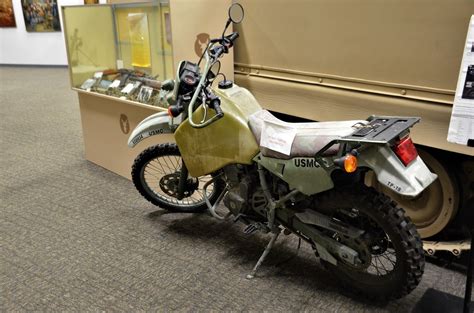
However, what once was a tactical asset has now become a rare collector’s item. Occasionally, one of these machines surfaces on the private market or at military surplus auctions. For enthusiasts of military hardware, adventure touring, or unique engineering, the M1030-M1 is more than just a bike — it’s a piece of battlefield history. Some of these motorcycles fetch higher prices than brand-new KLR650s, simply due to their rarity and unique capabilities.
Legacy and Lessons: Why the M1030-M1 Still Matters
Despite its discontinuation, the M1030-M1 leaves behind a powerful legacy in military vehicle design. It demonstrated that adaptability, logistical efficiency, and engineering innovation could be rolled into a single platform that addressed real-world combat needs. It also proved that motorcycles — typically seen as recreational — have a meaningful place in modern asymmetric warfare, particularly when modified for stealth and fuel flexibility.
As military operations continue to demand modular, efficient, and mobile systems, the M1030-M1’s development offers a blueprint for future innovation. Whether in disaster zones, reconnaissance missions, or special ops scenarios, the idea of a lightweight, fuel-flexible, off-road-capable vehicle remains highly relevant.
Even as electric vehicles begin to enter military testing environments, the diesel-powered, jet-fueled M1030-M1 remains an iconic example of battlefield ingenuity. In a world increasingly focused on green energy and fuel economy, it stands as a testament to what can be achieved when necessity meets engineering.
Conclusion: Not Just a Motorcycle, But a Mission Asset
The Kawasaki M1030-M1 wasn’t just a motorcycle. It was a purpose-built combat machine, designed to operate in the harshest environments with minimum support. Its ability to run on jet fuel, its field-tested reliability, and its compliance with NATO’s fuel policy made it one of the most unique vehicles ever fielded by the U.S. military.
While its production was limited and its era short-lived, the M1030-M1 will forever be remembered as the bike that didn’t just ride into combat — it roared through it on the same fuel that powers the world’s most advanced aircraft.