Frontier Airlines has quietly engineered one of the most aggressive and adaptive network expansions in the ultra-low-cost carrier segment. While legacy airlines continue to rely on traditional hub-and-spoke systems, Frontier’s evolving strategy revolves around high-frequency focus cities and broad point-to-point connectivity. The result is a dynamic map of “frontier airports” that dominate either by sheer operational volume or by the breadth of destinations they serve.
As of early 2026, the airline’s latest schedule data reveals a fascinating shift in dominance. Airports once considered secondary have surged forward, reshaping the competitive landscape and redefining what it means to be a “core base” in a low-cost network.
The Rise of Operational Giants: Airports with the Most Daily Flights
When measuring operational strength, daily departures remain the most immediate indicator of an airport’s importance within an airline’s ecosystem. This metric reflects aircraft utilization, crew allocation, and—most importantly—passenger throughput.
In Q2 2026, one airport stands above the rest.
Atlanta (ATL): Frontier’s New Operational Crown Jewel
Atlanta has emerged as the undisputed leader in daily departures, overtaking long-standing strongholds in a move that signals a decisive strategic pivot.
With 69 daily departures, Atlanta now accounts for approximately 21% of Frontier’s total system-wide flights. This is not incremental growth—it is a structural transformation. Frontier has aggressively expanded routes from ATL, capitalizing on its geographic advantage as a southeastern gateway and its position as one of the busiest aviation markets in the world.
This surge reflects a calculated move: leveraging Atlanta’s massive passenger base while undercutting legacy carriers on price. The result is a high-frequency operation that feeds both leisure and price-sensitive business demand.

Denver (DEN): The Enduring Backbone
For years, Denver served as Frontier’s primary operational base, and despite losing the top spot, it remains a critical pillar of the network.
With 60 daily departures, Denver continues to anchor Frontier’s western operations. Its central location allows efficient aircraft routing across both coasts, while its historical ties to the airline provide operational stability.
Denver’s role has evolved from dominant hub to strategic stabilizer—a base that ensures network resilience while newer markets like Atlanta absorb growth.
Orlando (MCO): The Leisure Powerhouse
Orlando matches Denver closely with 59 daily departures, underscoring its role as a leisure travel magnet.
Frontier has long capitalized on Orlando’s tourism-driven demand, connecting travelers from secondary cities directly to one of the world’s most visited destinations. The near-parity with Denver highlights how leisure-centric airports can rival traditional hubs in a low-cost model.

Network Breadth Leaders: Airports with the Most Direct Destinations
While flight frequency indicates operational intensity, the number of nonstop destinations reveals something deeper: network reach and market diversity.
Here, a three-way tie defines the top tier.
Atlanta, Denver, and Orlando: A Three-Way Network Supremacy
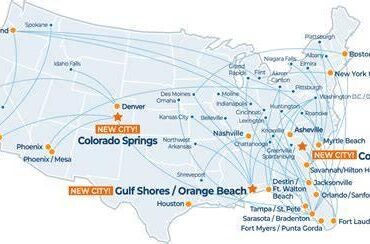
Each of these airports offers 60 unique nonstop destinations, forming the backbone of Frontier’s connectivity strategy.
This parity is not coincidental. It reflects a deliberate balancing act—ensuring that no single airport becomes overly dominant while maintaining maximum network flexibility. Each location serves a distinct geographic and demographic role:
- Atlanta dominates the Southeast and East Coast corridors
- Denver bridges transcontinental routes
- Orlando anchors leisure and seasonal demand flows
Together, they form a triangular network core that allows Frontier to scale without the rigidity of a traditional hub system.
Dallas/Fort Worth (DFW): The Strategic Challenger
With 50 direct destinations, Dallas/Fort Worth stands just below the top tier but represents one of the most strategically important growth markets.
DFW offers access to a vast population base in Texas and acts as a gateway to both domestic and near-international routes. Frontier’s expansion here signals a clear intent to challenge incumbents in one of the most competitive aviation markets in North America.
The Second Tier: High-Connectivity Focus Cities
A cluster of airports—including Chicago, Las Vegas, Miami, and Philadelphia—each serve approximately 40 direct destinations, forming the second layer of Frontier’s network hierarchy.
These airports function as flexible expansion nodes, capable of absorbing seasonal demand shifts and supporting route experimentation. Their importance lies not in dominance, but in adaptability.
Mid-Tier and Emerging Markets: Expanding the Frontier Footprint
Beyond the primary and secondary tiers lies a diverse group of airports serving around 20 nonstop destinations each. These include key markets such as Cancun, Charlotte, Cleveland, Fort Lauderdale, Houston, New York-area airports, and Phoenix.
While smaller in scale, these locations play a crucial role in Frontier’s strategy:
They enable point-to-point connectivity between underserved city pairs, often bypassing congested hubs. This approach aligns perfectly with the airline’s ultra-low-cost DNA—minimizing operational complexity while maximizing route efficiency.
In many cases, these airports act as seasonal accelerators, with capacity increasing during peak travel periods and scaling back when demand softens.
Why Atlanta Now Leads: The Strategy Behind the Shift
Atlanta’s rise to the top is not accidental—it is the product of precise, data-driven expansion.
Several factors explain its dominance:
First, Atlanta’s unmatched passenger volume provides a deep reservoir of demand. Frontier can introduce new routes with relatively low risk, knowing that baseline traffic levels are high.
Second, the competitive landscape creates opportunity. By positioning itself as a low-cost alternative in a high-fare market, Frontier captures price-sensitive travelers who might otherwise avoid flying.
Third, operational scalability at ATL allows rapid growth. Gate availability, infrastructure, and connectivity make it possible to scale frequencies quickly without the constraints seen at more saturated airports.
The result is a perfect storm of demand, opportunity, and execution—propelling Atlanta to the top of both operational and network rankings.

The Frontier Model: No Hubs, Only Power Centers
Unlike legacy carriers, Frontier does not rely on a single dominant hub. Instead, it operates a distributed network of high-impact focus cities.
This model offers several advantages:
It reduces dependency on any single airport, enhancing resilience. It allows the airline to pivot quickly in response to market changes. And it enables direct, nonstop connectivity that appeals to modern travelers seeking convenience and low fares.
Airports like Denver, Orlando, Las Vegas, and Philadelphia are not traditional hubs—they are power centers, each contributing to a broader, interconnected system.
Seasonality and Flexibility: The Hidden Engine of Growth
One of the most overlooked aspects of Frontier’s network is its seasonal adaptability.
Routes are not static. Frequencies shift, destinations rotate, and capacity is dynamically allocated based on demand patterns. This flexibility allows Frontier to maintain high load factors while minimizing risk.
For example, leisure-heavy markets like Orlando and Cancun see spikes during holidays and summer months, while business-oriented routes from Atlanta and Dallas maintain steadier year-round demand.
This balance ensures that the network remains both efficient and responsive, a critical advantage in an increasingly volatile aviation environment.
Competitive Implications: Redefining Airport Hierarchies
Frontier’s evolving network is doing more than just growing—it is reshaping airport hierarchies.
Airports that were once secondary are now becoming central to airline strategies. Atlanta’s rise within Frontier’s network mirrors a broader trend: the decentralization of airline operations.
As ultra-low-cost carriers continue to expand, the definition of a “major airport” is shifting. It is no longer just about legacy dominance—it is about frequency, connectivity, and cost efficiency.
Conclusion: The New Geography of Frontier Airlines
The latest data makes one thing unmistakably clear: Frontier Airlines is building a network defined not by tradition, but by precision and performance.
Atlanta leads in flights and ties for the most destinations, making it the airline’s most influential airport in 2026. Denver and Orlando remain indispensable, forming a الثلاثية core that underpins the entire system. Meanwhile, emerging markets like Dallas/Fort Worth and Las Vegas ensure that growth continues outward.
This is not a static map—it is a living, evolving network shaped by demand, competition, and strategic intent.
For travelers, the implications are clear: more direct routes, more competitive fares, and more choices than ever before. For the industry, the message is even sharper—the future belongs to airlines that can combine scale with flexibility, and Frontier is proving that this balance is not only possible, but powerful.