Toronto Pearson International Airport has reached a new operational milestone this winter, de-icing nearly 17,000 aircraft as the 2025–2026 cold season approaches its final stretch. In a country where winter is not a brief inconvenience but an entrenched reality, the airport’s ability to maintain departure schedules amid snow, freezing rain, and sub-zero temperatures has become a defining feature of its global reputation. January alone accounted for more than 6,000 aircraft passing through its de-icing facilities, underscoring the intensity of this year’s winter cycle and positioning Pearson for a record-breaking season.
The sheer scale of the operation becomes even more striking when compared to other North American hubs. By mid-February, Pearson had already serviced approximately 16,800 aircraft, surpassing total seasonal averages at many snow-prone airports. Pittsburgh International Airport, for instance, regularly battles winter storms, yet its de-icing volumes are typically a fraction of Toronto’s output. Pearson’s numbers are not incremental gains; they represent an operational magnitude that redefines what winter resilience looks like in commercial aviation.
The World’s Largest Central Deicing Facility
Toronto Pearson’s Central Deicing Facility (CDF) stands at the heart of this achievement. Spanning more than 65 acres, it is the largest centralized aircraft de-icing complex in the world. Designed for efficiency under extreme weather pressure, the facility allows aircraft to be treated with engines running after pushback, minimizing taxi delays and preserving precious departure slots during peak traffic waves.
The CDF includes six dedicated de-icing pads capable of handling up to 12 widebody aircraft or 24 narrowbody jets simultaneously. During severe weather, the system can process as many as 500 aircraft per day. That capacity transforms winter from a logistical threat into a managed operational variable. A workforce of roughly 200 personnel staffs the facility around the clock throughout the season, operating under tightly coordinated procedures that integrate air traffic control, airline dispatch, and ground services.
This winter’s elevated totals reflect both heavy snowfall and strategic improvements in infrastructure planning. The airport’s Pearson LIFT modernization program, launched last summer, aims to expand winter-readiness systems further. According to airport leadership, these upgrades represent long-term investments in Canadian infrastructure designed to keep Pearson competitive among major global gateways.
Engineering Winter Reliability at Scale
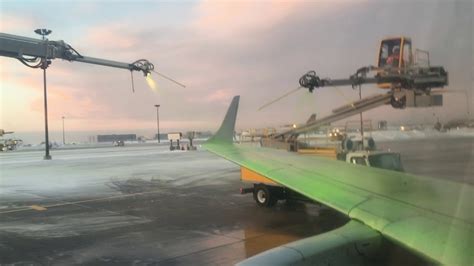
De-icing an aircraft is a mission-critical safety operation. Ice accumulation alters wing aerodynamics by disrupting smooth airflow, reducing lift, and increasing drag. Even a thin layer of frost can compromise takeoff performance. At Pearson, the process typically involves spraying heated glycol-based fluid to remove existing contamination, followed by anti-icing treatment to delay new ice formation before departure.
To sustain uninterrupted winter operations, Toronto Pearson requires approximately 3.17 million gallons (12 million liters) of de-icing and anti-icing fluids over a typical season. The facility maintains a robust on-site reserve capable of supporting three continuous days of heavy snow or freezing rain—an essential safeguard if supply logistics are disrupted during major storms.
The airport’s environmental safeguards are equally ambitious. Beneath the entire 65-acre de-icing area lies a geosynthetic liner engineered to prevent glycol seepage into surrounding groundwater. All runoff is channeled into 278 catch basins and stored in four massive underground tanks capable of holding 19 million liters of spent fluid. The captured glycol is then recycled, reflecting a system that balances operational necessity with environmental responsibility.
The Fleet Behind the Fluid
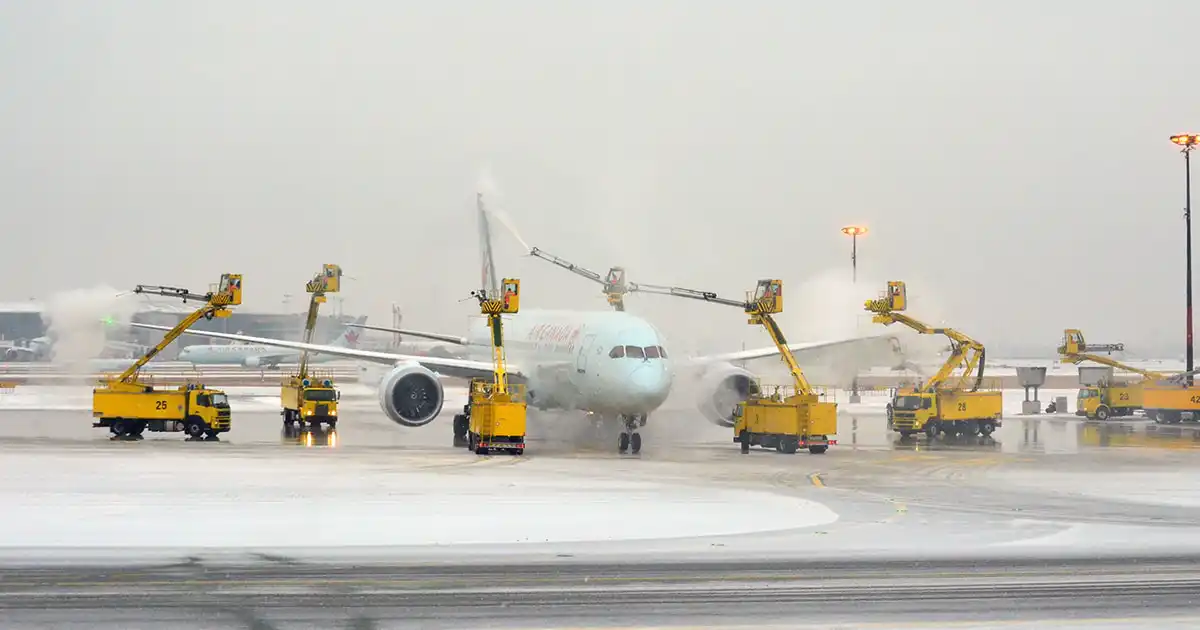
The choreography of Pearson’s winter operations depends on specialized machinery built for precision and reach. The airport operates 46 Vestergaard Elephant Beta de-icing trucks, each equipped with an elevated operator cab that can extend 45 feet above ground. From that vantage point, operators can spray the upper surfaces of aircraft ranging from regional turboprops to the Airbus A380.
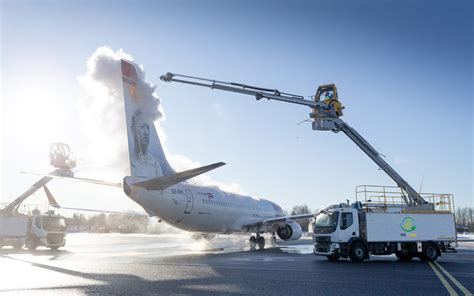
For widebody aircraft, standard procedures often deploy four trucks simultaneously, ensuring rapid and uniform application across wings, fuselage, and tail surfaces. Pearson distinguishes itself further as the only major North American airport operating a dedicated fleet of underwing deicers—modified pickup trucks designed to treat aircraft undersides when conditions demand.
Beyond the de-icing pads, 106 additional specialized vehicles maintain airside mobility. These include 40 plow-sweeper-blower units clearing runways and taxiways, as well as 14 chemical distribution trucks preventing ice accumulation on critical pavement surfaces. Winter reliability at Pearson is not a single process but an integrated ecosystem of coordinated systems.
Training, Coordination, and 24/7 Command
Operational scale means little without disciplined execution. Each winter, Pearson’s workforce expands by nearly 50% as seasonal hires reinforce permanent staff. New recruits complete an intensive eight-week training program combining classroom instruction with hands-on field simulations before they are authorized to operate de-icing equipment.
A centralized control center orchestrates movements across the de-icing pads using electronic message boards, UHF radio communications, and real-time monitoring systems. Technicians maintain complex data-tracking equipment and fluid heating systems year-round, ensuring that trucks function reliably even when ambient temperatures plunge well below freezing.
This synchronized approach allows the Greater Toronto Airports Authority to maintain safe departure schedules even during severe storm events. While winter inevitably introduces delays across global aviation networks, Pearson’s record numbers suggest a system engineered not merely to endure winter—but to master it.
As the 2025–2026 season concludes, the nearly 17,000 aircraft already treated signal more than a statistical achievement. They represent a case study in large-scale infrastructure, environmental stewardship, workforce training, and technological integration. In an industry where weather remains one of the few uncontrollable variables, Toronto Pearson International Airport has demonstrated that preparation, engineering precision, and disciplined execution can transform even the harshest winter into a manageable operational challenge.