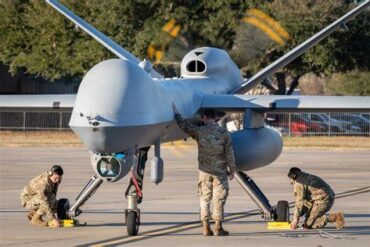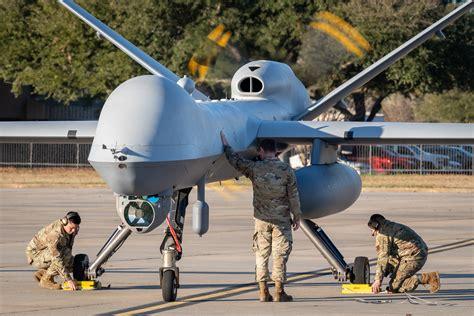
The U.S. Air Force is entering a transformative phase in unmanned aerial warfare by converting its fleet of MQ-9 Reaper drones into high-endurance mothership platforms for ALTIUS autonomous drones. With a $50 million SBIR Phase III contract awarded to Anduril Industries, this development marks a significant operational shift: from experimental capabilities to real-world deployment of attritable drone swarms across global theaters.
MQ-9 Reaper: From Precision Striker to Tactical Drone Hub
The MQ-9 Reaper, originally designed as a persistent ISR and strike platform, is undergoing a dramatic evolution. With a service ceiling of 50,000 feet, 27-hour endurance, and the ability to carry nearly 3,850 pounds of payload, including Hellfire missiles and JDAMs, the Reaper has traditionally operated as a lone hunter-killer. But that paradigm is changing.
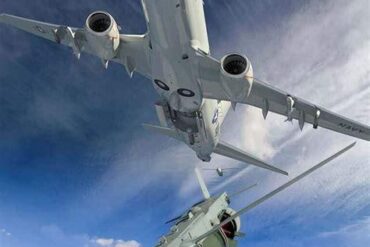
The integration of the ALTIUS-600 and ALTIUS-600M drones represents a strategic adaptation to contested airspace scenarios. These smaller drones can be launched mid-air from Reapers via wing-mounted pods, turning each MQ-9 into a mobile multi-drone command center, capable of ISR, electronic warfare, decoy, and kinetic strike missions without putting the primary aircraft in direct danger.
ALTIUS-600: Small Frame, Strategic Punch
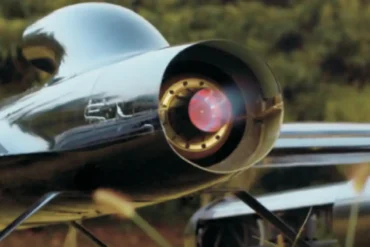
The ALTIUS-600 platform stands out as a Group 2, tube-launched, folding-wing drone optimized for long-range, loitering, and multi-mission flexibility. It weighs just over 20 pounds, boasts four hours of endurance, and can cover distances up to 440 kilometers, all while carrying a payload of 3.2 kilograms.
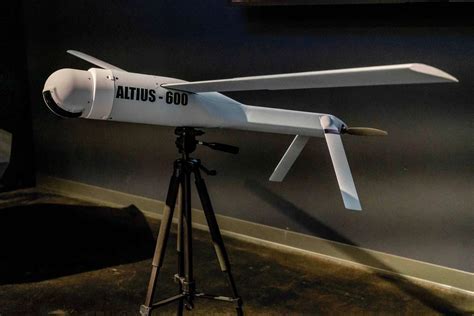
Its modular architecture allows mission-specific loadouts:
- Electro-optical and infrared sensors for intelligence gathering.
- Synthetic aperture radar or electronic surveillance payloads.
- Communication relay modules to extend C2 networks.
- Warhead modules such as the 600M variant, offering kinetic options.
The ALTIUS-600M, a loitering munition variant, carries a 3-kilogram explosive payload. It can perform extended loitering before executing precision strikes, mimicking cruise missile capabilities at a fraction of the cost and size.
From Demonstration to Deployment: The Adaptive Airborne Enterprise
The potential of this system was first showcased in late 2023, when an MQ-9A launched an ALTIUS drone mid-air under the Adaptive Airborne Enterprise framework. The operation demonstrated how a single crew could manage multiple Reapers and their ALTIUS payloads simultaneously, a foundational capability for autonomous swarm operations.
With the new contract, the Air Force is moving decisively from demonstration to operationalization, buying not just drones but the entire support ecosystem: launch tubes, datalinks, training packages, documentation, and accessories—all managed under configuration control to ensure consistent integration.
Operational Use Cases Across Theaters
Pairing MQ-9s with ALTIUS offers unique strategic advantages across varied geographies:
Indo-Pacific Theater
The Reapers can remain hundreds of kilometers away from Chinese air defenses, deploying ALTIUS drones to probe, classify, and strike without risking high-value assets. The approach ensures continuous ISR while presenting a smaller radar footprint.
European Frontlines
In potential conflicts with Russia, ALTIUS swarms could carry out SEAD missions, targeting mobile SAM units and long-range artillery. By integrating with NATO ISR frameworks, these drones enable joint operations with faster kill chains.
Middle East and Africa
Against non-state actors like ISIS and Iranian-backed militias, ALTIUS-equipped Reapers could maintain persistent coverage over high-value areas, dispatching low-signature drones for compound overwatch, convoy escort, or surgical strikes, all while reducing collateral damage.
The Strategic Role of ALTIUS in Joint Operations
The integration doesn’t stop with the Air Force. The U.S. Army’s Air Launched Effects (ALE) program already employs ALTIUS drones from Gray Eagle UAVs and rotary aircraft. The Air Force’s adoption paves the way for cross-service drone interoperability, especially under the emerging Joint All-Domain Command and Control (JADC2) strategy.
This convergence means that in future multi-domain conflicts, Army helicopters, Air Force Reapers, and potentially Navy aircraft could all deploy the same drone family, leveraging real-time data sharing and tasking across a distributed kill web.
The Replicator Initiative: Swarming to Counter Peer Adversaries
The ALTIUS integration also aligns with the Pentagon’s Replicator initiative, a push to mass-field autonomous systems to counter Chinese numerical advantage. By using “small, smart, cheap, and many” drones, the U.S. offsets its adversaries’ scale with distributed lethality.
Each MQ-9 now becomes a multiplicative force unit—one aircraft, potentially launching a dozen drones, each with distinct mission profiles. These drones can soak up enemy radar fire, jam electronic signatures, verify targets, or execute precision attacks—all without jeopardizing the mothership.
Anduril Industries: From Innovation to Program of Record
Anduril’s acquisition of Area I, the original developer of ALTIUS, positioned the company to scale its drone portfolio into a battlefield-ready solution. Through its Lattice autonomy stack, Anduril has evolved ALTIUS from a clever ISR tool into a modular, swarming drone system.
The SBIR Phase III contract ensures ongoing funding for payload upgrades, integration refinements, and supply chain robustness. It also designates ALTIUS as a sole-source capability, effectively locking it into the Air Force’s operational roadmap through at least 2028.

Looking Ahead: A Mothership Model for the Future of Air Warfare
The MQ-9 Reaper’s transformation into a drone mothership is not just a technical evolution—it is a doctrinal pivot. No longer a solitary orbiting shooter, the Reaper becomes a coordinator of distributed combat drones, executing layered ISR and kinetic operations in denied environments.
Whether deterring China, countering Russian artillery, or hunting insurgent networks, the ALTIUS-armed Reaper fleet represents the Air Force’s leap into swarming autonomy, powered by precision, scale, and adaptability. As integration efforts continue through 2028, the Reaper will define what it means to command the skies—not alone, but as the leader of many.
The skies are no longer dominated by single platforms, but by ecosystems of drones working in concert. In this new era, the MQ-9 and ALTIUS combination is not just an upgrade; it is a reinvention of airpower.