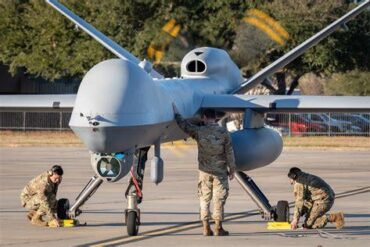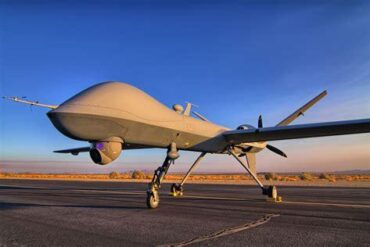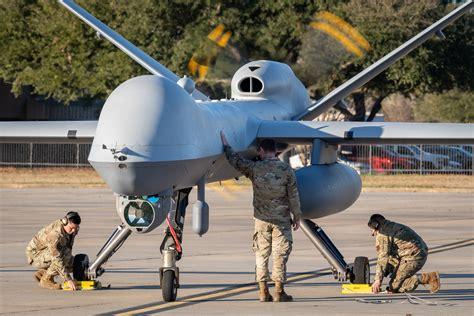
The deployment of U.S. Marine Corps MQ-9A Reaper drones to the Philippines marks a strategic enhancement in joint maritime surveillance and deterrence efforts in the contested waters of the South China Sea. Operating from Basa Air Base in Pampanga, a location fortified under the Enhanced Defense Cooperation Agreement (EDCA), these unmanned aircraft are tasked with bolstering intelligence, surveillance, and reconnaissance (ISR) coverage in a maritime domain fraught with escalating geopolitical tensions.
Strategic Deployment Aligned with Manila’s Request
In response to persistent maritime coercion by China, the Philippine government requested increased ISR support from its U.S. ally. In a discreet yet potent show of alliance strength, the U.S. Marine Corps dispatched MQ-9A Reapers from Marine Unmanned Aerial Vehicle Squadron 1 (VMU-1). This detachment is not an unprecedented step but rather a continuation and consolidation of ongoing ISR operations in the region since early 2024.
The MQ-9A’s operations focus on persistent, unarmed ISR missions. This presence does not escalate conflict but instead provides a critical deterrent effect, enhancing Manila’s political leverage and early warning capabilities. The Philippine Armed Forces (AFP), while still modernizing its fleet of ships and aircraft, now benefit from a force multiplier that fills current capability gaps.
MQ-9A Reaper Capabilities: A Technological Force Multiplier
The MQ-9A Reaper is one of the most advanced unmanned aerial systems employed by the U.S. military. Manufactured by General Atomics Aeronautical Systems, the Reaper boasts the following capabilities:
- Endurance: Over 27 hours of flight time
- Altitude: Up to 50,000 feet
- Speed: Maximum 240 knots
- Payload: 3,850 pounds (including ~3,000 pounds externally)
Equipped with the MTS-B electro-optical/infrared sensor turret, a Lynx multimode radar, and maritime-specific sensors such as a surface search radar and Automatic Identification System (AIS) receiver, the MQ-9A is optimized for maritime domain awareness. Its sensor data is transmitted via C-band line-of-sight and satellite communications (SATCOM), ensuring continuous data flow to command centers regardless of distance.
Creating a Recognized Maritime Picture (RMP)
The Reaper’s real value in the Philippine context lies in its ability to synthesize a comprehensive Recognized Maritime Picture (RMP). This enhanced situational awareness is critical in regions such as Second Thomas Shoal, where Chinese coast guard and militia forces frequently engage in aggressive tactics like ramming, blockades, and water cannon assaults against Philippine vessels.
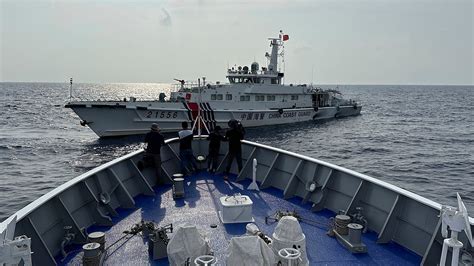
Each Reaper sortie provides minute-by-minute documentation of hostile maneuvers, recording changes in direction, formation shifts, and proximity violations. These persistent surveillance capabilities allow the AFP and U.S. Indo-Pacific Command (INDOPACOM) to:
- Reconstruct precise sequences of engagements
- Archive visual and radar evidence for diplomatic forums
- Plan defensive countermeasures
This capability is crucial for a nation still scaling up its surface patrol assets and air surveillance platforms. The Reaper’s role bridges the gap between intent and implementation in Philippine maritime security policy.
EMCON Operations and Tactical Stealth
The MQ-9A can operate under Electronic Emissions Control (EMCON), a mode that reduces its own electromagnetic footprint, making it less detectable in environments where electronic surveillance is pervasive. Despite operating in stealth mode, its data relays remain effective through protected communication pathways. This silent monitoring ability is invaluable in the highly contested and congested South China Sea.
Furthermore, the Reaper enhances real-time interoperability between U.S. and Philippine units. It acts as a mobile sensor and communications node, feeding actionable intelligence to:
- Philippine Coast Guard vessels for immediate response
- Air and naval assets for strategic planning
- Joint command structures for long-term operational oversight
Supporting Distributed Maritime Operations
Within the broader scope of distributed maritime operations, each Reaper drone serves as a forward-deployed ISR unit that can pivot between operational sectors. This capability supports not only surveillance but also crisis management and contingency planning.
This deployment also coincides with the formation of Task Force Philippines, a U.S.-Philippine bilateral initiative launched in October to coordinate South China Sea responses beyond localized hotspots like Ayungin Shoal. VMU-1’s presence amplifies the Task Force’s operational backbone, ensuring that ISR coverage is not just sector-specific but regionally adaptable.
This integration of ISR assets into joint task forces marks a strategic shift from static military presence to mobile command and sensor architectures, which are scalable and responsive to a dynamic threat landscape.
Building Doctrinal Capacity in the AFP
Beyond surveillance, the deployment represents a crucial knowledge transfer opportunity. The AFP gains exposure to:
- Mission planning for long-endurance drones
- Real-time imagery exploitation and analysis
- Data link bandwidth management
- Integration into joint C2 (Command and Control) frameworks
This hands-on operational training builds institutional capacity, accelerates the modernization of Philippine drone doctrine, and informs future procurement and system integration strategies. Over time, this could lead to greater national autonomy in managing MALE (Medium Altitude Long Endurance) ISR platforms and in designing interoperable surveillance architectures.
Political Signaling and Strategic Transparency
The public acknowledgment of Reaper operations over the West Philippine Sea also serves as a political signal to allies and adversaries alike. It underlines a shift in U.S. posture from rhetorical assurance to visible presence. This transformation manifests in several ways:
- Joint patrols with Philippine forces
- Deployment of dual-use systems with ISR-first posturing
- Operational transparency to counteract Chinese grey-zone tactics
Each hostile action by Chinese maritime actors is now likely to be recorded, archived, and publicized, thereby narrowing the ambiguity under which grey zone coercion typically operates. The use of Reapers contributes to strategic transparency, which in turn can help de-escalate potential flashpoints.
Balancing Deterrence and Escalation Risks
While the Reapers are currently unarmed, their mere presence introduces a latent military capability that is readily scalable. Their dual-use potential sends a subtle but unmistakable signal: ISR today can evolve into precision strike support tomorrow if the security environment deteriorates.
This calculated ambiguity balances the need for deterrence against the risks of provocation. The U.S. and Philippines are navigating a delicate path—using persistent surveillance to prevent escalation, not incite it.
The Future of Allied ISR in the Indo-Pacific
The integration of MQ-9A Reapers into Philippine maritime operations marks a new chapter in allied ISR doctrine. With increasing emphasis on:
- Forward deployment of ISR assets
- Joint command and control infrastructures
- Shared situational awareness tools
—this alliance sets the stage for a more resilient, responsive, and technologically advanced regional security framework.
As the Indo-Pacific remains a fulcrum of strategic competition, these developments are not just about documenting aggression, but about shaping the operational environment in favor of rules-based maritime order. The U.S. Marine Corps’ Reaper deployment is both a message and a method—a message of resolve and a method of real-time deterrence.
In conclusion, the sustained operation of MQ-9A Reapers from Basa Air Base is a game-changing evolution in how the Philippines and the United States confront challenges in the South China Sea. It signifies a maturing alliance, now bound not just by treaties and declarations, but by daily cooperation, shared surveillance, and joint deterrence in the face of mounting pressure in the maritime domain.