The United States has formally supplied three Beechcraft King Air surveillance aircraft to the Philippine Coast Guard (PCG), marking a significant expansion of Manila’s airborne maritime monitoring capabilities at a time of mounting pressure in the South China Sea. The agreement, signed on February 16 in Makati City by Coast Guard Commandant Admiral Ronnie Gil Gavan and U.S. Assistant Secretary of Defense for Indo-Pacific Security Affairs John Noh, signals more than a routine defense transfer. It reflects a calibrated effort to strengthen maritime governance, crisis response, and real-time domain awareness across one of the world’s most strategically contested waterways.
The acquisition forms part of a broader modernization program designed to close long-standing surveillance gaps over the Philippines’ vast archipelagic territory. With more than 7,600 islands and an exclusive economic zone spanning approximately 2.2 million square kilometers, maintaining persistent visibility across sea lanes has long challenged Philippine authorities. Surface vessels alone cannot provide sufficient coverage. The introduction of fixed-wing turboprop aircraft capable of sustained patrol at altitude significantly alters that equation.
Designed and manufactured by Textron Aviation, the Beechcraft King Air platform has earned a global reputation as a versatile special mission aircraft. Powered by twin Pratt & Whitney Canada PT6A turboprop engines, the aircraft can cruise at speeds exceeding 300 knots and operate at altitudes approaching 35,000 feet. This performance envelope enables wide-area maritime sweeps while remaining above turbulent weather layers common in tropical regions. Depending on configuration, endurance can reach approximately six hours, allowing extended patrol cycles over remote maritime corridors.

Expanding Philippine Maritime Domain Awareness Through Airborne ISR
In a maritime surveillance configuration, the King Air typically integrates a surface-search radar capable of detecting medium-sized vessels beyond 100 nautical miles under favorable conditions. This radar capability is complemented by electro-optical and infrared (EO/IR) sensor turrets, which provide high-resolution imagery for day-and-night identification. Together, these systems transform the aircraft into an airborne intelligence, surveillance, and reconnaissance (ISR) node capable of distinguishing cooperative shipping traffic from anomalous or non-compliant vessels.
Although full details of the Philippine mission suite have not yet been publicly disclosed, previous U.S.-supported configurations have included secure communication links and real-time data transmission systems. These allow radar tracks and sensor feeds to be transmitted directly to shore-based command centers, integrating the aircraft into a broader command, control, communications, computers, intelligence, surveillance, and reconnaissance (C4ISR) architecture. When paired with an onboard Automatic Identification System (AIS) receiver, operators can compare radar contacts with vessel transponder data, quickly identifying ships that fail to broadcast legally required identification signals.
This capability is especially critical in congested maritime corridors where fishing fleets, commercial shipping, and coast guard patrols operate in close proximity. Enhanced discrimination reduces the risk of miscalculation while enabling authorities to document incidents with evidentiary-grade imagery.
Strengthening Search and Rescue Across a Vast Archipelago
Beyond strategic surveillance, the King Air fleet will directly enhance search and rescue (SAR) performance. Recent maritime accidents, including the capsizing of bulk carriers and passenger vessels in Philippine waters, have highlighted the operational strain placed on limited aerial assets. A fixed-wing aircraft can rapidly transit to an incident site hundreds of nautical miles away, establish a search pattern, and relay precise coordinates to responding surface units.
The discussions accompanying the transfer included reference to the U.S.-developed Search and Rescue Optimal Planning System (SAROPS), a modeling tool that calculates drift patterns using environmental data and probabilistic algorithms. Integrating airborne surveillance with such planning software significantly increases the probability of locating survivors in time-critical operations. In open water, where debris fields disperse rapidly under wind and current influence, every minute saved translates directly into survival odds.
The King Air’s endurance and sensor stability make it particularly well-suited for coordinated multi-agency SAR efforts. Operating above adverse weather while maintaining persistent sensor coverage ensures continuity even when surface vessels face sea-state limitations.
Complementing Patrol Vessels for Layered Maritime Security
The aircraft transfer coincides with ongoing U.S. support through the provision of patrol vessels under Excess Defense Articles (EDA) and Foreign Military Sales (FMS) frameworks. The Philippine Coast Guard has already received 87-foot Marine Protector-class patrol boats from the U.S. Coast Guard. These vessels, capable of speeds exceeding 25 knots and optimized for law enforcement and interdiction missions, enhance near-shore and littoral enforcement capacity.
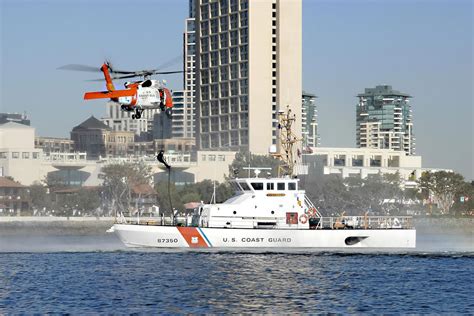
Manila has also explored the potential acquisition of larger former U.S. Coast Guard cutters, including the 210-foot Reliance-class cutter. Displacing roughly 1,000 tons and designed for extended offshore patrols exceeding several weeks, the Reliance class offers a range of more than 6,000 nautical miles. Such endurance would expand Philippine presence in distant sectors of its exclusive economic zone.
Together, airborne ISR platforms and patrol vessels create a layered operational structure. Aircraft extend the sensor horizon, detect contacts early, and cue surface units toward areas of interest. Patrol boats and cutters then provide visible presence, law enforcement authority, and boarding capability. This synergy compresses response timelines and enhances documentation of maritime incidents.
Strategic Implications in the West Philippine Sea
The delivery of the King Air aircraft arrives amid persistent friction between Manila and Beijing over contested features in the West Philippine Sea, the portion of the South China Sea within the Philippines’ exclusive economic zone. Incidents involving maritime militia vessels, coast guard shadowing maneuvers, and obstruction of resupply missions have underscored the importance of credible monitoring capacity.
By strengthening the Philippine Coast Guard rather than focusing exclusively on naval assets, the United States and the Philippines reinforce a law-enforcement-centered approach to maritime disputes. Coast guard vessels and surveillance aircraft operate under civilian authority, emphasizing adherence to international maritime law while reducing escalation risks associated with overt naval deployments.
Enhanced aerial documentation capability also carries diplomatic weight. High-resolution imagery and verified radar tracks provide objective records of encounters at sea. In contested environments where narratives often diverge, data integrity becomes a strategic asset.
A Broader Framework of Alliance Cooperation
The King Air transfer reflects sustained alliance cooperation under the U.S.-Philippines Mutual Defense Treaty and associated security assistance programs. Beyond hardware, the agreement encompasses training, maintenance infrastructure development, and operational integration. Sustained support ensures that the aircraft remain mission-capable over the long term rather than becoming isolated additions to inventory.
From a regional perspective, the move aligns with broader U.S. efforts to strengthen maritime security partnerships across Southeast Asia. Enhancing the capacity of allied coast guards contributes to collective maritime awareness, deters coercive behavior, and reinforces freedom of navigation principles.
The introduction of three King Air surveillance aircraft does not transform the strategic balance overnight. It does, however, close a critical capability gap. In maritime security, visibility equals leverage. Aircraft that can scan wide swaths of ocean, identify anomalies, and coordinate timely response provide a multiplier effect far beyond their number.
As tensions continue to simmer across the South China Sea, the Philippines’ expanded airborne surveillance capacity underscores a clear message: maritime governance depends not only on ships at sea, but on eyes in the sky capable of seeing the full picture.