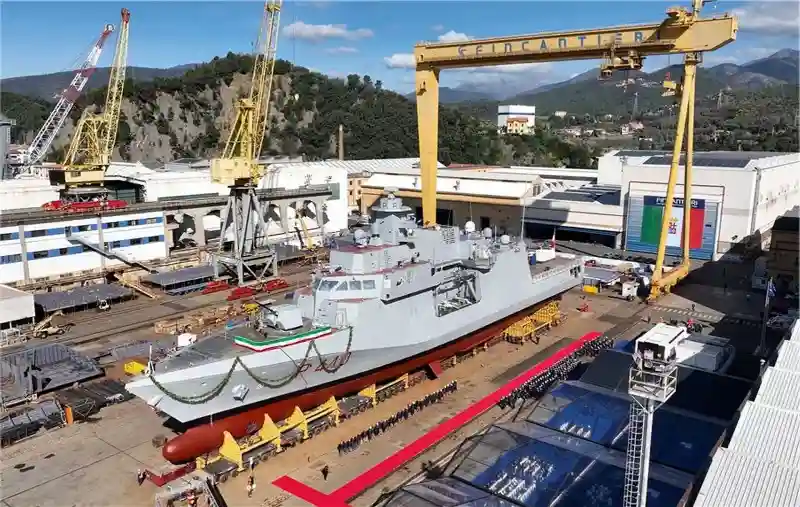
Italy has formally entered a new chapter in naval modernization with the launch of Ugolino Vivaldi, the first of four next-generation Offshore Patrol Vessels (OPVs) built for the Italian Navy. Constructed by Fincantieri, the 95-meter vessel represents a strategic investment in maritime surveillance, exclusive economic zone enforcement, and sustained presence operations across the Mediterranean. More than a routine fleet addition, this platform signals a deliberate recalibration of Italy’s lower-tier surface forces to meet emerging operational demands in increasingly contested waters.
The launch ceremony took place on February 21, 2026, at Fincantieri’s Riva Trigoso shipyard, a facility long associated with advanced Italian naval construction. Built under the industrial coordination of Orizzonte Sistemi Navali, the joint venture between Fincantieri (51 percent) and Leonardo (49 percent), the program operates under contract from Italy’s Naval Armaments Directorate. The presence of senior Navy officials and defense industry leadership underscored the institutional weight behind the initiative, reflecting a broader commitment to modernizing Italy’s maritime posture.
A 95-Meter Platform Designed for Persistent Maritime Surveillance
Measuring approximately 95 meters in length with a displacement of around 2,400 tons, Ugolino Vivaldi is engineered as a compact yet capable patrol asset. The vessel accommodates up to 93 personnel, balancing automation with operational flexibility. While modest in size compared to Italy’s frigates and destroyers, the OPV’s architecture prioritizes endurance, efficiency, and adaptability—qualities essential for prolonged patrols across heavily trafficked maritime corridors.
The Mediterranean remains one of the world’s most strategically dense maritime theaters. Italy’s exclusive economic zone encompasses critical shipping lanes, subsea energy infrastructure, and vital communication cables. The new OPV is optimized for maritime domain awareness, merchant traffic monitoring, and sea line security operations. Its mission set also includes enforcement tasks within Italy’s EEZ and support for environmental protection, particularly in response to hazardous liquid spills. This dual-capability design reflects the evolving reality that modern naval forces must balance security operations with environmental stewardship.
Integrated Naval Cockpit: Automation as Force Multiplier
One of the defining innovations of the class is the integrated naval cockpit system, adapted from the Italian Navy’s PPA multi-purpose combat ships. Developed collaboratively by Fincantieri NexTech and Leonardo, the cockpit consolidates propulsion management, steering, platform control, and selected combat system functions into a unified command station. Engines, rudders, and core onboard systems can be controlled by just two operators—a pilot and co-pilot—significantly reducing crew workload.
This level of integration represents a generational shift in Italian ship design. By streamlining command architecture and reducing manpower requirements for navigation and propulsion management, the Navy enhances operational sustainability while lowering long-term personnel costs. Crucially, the reduced burden on technical crew does not translate into diminished mission capability. Instead, preserved accommodation space allows flexibility for boarding teams, maritime interdiction units, and crisis-response detachments.
Automation here is not merely a convenience feature. It functions as a force multiplier, enabling rapid response in complex navigational environments such as congested Mediterranean straits. In operational terms, faster decision loops translate into improved safety margins and greater tactical agility.
Combat-Ready Architecture in a Patrol Configuration
Although detailed armament specifications remain undisclosed, the design philosophy makes clear that Ugolino Vivaldi is not a lightly equipped constabulary cutter. The platform is expected to integrate scalable combat system components aligned with Italy’s network-centric naval doctrine. This approach allows the vessel to operate within distributed maritime task groups, sharing sensor and tactical data with frigates, maritime patrol aircraft, and NATO command networks.
The distinction is significant. Traditional patrol vessels focus primarily on law enforcement and presence missions. The new Italian OPV, by contrast, is conceived as a digitally connected surveillance node capable of contributing to layered maritime defense. In a scenario involving hybrid threats or gray-zone operations, such connectivity allows the vessel to cue higher-end assets or integrate seamlessly into multinational formations.
This capability reflects Italy’s strategic reality. The central Mediterranean has witnessed increased military activity, energy competition, and infrastructure vulnerability. Subsea pipelines and communication cables represent strategic lifelines. Protecting them demands persistent monitoring backed by credible response options. A modern OPV equipped with advanced sensors and data-sharing capacity becomes an indispensable component of that architecture.
Strategic Fleet Rebalancing and NATO Integration
The introduction of this next-generation OPV addresses a structural fleet requirement. High-end surface combatants such as FREMM frigates are costly to operate and increasingly tasked with NATO commitments and deterrence patrols. Assigning them to routine presence missions creates inefficiencies. By deploying modern patrol vessels capable of sustained surveillance and limited combat integration, the Italian Navy can preserve its advanced warships for higher-intensity operations.
This redistribution enhances readiness across the fleet. The OPV class effectively absorbs day-to-day maritime security duties while maintaining interoperability within allied frameworks. Given Italy’s central geographic position within NATO’s southern flank, such flexibility carries alliance-wide implications.
Industrial Significance and Export Implications
For Fincantieri, the program strengthens its competitive positioning within the global patrol vessel market. The design aligns with the company’s FCX product family, emphasizing modular construction, export adaptability, and integrated combat systems. Lessons derived from larger combatant programs inform the OPV’s digital architecture, yet the vessel remains cost-efficient for prolonged patrol operations.
The Orizzonte Sistemi Navali industrial framework consolidates hull construction and combat system integration under a unified management structure. This synergy reinforces Italy’s domestic naval industrial base at a time of intensifying European defense cooperation and global competition. As nations reassess maritime security requirements, demand for versatile, digitally integrated patrol platforms is expected to grow.
The launch of Ugolino Vivaldi therefore represents more than a ceremonial milestone. It marks the operationalization of Italy’s effort to modernize its surface fleet with platforms tailored for persistent presence, environmental responsibility, and allied interoperability. As the remaining three vessels progress through construction, the program will shape the Italian Navy’s ability to project stability, protect maritime infrastructure, and sustain influence across the Mediterranean’s dynamic security landscape.