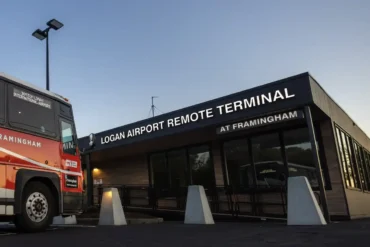
Modern aviation security exists in a constant arms race against evolving threats, and nowhere is that reality more visible than inside the world’s busiest airports. Screening systems must balance three forces that rarely cooperate: speed, accuracy, and passenger comfort. The Transportation Security Administration is now pushing toward a future where advanced sensing, automation, and artificial intelligence converge to create security checkpoints that feel less like bottlenecks and more like seamless gateways. The next wave of screening technology is not simply about detecting prohibited items; it is about building predictive, adaptive, and scalable security ecosystems capable of responding to emerging risks in real time.
Airport security since the early 2010s has largely relied on standardized workflows: passengers pass through body scanners, belongings move through X-ray machines, and officers perform manual checks when anomalies appear. That system has worked, but it was designed for a different era of travel volume and threat complexity. Global passenger numbers continue rising, while prohibited item concealment methods grow more sophisticated. The result is a growing need for systems that can see deeper, process faster, and reduce human error without removing human oversight entirely.
The Transportation Security Administration has been quietly building a portfolio of technologies aimed at fundamentally rethinking how screening happens. Some of these tools improve existing workflows, while others introduce completely new methods of evaluating passengers and baggage. Together, they represent a shift toward security that is more automated, more data-driven, and less physically intrusive.
Automated Security Lanes: Engineering Speed Without Sacrificing Accuracy
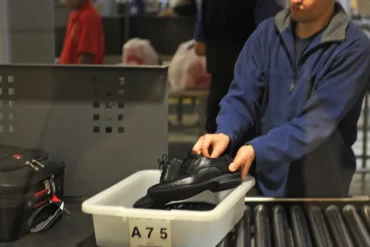
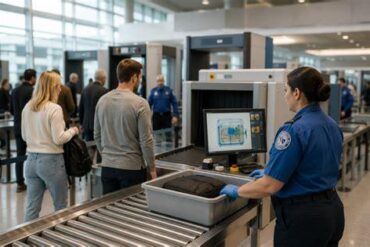
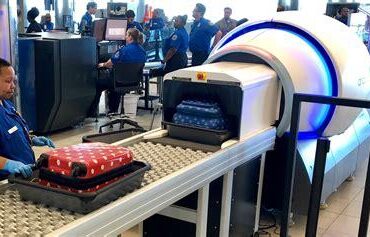
Automated screening lanes are one of the most visible examples of how engineering can directly improve passenger flow. Traditional checkpoint lanes depend heavily on manual bin handling, which creates choke points during peak travel windows. Automated systems replace static bin stations with conveyor-based smart lanes capable of moving multiple bins simultaneously, dramatically increasing throughput while maintaining detailed inspection capability.
Airports like New York JFK, Los Angeles International, and Newark Liberty International began adopting these lanes early, but newer deployments incorporate significantly upgraded hardware. The bins themselves are larger and designed to accommodate modern travel realities, where passengers carry multiple electronics and dense personal items. The system automatically routes bins toward X-ray scanners and then cycles them back to the front of the line, eliminating the need for staff to manually restock containers. This might seem like a small operational tweak, but multiplied across thousands of daily passengers, it produces massive time savings.
When suspicious items appear during screening, the system diverts that specific bin into a secondary inspection track without interrupting the rest of the flow. This selective routing reduces checkpoint slowdowns caused by single anomalies. The broader effect is a checkpoint that behaves more like an assembly line than a queue, reducing stress for travelers while allowing officers to focus attention only where it is actually needed.
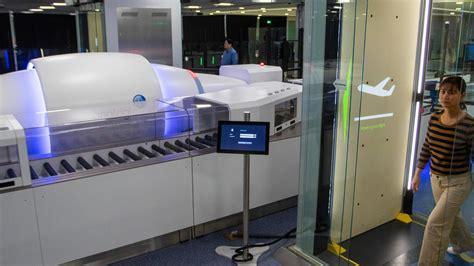
Automation is also opening doors to partial self-screening environments. Trials such as the PAX MX2 system tested at Harry Reid International Airport in Las Vegas demonstrate how passengers can follow guided instructions to scan belongings themselves. When combined with facial recognition identity matching and compact CT scanners, this concept hints at a future where routine screening becomes largely self-directed, reserving officer intervention for exceptions rather than standard procedure.
Wearable Contactless Sensors: Reinventing Physical Screening Through Haptic Technology
Physical pat-down screening has always been one of the most sensitive aspects of airport security, balancing necessity with passenger comfort. The Department of Homeland Security’s wearable sensor concept aims to replace direct physical contact with advanced sensing combined with haptic feedback, effectively allowing officers to “feel” objects without touching passengers.
The device is envisioned as a sensor-equipped glove or wearable pad capable of translating remote scans into tactile sensations. Using combinations of millimeter wave scanning, LiDAR mapping, and backscatter X-ray analysis, the system builds a digital model of the passenger’s body and any concealed objects. That data is then translated into physical feedback for the officer through vibration or pressure simulation.
The implications go far beyond comfort. Contactless screening could reduce contamination risks, improve consistency across screenings, and allow for deeper analysis of suspicious objects without physical exposure. For example, if a concealed device is detected, the officer could analyze its shape and density characteristics virtually before deciding on next steps. This creates a layered security model where data analysis precedes physical intervention, potentially reducing false alarms while improving detection rates.
Although still conceptual, the technology reflects a broader trend: replacing physical procedures with sensor-driven digital equivalents. In security environments where consistency matters, machines that replicate the same sensitivity level every time can dramatically improve overall reliability.
AI-Enhanced Computed Tomography: The Brain Upgrade for Baggage Scanning
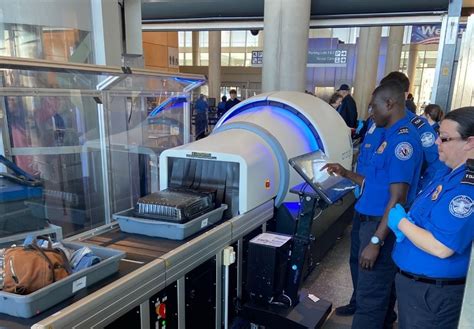
Computed Tomography scanning already represents a major leap forward compared to traditional X-ray imaging. Conventional scanners produce flat, two-dimensional images that require significant interpretation skill from operators. CT scanners generate full 3D reconstructions of bag contents, allowing officers to rotate and analyze objects from any angle.
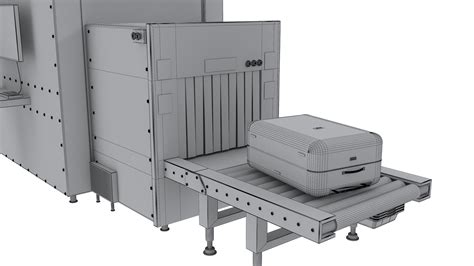
The next leap comes from integrating artificial intelligence directly into CT scanning workflows. AI models trained on massive libraries of threat item imagery can highlight suspicious shapes, densities, or component patterns in real time. Instead of replacing human judgment, AI acts like an expert assistant constantly scanning for anomalies across thousands of micro-features within each bag.
One major advantage is consistency. Human fatigue can reduce detection accuracy during long shifts, while AI maintains constant performance levels. More importantly, AI systems can learn from new threat data continuously, allowing them to adapt faster than traditional rule-based detection software.
Passengers are already seeing the early effects of this shift. At some airports, travelers can leave electronics and liquids inside carry-on bags because CT scanners combined with AI can differentiate between benign and suspicious items with much greater confidence. This reduces checkpoint friction while maintaining extremely high detection probability, creating a system that is simultaneously more secure and more convenient.
HEXWAVE Radar Imaging: Screening Multiple Passengers Simultaneously
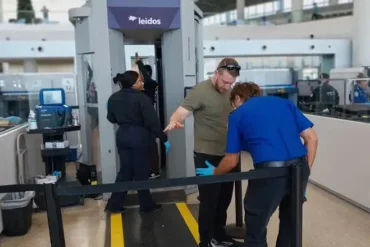
Traditional body scanners process passengers one at a time, creating unavoidable queues during busy periods. HEXWAVE technology, developed by Liberty Defense, proposes a fundamentally different model by enabling simultaneous multi-person screening using advanced radar imaging and AI interpretation.
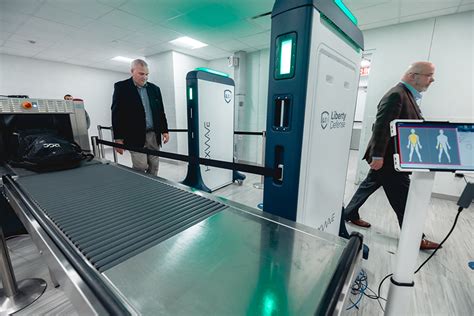
HEXWAVE uses extremely low-power radio waves to build three-dimensional images of individuals as they walk naturally through screening zones. Unlike metal detectors, which only identify conductive materials, HEXWAVE can detect both metallic and non-metallic threats. This includes ceramics, plastics, and composite weapon materials increasingly used in modern threat designs.
The system is already being evaluated for use in TSA PreCheck environments and has been tested in multiple real-world scenarios. One of its most powerful capabilities is distinguishing between individuals standing close together. Advanced signal processing allows the system to isolate each person’s signature, enabling accurate screening even in crowded environments like stadium entrances or transit hubs.
Beyond passenger checkpoints, HEXWAVE is also being explored for employee screening mandates at airports. This creates a unified security model where staff and passengers pass through similar detection frameworks, closing potential insider threat gaps while maintaining efficient movement.
TSA ConfirmID and Biometric Identity Expansion: Rethinking Identity Verification
Identity verification is often the most stressful part of travel when documentation is missing or damaged. TSA ConfirmID introduces a fallback identity verification pathway designed to prevent travelers from missing flights due to documentation errors while still maintaining strict security standards.
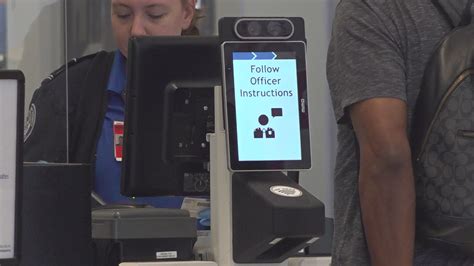
Under ConfirmID, eligible travelers can complete identity verification forms online or at the airport and pay a processing fee. The system then uses biometric analysis and database verification to confirm identity through facial recognition and identity cross-referencing systems. Once verified, travelers receive authorization to pass through security screening without traditional ID documents.
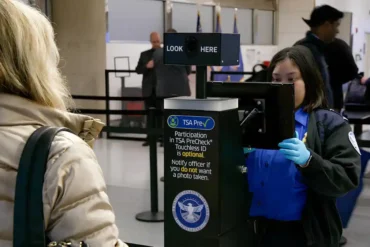
This technology aligns with the TSA’s broader push toward touchless identity verification. In expanding TSA PreCheck environments, passengers can already move through checkpoints using facial recognition linked to verified identity databases. Physical documents remain recommended, but the direction is clear: identity verification is becoming increasingly digital, automated, and frictionless.
Biometric identity systems also reduce fraud potential by tying verification directly to physical biometric markers rather than transferable documents. As biometric databases improve and encryption standards strengthen, identity fraud becomes significantly more difficult to execute.
The Strategic Future of Airport Screening Technology
These five technologies represent more than isolated upgrades. Together, they signal a structural shift toward fully integrated, sensor-rich security ecosystems. The future checkpoint will likely combine CT scanning, AI threat detection, biometric identity verification, automated bin handling, and contactless physical screening into a single seamless experience.
The long-term vision is security that passengers barely notice. Instead of stopping travelers repeatedly for separate checks, future systems will likely perform layered scanning passively as passengers move through environments. Sensors embedded in architecture, combined with AI analytics platforms, could transform entire terminal zones into continuous security spaces.
For security agencies, the benefit is predictive intelligence. By analyzing aggregated sensor data, systems could identify behavioral anomalies, suspicious item patterns, or emerging threat techniques before incidents occur. For passengers, the benefit is simplicity: shorter lines, fewer manual checks, and more predictable travel experiences.
The transformation will not happen overnight. Deployment costs, privacy considerations, and infrastructure integration challenges all require careful navigation. But the direction is unmistakable. Airport security is evolving from checkpoint-based inspection toward continuous, intelligent risk assessment frameworks.
As global air travel continues expanding, security technology must evolve at the same pace. The projects currently being explored by the TSA illustrate how advanced sensing, automation, and machine intelligence can converge to create systems that are simultaneously more secure and more human-centered. The result is a future where safety and convenience are no longer competing priorities but parts of the same technological equation, reshaping how the world moves through airports for decades to come.