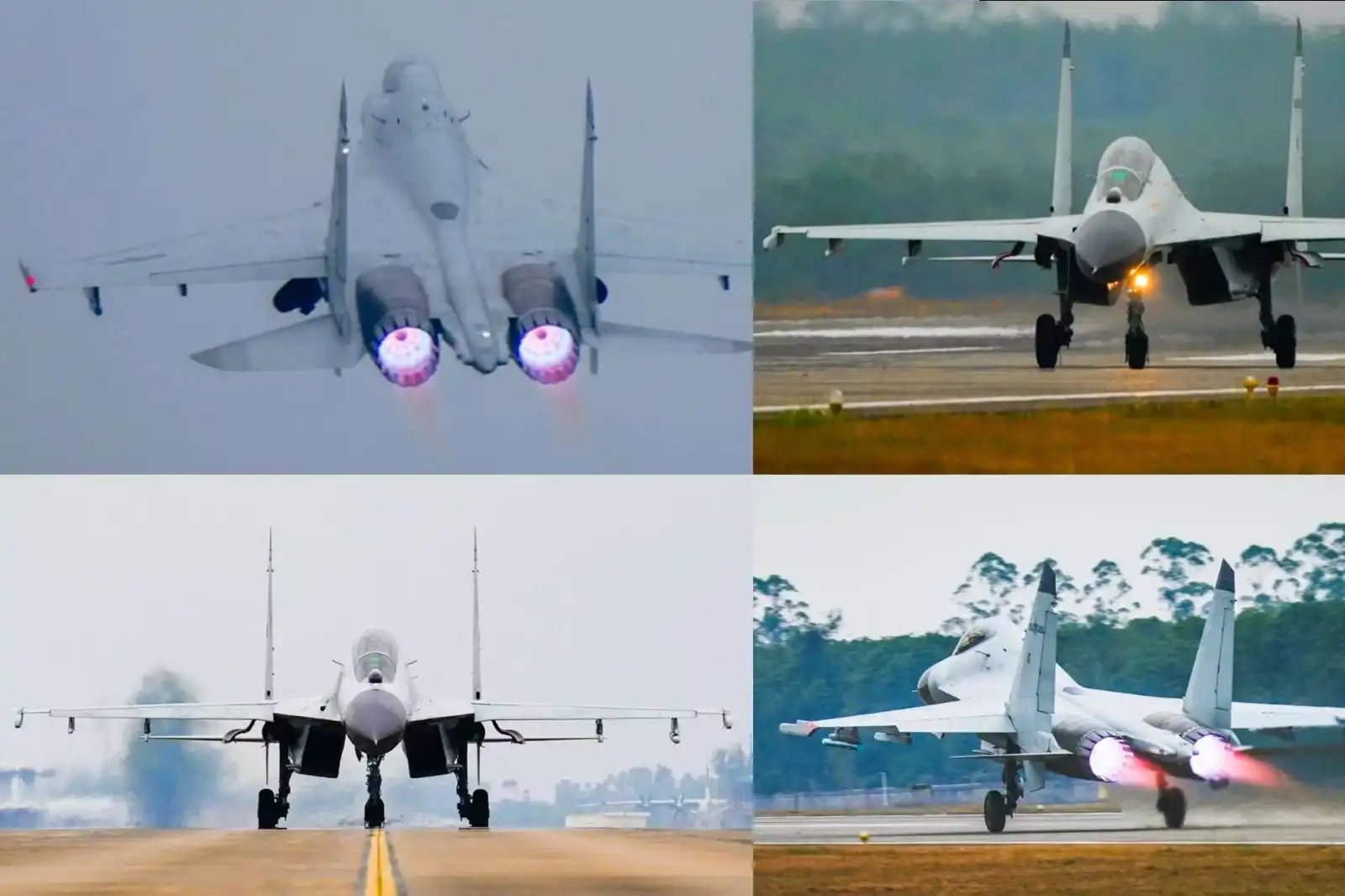
China’s People’s Liberation Army Navy (PLAN) has intensified operational training for its J-11BSH twin-seat naval fighters, signaling a deliberate expansion of long-range maritime airpower capabilities under the Southern Theater Command. Newly released imagery dated 13 February 2026 provides rare visibility into how the PLAN is sharpening over-water combat proficiency at a time of persistent regional air and naval activity in the South China Sea.
The photographs depict a structured, multi-aircraft training sequence rather than a routine sortie, underscoring the aircraft’s expanding role in theater-level maritime operations. The deliberate public release of such imagery is itself meaningful. It reflects not only pilot training progress but also a strategic message: land-based heavy fighters remain central to China’s evolving maritime posture alongside carrier aviation and long-range bomber forces.
The J-11BSH is a navalized derivative of the twin-seat J-11BS, itself an extensively localized evolution of the Russian-designed Su-27UB airframe manufactured by Shenyang Aircraft Corporation. While carrier-based J-15 fighters often draw greater attention, the J-11BSH occupies a distinct operational niche. It is optimized for sustained land-based maritime missions, bridging high-end air superiority with maritime strike and integrated air-sea operations.
Long-Range Maritime Sorties Signal Elevated Combat Readiness
The released images show J-11BSH aircraft taxiing in sequence, executing maximum-power takeoffs with WS-10 series turbofan engines in full afterburner, and climbing in coordinated formation. The presence of extended landing gear during rotation suggests heavy-thrust departure profiles typical of long-range mission training.
Close frontal angles reveal two visible underwing hardpoints per wing. The outermost stations carry short-range air-to-air missiles, while wingtip rails appear empty. Notably absent are external fuel tanks, targeting pods, or anti-ship missiles. This configuration indicates a focus on flight handling, formation discipline, radar employment, and crew coordination rather than full-scale strike rehearsal.
Such training profiles are foundational. Before heavy anti-ship missiles or precision-guided munitions are added, aircrews must master over-water navigation, target acquisition, and multi-ship tactical integration. Over the open sea, where visual references vanish and electromagnetic clutter increases, procedural precision becomes mission-critical.
The J-11BSH: Navalized Heavy Fighter with Dual-Crew Advantage
The twin-seat configuration is central to the J-11BSH’s maritime value. Unlike single-seat fighters, this platform assigns a dedicated weapon systems officer (WSO) to the rear cockpit. The front pilot concentrates on aircraft control and tactical maneuvering, while the WSO manages radar modes, electronic warfare functions, and complex weapon sequencing.
The aircraft features a multi-mode fire-control radar with maritime search and air-to-surface capabilities, a digital glass cockpit, and hands-on-throttle-and-stick (HOTAS) controls designed for high workload missions. Power is provided by domestically produced WS-10 engines, delivering strong thrust-to-weight performance, sustained supersonic capability, and rapid climb rates suitable for long-distance intercept missions.
In air-to-air roles, the J-11BSH is assessed to employ PL-8 short-range infrared missiles, PL-12 active radar-guided BVR missiles, and potentially newer long-range systems such as the PL-15. For maritime strike, integration with YJ-series anti-ship missiles and guided bombs provides credible stand-off engagement capability consistent with China’s layered maritime defense doctrine.
Integration into the Southern Theater Command’s Maritime Architecture
Operating from coastal bases, J-11BSH units under the Southern Theater Command are positioned to project airpower deep into contested waters. Their endurance and radar reach allow them to provide combat air patrol (CAP) coverage far beyond shore-based surface-to-air missile envelopes.
These fighters are believed to conduct escort missions for KJ-500 airborne early warning aircraft, maritime patrol platforms such as the Y-8 and Y-9 variants, and naval surface action groups operating across the South China Sea. Through secure datalinks, they integrate into a broader sensor network that includes shore-based radars, surveillance aircraft, and naval combatants.
The result is an increasingly coherent air-sea integrated operational picture, where detection, tracking, and engagement data flows across multiple domains. In such a system, the J-11BSH functions as both interceptor and potential strike executor, extending the PLAN’s aerial shield over maritime task groups and strategic outposts.
Historical Precedent and Intercept Missions
Though operational details remain limited, the J-11BSH has surfaced in high-profile intercept incidents. In late 2022, a PLAN aircraft of this type conducted a close intercept of a U.S. Air Force RC-135 reconnaissance aircraft over the South China Sea. The event illustrated the aircraft’s role in defensive counter-air and airspace identification missions.
Daily operational tasks likely include quick-reaction alert launches, maritime air policing, and high-value asset escort. The aircraft’s long endurance and radar capability enable complex intercept geometries, particularly when confronting foreign maritime patrol aircraft, intelligence platforms, or carrier-based strike assets operating near contested zones.
Anti-Access and Area Denial: Expanding the Kill Chain
China’s broader maritime strategy increasingly emphasizes anti-access/area-denial (A2/AD) principles. Within this framework, the J-11BSH is not merely an interceptor but a critical link in a layered engagement chain. From coastal bases, these fighters can provide air cover for surface combatants equipped with long-range air defense systems while coordinating with H-6J bombers carrying anti-ship cruise missiles.
This layered approach complicates adversary planning. Potential opponents must account for heavy fighters capable of long-range BVR engagements combined with stand-off anti-ship strike options. The clean configuration observed in current training imagery suggests foundational proficiency building, yet the underlying platform is fully capable of transitioning to a heavily armed configuration in crisis scenarios.
Training Focus: Mastering Over-Water Complexity
Maritime flight operations impose unique demands. Over open water, radar reflections behave differently due to sea clutter, weather effects can be abrupt, and visual horizon cues are limited. Pilots must rely heavily on instrumentation and sensor data.
The twin-seat cockpit architecture supports these complexities. One crew member can monitor radar tracks and electronic support measures while the other manages flight path and formation alignment. This division of labor becomes critical when operating at extended ranges where refueling windows, fuel margins, and threat envelopes must be continuously assessed.
Although no aerial refueling assets appear in the released imagery, long-range mission rehearsal often incorporates tanker coordination profiles. Practicing such integration ensures that in operational scenarios, fighters can maintain sustained presence far from base while preserving sufficient combat margins.
Strategic Messaging Through Transparency
Publicizing J-11BSH maritime training serves both operational and informational objectives. It demonstrates sustained pilot proficiency while signaling that China’s maritime airpower is not limited to carrier-based aviation. Land-based heavy fighters remain a flexible, rapidly deployable component of regional air dominance.
By investing in a relatively modest fleet of twin-seat heavy fighters—estimated in open sources at roughly three dozen aircraft—the PLAN appears focused on quality integration rather than sheer quantity. Enhanced training cycles, multi-ship coordination, and cross-domain data fusion indicate maturation in operational doctrine.
Operational Implications for Regional Security
For regional navies and extra-regional forces operating in the South China Sea, the intensification of J-11BSH training alters the operational calculus. Missions that previously accounted primarily for surface-based air defenses must now factor in responsive, long-range heavy fighters with advanced BVR missile reach.
In a crisis scenario, J-11BSH aircraft could assume roles including:
- Long-range CAP shielding surface task groups
- Escort for bomber-led anti-ship strike packages
- Offensive counter-air missions targeting forward operating bases
- Maritime interdiction and stand-off precision strikes
Each role leverages the platform’s range, radar capability, and dual-crew efficiency. Importantly, such versatility allows rapid adaptation between peacetime presence operations and high-intensity conflict.
The Quiet Expansion of Maritime Airpower
The February 2026 training imagery may appear routine at first glance—fighters taxiing, lifting into gray coastal skies, climbing in disciplined formation. Yet beneath this surface lies a steady refinement of tactics and integration. Maritime airpower is not built overnight. It is cultivated through repetition, procedural mastery, and cross-domain synchronization.
The J-11BSH exemplifies this incremental strengthening. While more advanced platforms like the J-16 or carrier-based J-15 attract international headlines, the navalized Flanker derivative continues to mature quietly within land-based brigades. Its twin-seat architecture, domestic engine integration, and maritime-optimized avionics position it as a capable, flexible asset in China’s evolving force structure.
As long-range maritime competition intensifies across the Indo-Pacific, the operational significance of platforms like the J-11BSH will extend beyond headline moments. They represent the backbone of sustained air presence—fighters capable of projecting coverage, coordinating with surface fleets, and reinforcing layered defenses across vast stretches of contested sea.