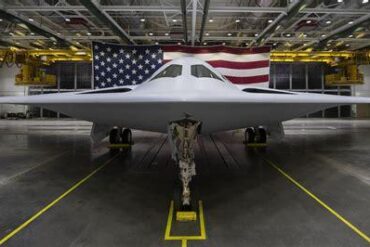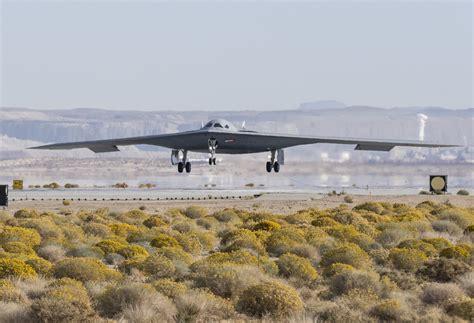
The United States is accelerating the production of its next-generation B-21 Raider stealth bomber, committing $4.5 billion in fiscal year 2025 funding to expand annual manufacturing capacity by 25 percent. The decision, confirmed by the U.S. Department of the Air Force, is more than an industrial adjustment. It represents a strategic recalibration designed to strengthen America’s ability to penetrate advanced air defenses and maintain credible long-range strike options against near-peer competitors including China, Russia, and Iran.
This acceleration signals urgency. In modern warfare, timing often outweighs raw capability. A bomber that arrives five years earlier alters the deterrence equation today. By compressing delivery timelines while maintaining cost and performance benchmarks, the Air Force aims to close potential capability gaps before they widen under geopolitical pressure.
The B-21 Raider is designed as a dual-capable penetrating stealth bomber, capable of delivering both conventional and nuclear weapons deep inside contested airspace. Its purpose is straightforward but formidable: survive where legacy aircraft cannot, strike hardened and mobile targets, and remain relevant in environments saturated with radar, electronic warfare systems, and layered missile defenses.
Strategic Acceleration: Why a 25% Production Increase Matters
The 25 percent production increase stems from funding already authorized and appropriated under fiscal year 2025 reconciliation legislation. The Air Force reached agreement with Northrop Grumman, the B-21’s prime contractor, to expand manufacturing throughput while maintaining discipline in cost control and program execution.
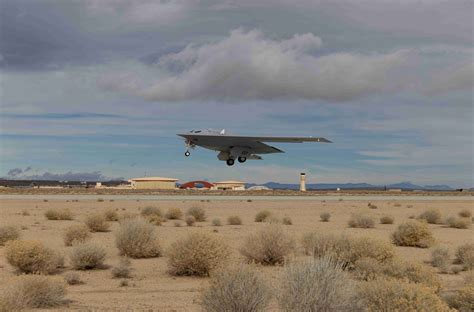
Aircraft deliveries began on schedule in 2025. Officials confirm the service remains on track to have B-21s operational at Ellsworth Air Force Base in 2027, even as flight testing continues. That alignment between testing, production, and basing is critical. Modern defense programs often suffer from schedule slippage; the Raider’s steady timeline provides confidence that accelerated production will translate into real operational inventory.
Strategically, increasing production capacity does not simply add aircraft. It compresses vulnerability windows. If potential adversaries calculate that the U.S. penetrating bomber fleet will remain numerically limited for a decade, they may take greater risks. Expanding production narrows that window and complicates such calculations.
Transitioning the Bomber Force for High-End Conflict
The B-21 enters service amid a generational transition in the U.S. bomber fleet. The B-2 Spirit, while exceptionally survivable, exists in limited numbers. The B-1B Lancer carries heavy conventional payloads but faces aging airframe constraints. The B-52 Stratofortress remains indispensable for standoff missile mass, yet it was never intended to routinely penetrate modern integrated air defense systems.
This creates a structural imbalance: exquisite stealth in small quantity, large payload in non-stealth platforms, and limited capacity to sustain penetrating operations at scale. The B-21 is designed to restore that balance by enabling stealthy sortie generation in meaningful numbers, not as a boutique capability but as an operational backbone.
In practical terms, that means commanders gain more options during the opening phases of a high-end campaign. When facing dense anti-access/area-denial networks, relying exclusively on standoff missiles may prove insufficient. Penetrating bombers provide the ability to directly strike command nodes, mobile missile launchers, and hardened facilities that underpin an adversary’s defensive architecture.
Design Philosophy: Survivability, Connectivity, and Adaptability
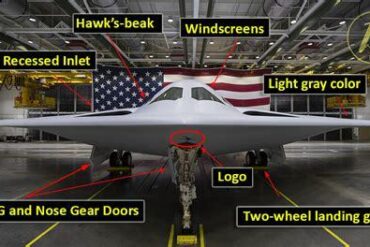
Publicly released performance specifications remain limited, but the Air Force has emphasized the Raider’s defining characteristics: advanced stealth, resilient networking, and open-systems architecture. These attributes form the core of its combat relevance.
Stealth alone is no longer enough. Modern battlefields are defined by distributed sensors, electronic warfare, and long-range precision fires. A penetrating bomber must remain connected inside contested environments. The B-21 is engineered as a networked strike node, capable of receiving dynamic targeting data and contributing to multi-domain kill chains in real time.
Open-systems architecture allows for modular upgrades over the aircraft’s service life. Rather than freezing capability at production, this design philosophy enables competitive modernization, reducing integration risk and extending operational relevance. In a technological race measured in decades, adaptability becomes a strategic advantage.
The Air Force has identified an average procurement unit cost benchmarked at $550 million in base-year 2010 dollars, updated to approximately $692 million in base-year 2022 dollars. The official inventory objective stands at at least 100 aircraft, though analytical studies have suggested higher numbers may be required for sustained high-tempo operations against peer adversaries.
Penetrating Strike in Contested Theaters
The Raider’s value lies in enabling both entry and endurance. During the opening stages of conflict, adversaries rely on integrated air defense systems, long-range missile forces, and hardened infrastructure to deny U.S. power projection. The B-21 is built to penetrate those defenses and strike the nodes that hold the network together.
Targets may include:
- Air defense command centers
- Mobile missile batteries
- Leadership facilities
- Hardened underground complexes
- Critical logistics infrastructure
By combining stealth with internal payload capacity, the Raider forces defenders into strategic dilemmas. They must protect more targets across broader geography, uncertain of attack vectors or timing. That uncertainty alone carries deterrent weight.
Moreover, its ability to deliver both direct-attack and stand-off munitions expands flexibility. The bomber can operate as a penetrating striker or as part of distributed long-range missile salvos, blending roles depending on operational demands.
Industrial Throughput and Defense Readiness
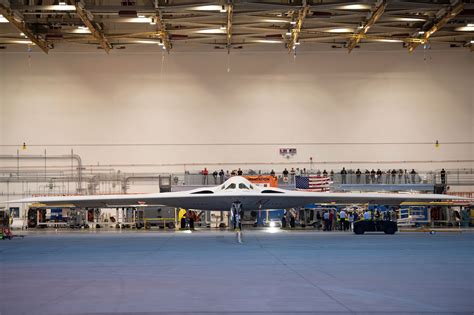
The $4.5 billion investment is not merely an aircraft purchase; it represents expanded industrial throughput. Northrop Grumman has previously absorbed significant costs to accelerate program milestones. Scaling production requires facility expansion, workforce growth, and supply chain stabilization.
Defense industrial capacity has emerged as a strategic factor in its own right. Modern conflicts demonstrate that production speed and logistical resilience can influence outcomes as decisively as frontline technology. Increasing B-21 manufacturing capacity ensures that the United States can translate program stability into operational inventory before potential crises escalate.
The acceleration also signals confidence. Programs suffering technical instability rarely expand production rates. Increasing output while flight testing continues suggests that risk has been sufficiently mitigated to justify scaling.
Nuclear Modernization and Deterrence Signaling
The B-21 Raider forms a central pillar of U.S. nuclear modernization efforts. As a dual-capable bomber, it will eventually assume a foundational role in the bomber leg of the nuclear triad, operating alongside a modernized B-52 fleet.
Bombers possess unique deterrence characteristics. Unlike ballistic missiles, they are visible and recallable. They can be forward deployed, surged, or signaled during crises, providing escalation management tools unavailable to silo-based systems. In an era increasingly defined by simultaneous strategic competition with multiple nuclear-armed states, such flexibility carries amplified importance.
The Air Force has described the Raider as “foundational” to long-range strike and credible deterrence. That language reflects more than institutional optimism. It acknowledges that survivable, penetrating bombers remain essential in a strategic environment where air defenses continue to evolve.
Debates Over Fleet Size and Future Expansion
While the official procurement objective remains at least 100 aircraft, multiple defense analyses argue that a larger fleet—potentially 200 or more—may be required to sustain operations in a China-focused scenario while deterring other adversaries. Historical assessments have proposed a 220-bomber force structure with approximately 145 B-21s as a moderate-risk baseline.
These debates hinge on classified force-planning assumptions, including sortie generation rates, loss projections, and theater demands. What is clear is that increasing production capacity today creates flexibility for expansion tomorrow. Once industrial infrastructure matures, scaling additional orders becomes more feasible than rebuilding dormant capacity.
The 25 percent production increase therefore functions as both immediate reinforcement and strategic hedge. It strengthens near-term deterrence while preserving options for future force growth.
A Clear Operational Message
The expansion of B-21 production capacity delivers a direct message to allies and competitors alike. The United States is prioritizing penetrating long-range strike capability as a core instrument of national defense. It is investing not only in advanced technology but also in the industrial base required to field that technology at scale.
In an era defined by contested airspace, anti-access strategies, and multi-domain competition, the B-21 Raider embodies a deliberate shift toward survivable, networked, and adaptable airpower. Accelerating its production by 25 percent underscores that this shift is not theoretical. It is operational, funded, and advancing on schedule.
As geopolitical tensions evolve across the Indo-Pacific, Europe, and the Middle East, the Raider’s expanding presence in the U.S. arsenal will shape deterrence calculations long before it ever releases a weapon. The strategic equation is being adjusted now—one production line at a time.