What Is an Airworthiness Certificate?
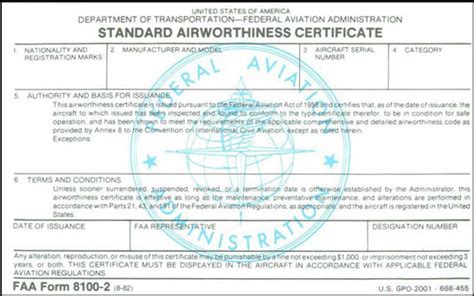
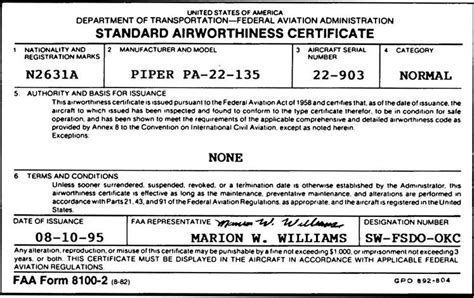
An airworthiness certificate is a formal document issued by the Federal Aviation Administration (FAA) that grants legal authorization for an aircraft to operate in U.S. airspace. Without this certification, no aircraft—civilian or commercial—may be flown lawfully. This document confirms that the aircraft has met all design, construction, and maintenance standards defined in Title 14 of the Code of Federal Regulations (14 CFR) Subpart H.
The airworthiness certificate serves as a visible testament to the aircraft’s compliance with rigorous safety standards. Displayed prominently within the aircraft, it must always be current and valid to remain in legal operation. This certification framework ensures uniformity, safety, and compliance across the United States aviation sector.
Categories of Airworthiness Certificates
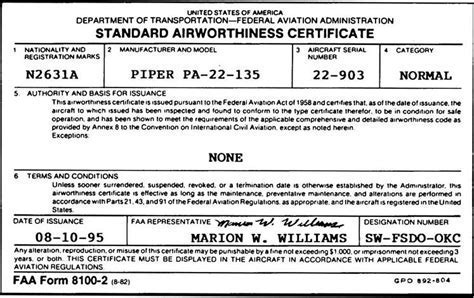
The FAA classifies airworthiness certificates into two principal types: the Standard Airworthiness Certificate and the Special Airworthiness Certificate. These classifications are tailored to the purpose and condition of the aircraft.
The Standard Airworthiness Certificate is issued for aircraft that conform to a type design and are in a condition for safe operation. It is most commonly granted to:
-
Transport category aircraft
-
Normal and utility aircraft
-
Commuter aircraft
-
Acrobatic and restricted aircraft
On the other hand, the Special Airworthiness Certificate applies to aircraft that do not meet the criteria of the standard category. These may include:
-
Experimental aircraft
-
Light-sport aircraft
-
Primary category aircraft
-
Provisional and special flight permit aircraft
These distinctions allow for regulatory flexibility while maintaining uncompromised safety expectations across diverse aviation activities.
Who Can Apply for an Airworthiness Certificate?
Only the registered owner of an aircraft, or their legally authorized agent, may submit an application for an airworthiness certificate. This applies universally across all aircraft categories and classes, from corporate jets to homebuilt experimental planes.
The process begins with the aircraft being properly registered with the FAA. Without current registration, no certification application will be accepted. Ownership documentation, conformity inspections, and compliance with maintenance requirements are all essential.
Who Issues an Airworthiness Certificate?
Only FAA officials vested with regulatory authority may issue an airworthiness certificate. These include:
-
FAA Aviation Safety Inspectors, and
-
Designees, known formally as Representatives of the Administrator under 14 CFR Part 183.
Designees include individuals specifically appointed to act on behalf of the FAA, such as Designated Airworthiness Representatives (DARs). These professionals extend the FAA’s capacity and are often used in remote locations or to expedite high volumes of certifications.
The Certification Process Explained
The FAA’s airworthiness certification process consists of several coordinated steps, each governed by federal regulation and internal FAA procedural orders. To be eligible for a certificate, the applicant must:
-
Register the aircraft with the FAA.
-
Submit FAA Form 8130-6, the Application for U.S. Airworthiness Certificate.
-
Schedule an inspection with a local FAA Flight Standards District Office (FSDO).
-
Demonstrate conformity to the aircraft’s approved type design.
-
Ensure the aircraft is in a condition for safe operation.
Applicants can streamline this process through the FAA’s online Airworthiness Certification (AWC) tool, the agency’s preferred method. Alternatively, paper applications may be submitted to local FAA offices.
Digital Application Tools and Guidance
To assist applicants, the FAA provides several digital resources, including:
-
The AWC Applicant Registration Guide
-
An Application Process Overview video
-
Advisory Circular 21-12C, which offers in-depth guidance on completing Form 8130-6
For unique situations such as the issuance of Special Flight Permits—often granted when aircraft need to be flown for maintenance or repair—additional documentation may be required. These cases are also covered under the same form and process, albeit with specific justifications.
Conditions for Revocation
Airworthiness is not a permanent status. According to 14 CFR Section 21.181, the FAA may revoke or suspend a certificate if an aircraft:
-
No longer conforms to its approved design, or
-
Is not in an airworthy condition
This authority is exercised to ensure continued operational safety and to remove potentially hazardous aircraft from active service. Revocation can occur following inspection failures, reported incidents, or discovery of unauthorized modifications.
Understanding the Definition of “Airworthy”
The FAA defines “airworthy” as the state in which an aircraft conforms to its type certificate and is in a condition for safe operation. This dual requirement—design conformity and mechanical condition—is outlined in FAA Order 8130.2, specifically within Appendix I.
Conformity refers to all physical and functional aspects matching the original approved design. Condition for safe operation means the aircraft systems, engines, avionics, structure, and airframe meet current standards and operate without hazard. Both elements are continuously monitored through inspections, scheduled maintenance, and service bulletins.
Ongoing Airworthiness and Continued Compliance
Maintaining an airworthiness certificate involves a lifecycle of compliance. Aircraft owners and operators are responsible for ensuring that ongoing airworthiness is preserved through regular inspections such as:
-
Annual inspections (required for most aircraft)
-
100-hour inspections (required for aircraft used for hire)
-
Progressive inspections (for certain high-utilization operations)
Owners must also comply with all Airworthiness Directives (ADs), which are legally enforceable rules issued when unsafe conditions are identified. ADs require specific corrective actions, and failure to comply can lead to certificate revocation.
Why Airworthiness Certification Matters
The concept of airworthiness lies at the very core of modern aviation safety. From small general aviation aircraft to intercontinental commercial jets, the airworthiness certificate signifies that an aircraft has met the highest federal safety benchmarks. It is both a regulatory necessity and a safeguard of public trust.
Beyond mere legality, a current and valid airworthiness certificate assures:
-
Regulatory compliance
-
Insurance validity
-
Passenger confidence
-
Manufacturer support
-
Operational clearance for air traffic control and international airspace entry
Aircraft operating without a valid certificate not only risk FAA enforcement action, but also compromise passenger safety and institutional credibility.
FAQs About Airworthiness Certificates
What happens if an aircraft fails the airworthiness inspection?
If an aircraft fails inspection, it cannot receive or retain its airworthiness certificate until identified discrepancies are corrected. Maintenance must be performed, documented, and reinspected to verify compliance before certification is granted.
Can an aircraft with a revoked airworthiness certificate be restored to service?
Yes. If the issues that led to revocation are rectified and the aircraft is restored to conformity and safe condition, a new airworthiness application can be submitted. The FAA will inspect the aircraft before reinstating its certification.
Is a special airworthiness certificate valid for international flights?
In most cases, a special airworthiness certificate restricts operations to U.S. airspace unless the receiving country explicitly accepts the aircraft under bilateral agreements or specific authorizations. Operators must check with the FAA and international authorities before planning cross-border operations.