The idea of airline loyalty once felt refreshingly simple: fly more, earn more, and eventually redeem those miles for free travel. That clarity has steadily dissolved. In its place stands a far more calculated ecosystem—one where spending power, not distance flown, dictates value. United Airlines’ MileagePlus transformation marks one of the clearest signals yet that loyalty has officially become transactional, not experiential.
What has emerged is not merely a program update but a philosophical shift. MileagePlus is no longer just about rewarding frequent flyers—it is engineered to reward frequent spenders, particularly those deeply embedded in United’s credit card ecosystem. The implications ripple across how travelers earn, redeem, and even think about loyalty.
A Structural Shift: MileagePlus Becomes Spend-Centric
The most defining change is the introduction of a dual-track earning system that separates members into two distinct categories: credit cardholders and non-cardholders. This is more than a tweak—it’s a dividing line that reshapes the entire value proposition.
Previously, all MileagePlus members earned a base rate of five miles per dollar spent on tickets, with elite members receiving incremental bonuses. Now, that uniformity is gone. Non-cardholders see their earning potential reduced, while cardholders are elevated into a more lucrative tier.
For general members without a United credit card, earnings drop to three miles per dollar. Meanwhile, elite members without cards retain moderate earning rates ranging from five to nine miles per dollar. On the other side, cardholders immediately gain an advantage, starting at six miles per dollar, with elite cardholders earning as much as twelve miles per dollar.
This isn’t subtle encouragement—it’s deliberate pressure.
Basic Economy: A Silent Devaluation
One of the more controversial adjustments lies in how Basic Economy fares are treated. Non-cardholders who purchase these already restrictive tickets will now earn zero miles, unless they hold Premier status.
That decision carries weight. Basic Economy is often marketed as an entry-level option for budget-conscious travelers, but stripping mileage earnings from these tickets effectively excludes a large segment of customers from meaningful participation in the program.
For cardholders, however, the sting is softened. Their affiliation restores earning potential and reinforces the message: loyalty is no longer about flying—it’s about financial alignment with the brand.
Redemption Perks: Preferential Treatment Takes Center Stage
Earning miles is only half the equation. Redemption is where perceived value truly lives—and United has reengineered that side of the program with equal intent.
Cardholders now receive a 10% discount on award flights, increasing to 15% for those with Premier status. While that may sound incremental, over multiple redemptions, the savings compound into a meaningful advantage.
Even more strategically, United is offering expanded access to saver-level award seats in Polaris business class for cardholders. This is a critical lever. Saver awards are notoriously scarce, especially in premium cabins. By reserving better availability for cardholders, United is effectively placing its most aspirational rewards behind a financial gateway.
The message is unmistakable: premium experiences are now gated by participation in the credit ecosystem.
Why Credit Cards Now Dominate Airline Economics
To understand why MileagePlus has evolved this way, it’s necessary to look beyond the surface and into airline economics. Flying planes, surprisingly, is not where airlines make most of their money. The real profit engine lies in loyalty programs and credit card partnerships.
Airlines sell miles in bulk to banks and financial institutions—often at high margins. These partners then distribute miles as rewards to cardholders. The airline receives immediate revenue, while the actual cost of fulfilling those miles later remains relatively low.
For carriers like United, this model has become indispensable. In fact, loyalty programs often generate more profit than flight operations themselves. That reality has fundamentally reshaped priorities.
Credit card partnerships also create a powerful behavioral loop. A traveler who earns miles through everyday spending becomes less likely to choose a competing airline, even if fares are cheaper. Loyalty becomes financially sticky, locking customers into a specific ecosystem.
United’s latest changes are a direct extension of this strategy—tightening that loop and maximizing its yield.
Industry-Wide Momentum Toward “Pay-To-Play” Loyalty
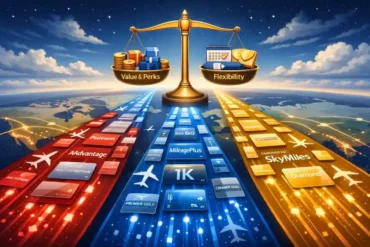
United is not acting in isolation. Across the U.S. airline industry, a similar pattern is unfolding. American Airlines and Delta Air Lines have already embraced spend-based models, with loyalty programs that allow members to achieve elite status without stepping onto an aircraft.
Delta’s SkyMiles program, for example, integrates credit card spending directly into status qualification. American’s AAdvantage system goes even further, removing minimum flight requirements entirely.
This convergence signals a broader truth: the definition of loyalty has shifted from travel frequency to revenue contribution.
Even outside the U.S., airlines are following suit. Programs like Air Canada’s Aeroplan and JetBlue’s TrueBlue operate on spend-based frameworks, while hybrid systems—like Alaska Airlines’—are becoming rare exceptions rather than the norm.
MileagePlus Credit Cards: The New Gatekeepers of Value
At the center of United’s strategy sits a portfolio of co-branded credit cards issued by Chase, each designed to pull travelers deeper into the ecosystem.
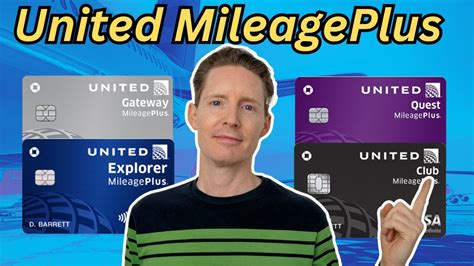
The lineup spans from entry-level to premium tiers, ensuring accessibility across different spending profiles. The United Gateway Card, with no annual fee, offers modest perks like inflight discounts and limited baggage benefits. It serves as an entry point—a low-friction way to begin earning enhanced miles.
Moving up, the United Explorer Card introduces tangible travel benefits, including free checked bags, priority boarding, and lounge passes. It bridges the gap between casual and committed travelers.
The United Quest Card and United Club Card escalate the offering significantly. With higher annual fees come travel credits, expanded baggage allowances, lounge access, and substantial partner benefits. At the top end, the Club Card effectively integrates the airline experience into a premium lifestyle product.

Business travelers are not left out. United’s business credit cards mirror many of the personal card benefits while targeting corporate spending patterns. The strategy is comprehensive—capturing both individual and organizational loyalty.
Elite Status Still Matters—But It’s Not Enough Alone
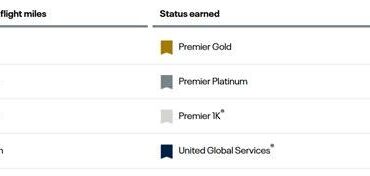
Despite the heavy emphasis on credit cards, Premier status tiers remain relevant. United continues to offer four levels—Silver, Gold, Platinum, and 1K—each with escalating benefits such as priority boarding, complimentary upgrades, and baggage allowances.
However, the pathway to these tiers reinforces the broader shift. Achieving status now requires a combination of Premier Qualifying Points (PQPs) and, optionally, Premier Qualifying Flights (PQFs). While flying still plays a role, spending carries increasing weight.
Notably, United maintains a minimum flight requirement—unlike some competitors. Members must complete at least four segments annually on United or United Express to qualify for Premier status. This preserves a thin connection to traditional loyalty, even as the system evolves.
Higher tiers unlock significant advantages, including PlusPoints, which can be used to secure upgrades into premium cabins. These benefits retain their allure, but their accessibility is increasingly tied to financial engagement rather than travel frequency alone.
The Psychological Shift: Loyalty as a Subscription Model
What makes MileagePlus particularly interesting is not just the mechanics, but the psychology behind it. The program now resembles a subscription ecosystem, where participation—and value—is tied to ongoing financial commitment.
Credit cardholders effectively “opt in” to a higher tier of benefits, similar to a premium membership model. The annual fee becomes a gateway to better earning rates, enhanced redemption options, and preferential treatment.
This reframing changes how travelers evaluate loyalty. Instead of asking, “How often do I fly?” the more relevant question becomes, “How deeply am I invested in this ecosystem?”
For frequent travelers, the answer may justify the cost. For occasional flyers, the equation becomes more complex—and potentially less rewarding.
Winners, Losers, and Strategic Trade-Offs
The new MileagePlus structure creates clear winners and losers. High-spending cardholders and elite members stand to gain the most, enjoying accelerated earnings, better redemption rates, and improved access to premium experiences.
Conversely, casual travelers and non-cardholders face diminishing returns. Lower earning rates, restricted benefits, and reduced redemption value make it harder to extract meaningful rewards without deeper financial engagement.
This bifurcation is intentional. By concentrating value among its most profitable customers, United maximizes revenue while encouraging others to upgrade their participation.
It’s a calculated trade-off—one that prioritizes profitability over inclusivity.
What This Means for the Future of Airline Loyalty
United’s overhaul is unlikely to be the final step. Instead, it signals the direction of travel for the entire industry. As airlines continue to refine their loyalty programs, expect further integration between financial products and travel experiences.
The line between airline and bank will continue to blur. Loyalty programs will function less as rewards systems and more as revenue platforms, designed to capture and retain high-value customers.
For travelers, adapting to this new reality requires a shift in strategy. Maximizing value now depends on understanding not just flight patterns, but also spending habits, card benefits, and redemption timing.
A New Era of Loyalty—Defined by Spending Power
United Airlines’ MileagePlus transformation encapsulates a broader evolution in how loyalty is defined and rewarded. What was once a straightforward exchange of miles for flights has become a layered system where financial engagement determines access, value, and experience.
The program is no longer simply about where you fly—it’s about how you spend, how you engage, and how deeply you commit to the ecosystem.
For some, this opens the door to richer rewards and premium travel opportunities. For others, it raises the barrier to entry, turning loyalty into something that must be actively bought rather than passively earned.
Either way, one thing is clear: the age of “pay-to-play” airline loyalty has fully arrived—and MileagePlus is leading the charge.