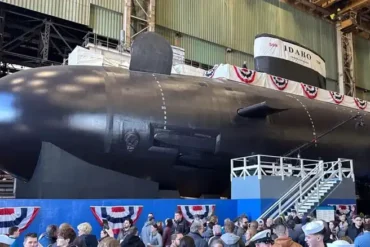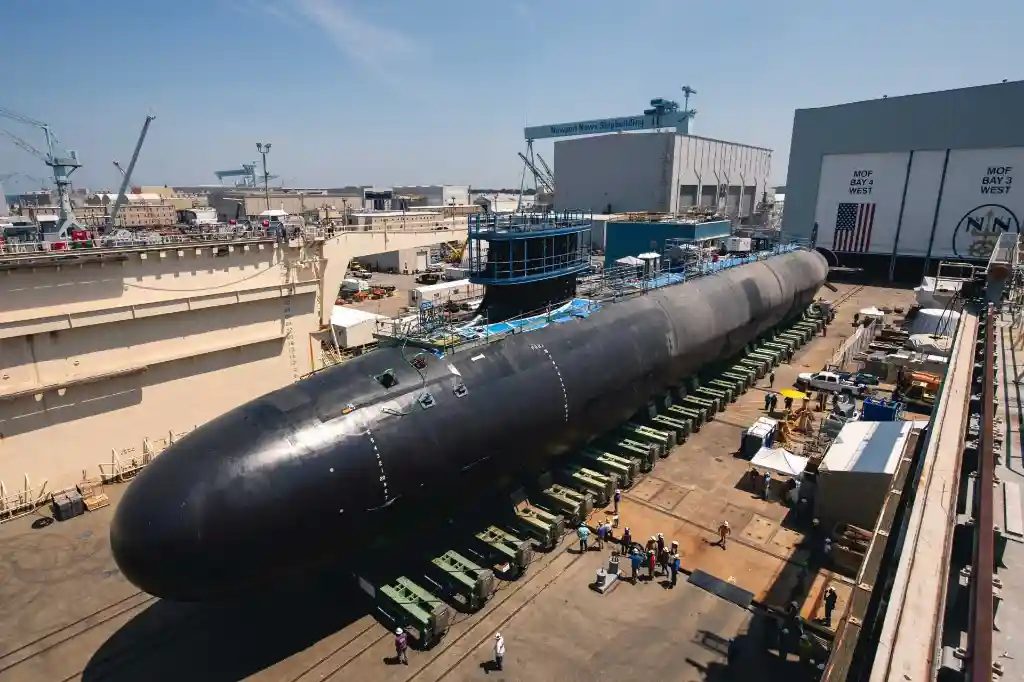
On July 2, 2025, a major milestone in U.S. naval modernization was achieved as Huntington Ingalls Industries (HII) launched the USS Arkansas (SSN 800), a Block IV Virginia-class attack submarine, into the James River. The move signifies a significant stride in the U.S. Navy’s long-term strategy to enhance stealth patrol readiness and operational availability across global maritime theaters.
Constructed at Newport News Shipbuilding (NNS), one of only two U.S. shipyards capable of building nuclear-powered submarines, the USS Arkansas marks the 27th submarine of its class and the 13th delivered by NNS. The vessel’s journey began with its order in April 2014, keel laying in November 2022, and christening in December 2024. Now afloat and in final outfitting stages, it is on track for commissioning in 2026, setting the stage for decades of strategic deployments.
Block IV: Redefining Undersea Readiness and Maintenance Cycles
The Block IV variant of the Virginia-class embodies critical evolutionary design improvements, with a sharp focus on reducing total lifecycle costs while improving mission availability. Designed for a 33-year service life, the USS Arkansas incorporates structural and technological refinements that allow it to execute 15 full-length deployments, up from 14 in previous blocks, by reducing major maintenance periods from four to three.
Each Block IV submarine maintains the class’s signature stealth, endurance, and versatility while introducing enhanced component durability and maintainability. These refinements make Block IV boats uniquely suited to the Navy’s demand for high-persistence undersea assets.
Technical Specifications and Propulsion Innovations
The USS Arkansas shares the fundamental dimensions of earlier Virginia-class submarines:
- Length: 377 feet
- Beam: 34 feet
- Submerged Displacement: Approx. 7,800 tons
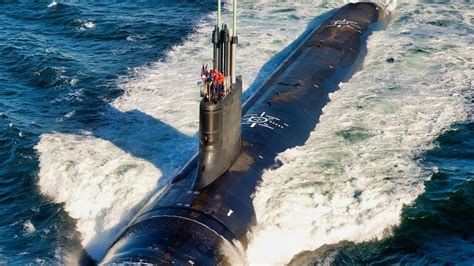
Propulsion is driven by the S9G nuclear reactor, paired with a pump-jet propulsor, enabling sustained submerged operations at speeds exceeding 25 knots and depths beyond 800 feet. A defining strength of the S9G reactor is its life-of-ship core, eliminating the need for mid-life refueling — a strategic advantage in both cost and deployment tempo.
Modular Construction and Industry Partnerships
The construction of the USS Arkansas underscores the dual-yard partnership between HII Newport News and General Dynamics Electric Boat (GDEB). In this arrangement, NNS is responsible for building the bow, sail, stern, torpedo room, and crew accommodations, while Electric Boat fabricates the control room and engine room. The two yards alternate final assembly and delivery roles.
A standout feature of Block IV’s construction is the continued use of pre-outfitted modules or “rafts,” pre-integrated with systems and equipment before installation into the pressure hull. This technique enhances production safety, efficiency, and cost control, and reflects the broader COTS (Commercial Off-The-Shelf) philosophy of the Virginia-class design ethos.
Advanced Armament Suite
The USS Arkansas is a formidable platform for undersea and surface warfare, thanks to a cutting-edge arsenal that includes:
- Two Virginia Payload Tubes (VPTs), each housing six Tomahawk cruise missiles
- Four 21-inch torpedo tubes supporting Mk-48 ADCAP torpedoes and UGM-84 Harpoon anti-ship missiles
- Capability to deploy mobile mines and unmanned undersea vehicles (UUVs)
- Support infrastructure for Advanced SEAL Delivery System (ASDS) and dry deck shelter for special operations forces
The Block IV design, while not featuring the Virginia Payload Module (VPM) of Block V, compensates by reorganizing its launch configuration to maintain tactical flexibility with up to 12 Tomahawk missiles — making it a potent asset for long-range precision strike missions.
State-of-the-Art Combat and Sensor Systems
Combat management on the USS Arkansas is powered by the AN/BYG-1 combat system, a highly integrated suite combining Tactical Control System (TCS) and Payload Control System (PCS). This core is supported by a next-generation fiber-optic fly-by-wire ship control system, granting increased maneuverability with reduced mechanical complexity.
The submarine boasts an impressive sensor suite:
- Large Aperture Bow (LAB) sonar array for passive detection
- Wide-aperture fiber-optic arrays along the hull
- High-frequency chin and sail-mounted sonar systems
- Low-cost conformal arrays
- Towed arrays (TB-16, TB-29, or TB-33) for long-range detection
- Electronic warfare via AN/BLQ-10 system
Traditional periscopes have been replaced by photonic masts, equipped with high-resolution cameras, IR sensors, and laser rangefinders, which transmit visual and electronic data directly to the control center via optical fibers — further relocating command operations away from traditional sail-centered configurations.
Strategic Role Amid Rising Global Tensions
As the Navy prepares to retire its Ohio-class SSGNs by 2028, the Virginia-class, and by extension the USS Arkansas, will serve as the backbone of undersea strike warfare. Although they carry fewer weapons than their SSGN predecessors, their stealth, mobility, and mission adaptability make them critical tools in contemporary and future maritime conflict environments.
The USS Arkansas will support covert intelligence, surveillance, and reconnaissance (ISR), anti-submarine warfare (ASW), sea denial, and special operations — all while evading detection through one of the most advanced stealth profiles in the world.
Addressing Production Bottlenecks and Industrial Expansion
Despite its success, the Virginia-class program has faced headwinds. Labor shortages, material delays, and infrastructure stress continue to challenge the U.S. shipbuilding industrial base. To mitigate these pressures, the U.S. Navy has issued long-lead procurement contracts to HII and GDEB, ensuring stability in the production of future Blocks — including Block VI and even potential Block VIII boats.
At present, the Navy maintains a two-submarine-per-year construction rate for Virginia-class vessels. This tempo is vital not only to replace aging Los Angeles-class boats but also to fulfill AUKUS alliance commitments. Under this trilateral defense agreement, Australia is expected to acquire up to five Virginia-class submarines starting in the early 2030s, solidifying U.S. geopolitical influence and industrial relevance in the Indo-Pacific.
Financial Implications and Deployment Projections
Each Block IV submarine, according to 2012 projections, costs approximately $2.6 billion, with annual operating costs estimated at $50 million. Over its three-decade lifespan, the USS Arkansas will complete 15 operational deployments, marking a significant boost to the Navy’s undersea presence.
While Block V introduces the Virginia Payload Module, expanding Tomahawk missile capacity to 65 weapons, Block IV boats serve as vital transitional platforms — sustaining strategic readiness as future configurations and the long-awaited SSN(X) program evolve.
Conclusion: USS Arkansas as a Force Multiplier
The launch of the USS Arkansas is not merely a ceremonial milestone; it is a deliberate, forward-looking investment in strategic deterrence, regional influence, and maritime dominance. In an age where contested waters and near-peer competitors pose rising threats, submarines like the Arkansas provide flexible, survivable, and lethal capabilities vital to preserving American interests at sea.
As it enters final outfitting and prepares for commissioning, the USS Arkansas stands as a symbol of industrial resilience, technological excellence, and the enduring necessity of undersea superiority in the evolving global order.