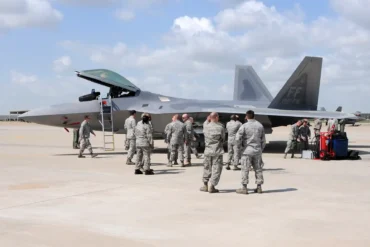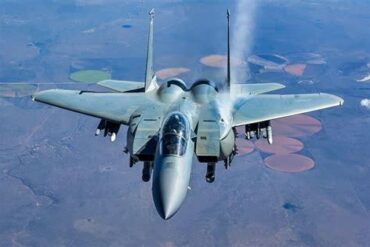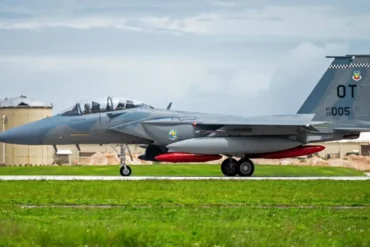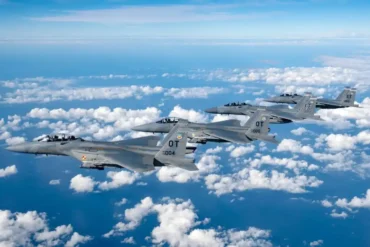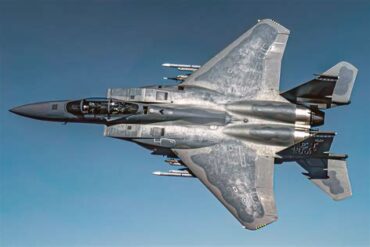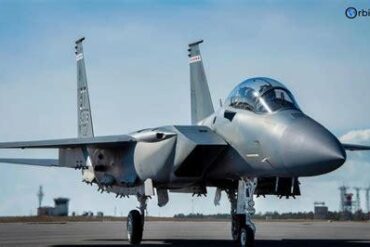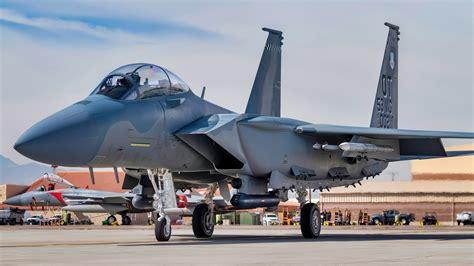
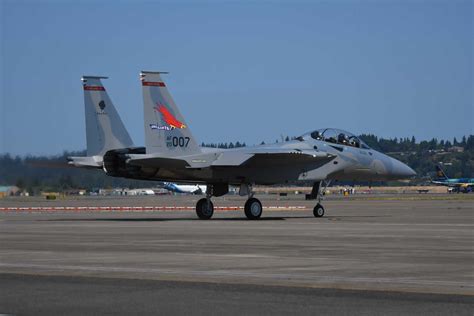
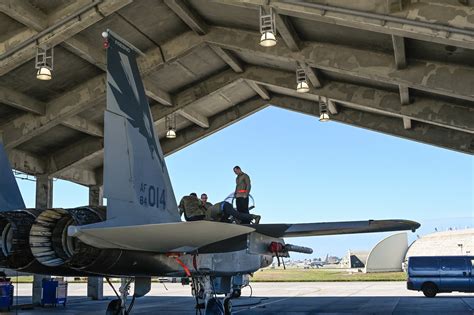
The F-15EX Eagle II is entering U.S. Air Force service in an unusual order. Instead of going first to an active-duty fighter wing, the newest version of the legendary Eagle was initially delivered to the Air National Guard. On July 12, 2024, Oregon’s 142nd Wing at Portland Air National Guard Base unveiled its first two operational F-15EXs, making it the first mission-ready F-15EX unit in the United States.
That decision represented a major break from traditional Air Force procurement practice. For decades, newly introduced combat aircraft generally flowed first to active-duty squadrons before eventually reaching Guard and Reserve formations. Yet this time, the Guard was placed at the front of the line, with units in Portland, Fresno, and New Orleans selected to replace aging F-15C/D Eagles.
The reason is not simply that the Air National Guard wanted the latest fighter. It is rooted in a much more immediate operational problem: the aircraft being replaced are among the most heavily relied-upon and increasingly worn-out fighters in the Air Force inventory. These Guard units perform homeland-defense missions that cannot simply be paused while an aging fleet reaches the end of its structural life.
The Air Force’s Aging F-15C/D Fleet Created an Urgent Problem
The F-15C/D has enjoyed an extraordinary career. Introduced during the Cold War and based on a design that first flew in 1972, the Eagle became one of the world’s most successful air-superiority fighters. Its operational record includes a remarkable 104-to-zero air-to-air combat record, achieved without an air-to-air loss.
But combat success does not stop metal from aging.
The F-15C/D fleet was originally designed around an expected service life of approximately 4,000 flight hours. Many aircraft eventually accumulated more than twice that amount. Decades of repeated takeoffs, landings, high-G maneuvers, supersonic flight, and other stresses gradually created structural fatigue throughout the fleet.
By the time replacement planning accelerated, the problem had become impossible to ignore. According to a November 2025 Air Force report to Congress, more than 75% of the remaining F-15C/D fleet was performance-limited. Depending on the aircraft, restrictions could affect maximum speed, allowable G-loading, or both.
For a conventional training fighter, such restrictions would already be troublesome. For an aircraft responsible for rapidly responding to unidentified aircraft approaching U.S. airspace, they become a much more serious operational concern.
The maintenance burden also increased as the original manufacturing ecosystem disappeared. With McDonnell Douglas no longer producing components for the legacy Eagle design, maintainers increasingly had to rely on cannibalization, removing usable parts from one aircraft to keep another operational.
The result was an uncomfortable contradiction. The Air Force still depended on the F-15C/D for critical missions, yet the aircraft performing those missions were becoming increasingly difficult to keep at full capability.
Why Homeland Defense Put Guard Squadrons at the Front of the Line
The most important clue to the F-15EX delivery sequence is the mission performed by these Guard units.
The 142nd Wing in Oregon operates the 123rd Fighter Squadron, known as the Redhawks. The squadron supports the Western Air Defense Sector and performs the air sovereignty mission for NORAD, maintaining the ability to identify and intercept aircraft entering or approaching U.S. airspace.
This is not a theoretical wartime assignment. Aircraft and crews have to be ready to respond to real-world situations.
The same logic applies to the 144th Fighter Wing in Fresno, California, which has performed an alert mission for the western continental United States for more than a decade. Louisiana’s 159th Fighter Wing, based at Naval Air Station Joint Reserve Base New Orleans, similarly maintains aircraft and crews for the defense of the Gulf Coast.
That operational requirement helps explain why the Guard became such an unusual priority for the F-15EX.
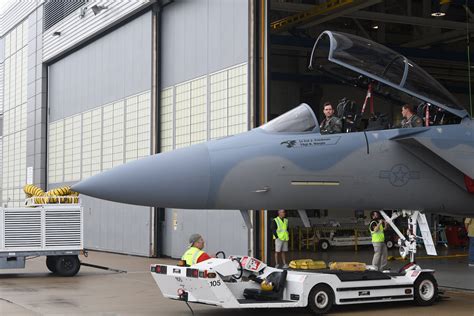
The homeland-defense mission does not necessarily demand the same characteristics as an air-superiority mission deep inside heavily contested enemy territory. An interceptor needs to get airborne, accelerate rapidly, reach an intercept position, detect and identify a target, and coordinate with the broader air-defense network.
Raw speed and availability therefore matter enormously.
When an aging F-15C is restricted because of structural fatigue, the aircraft may still be an impressive fighter, but it no longer provides the same performance margin it had when new. The F-15EX directly addresses that problem by providing a modern airframe with a dramatically longer structural life.
In other words, the Guard did not receive the Eagle II first simply because it was being rewarded with a new toy. It received the aircraft because the operational requirement was especially difficult to postpone.
What Makes the F-15EX Eagle II Different
The F-15EX is much more than a refurbished F-15C with updated electronics. Boeing built the Eagle II around a substantially modernized architecture intended to keep the aircraft relevant for decades.
One of its most important changes is digital fly-by-wire flight control. Unlike the older mechanically controlled Eagles, the F-15EX uses digital flight controls that improve how the aircraft responds to pilot inputs while providing a foundation for modern flight-control functions.
The cockpit is also thoroughly modernized, featuring a large digital display and glass-cockpit architecture that gives pilots access to considerably more information than the analog-heavy environments of earlier F-15 variants.
Perhaps even more important for the aircraft’s future is its Open Mission Systems architecture. This approach is designed to make future upgrades easier by allowing new software and capabilities to be integrated without requiring the entire aircraft to undergo a fundamental hardware redesign every time technology advances.
That matters because the F-15EX is expected to remain in service for decades. A fighter entering service today cannot simply depend on today’s sensors and weapons and expect to remain competitive throughout its career.
The Eagle II is therefore designed as a platform that can evolve.
F-15EX Radar and Electronic Warfare Give the Guard More Than Speed
The aircraft’s sensor suite is another major reason why the F-15EX makes sense for homeland defense.
The fighter is equipped with an AESA radar, providing improved detection, tracking, and multi-target engagement capabilities compared with the mechanically scanned systems associated with older Eagles. The radar’s technology lineage also connects to the advanced sensor developments associated with the F-22 Raptor.
For a homeland-defense squadron, this provides an important increase in situational awareness. An aircraft tasked with identifying an unknown contact needs to detect and track that contact reliably while maintaining awareness of other aircraft operating nearby.
The F-15EX also incorporates the Eagle Passive/Active Warning and Survivability System, or EPAWSS. The electronic-warfare suite provides capabilities intended to detect, identify, and respond to threats while improving the aircraft’s ability to survive in contested electromagnetic environments.
That is a major departure from simply replacing an old airframe with a new version of the same basic aircraft.
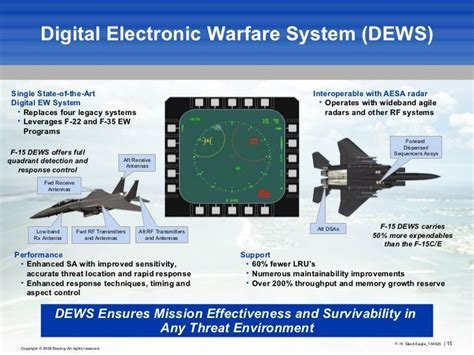
The Eagle II is also built around modern networking. Its ability to share information with other aircraft and command systems means it can contribute to a broader combat network rather than operating as an isolated interceptor.
That becomes particularly interesting when the F-15EX operates alongside fifth-generation fighters. The Eagle II does not need to possess the same low-observable characteristics as an F-35 or F-22 to contribute useful information. Its sensors can help generate and distribute targeting information while other platforms exploit that information from positions where their stealth characteristics provide an advantage.
The F-15EX Carries a Huge Weapons Load
Another defining characteristic of the Eagle II is its enormous weapons capacity.
The F-15EX adds two additional weapon stations, giving the aircraft up to 12 hardpoints and a payload capacity of approximately 29,500 pounds. That makes it one of the most heavily armed tactical aircraft in the U.S. inventory.
For an air-defense mission, the significance is straightforward. The aircraft can carry a large number of air-to-air missiles, including combinations of AIM-120 AMRAAM and AIM-9X weapons.
The large weapons capacity also gives the F-15EX potential value well beyond homeland defense. The aircraft can carry substantial air-to-ground weapons, including long-range weapons such as the JASSM cruise missile, giving commanders another option for delivering large numbers of weapons from a single aircraft.
This is one reason the Air Force increasingly views the Eagle II as a complementary platform rather than simply a replacement for the F-15C.
The F-35 brings stealth and advanced sensor fusion. The F-15EX brings speed, range, payload, weapons capacity, and a huge airframe capable of carrying substantial weapons and sensors. In a mixed fleet, those characteristics can complement one another.
A 20,000-Hour Airframe Changes the Replacement Equation
Perhaps the most compelling argument for the F-15EX in Guard service is hidden beneath its electronics and weapons.
The Eagle II has a rated service life of approximately 20,000 flight hours.
That figure is roughly five times the original design target of the F-15C and approximately double the service life commonly associated with an F-15C-class airframe. For an Air Force attempting to escape the cycle of repeatedly extending aging fighters, that durability has enormous value.
The Guard is particularly well positioned to benefit from this characteristic. Air National Guard units often operate aircraft for long periods, supporting national missions while maintaining a force structure that can be mobilized for major conflicts.
A modern airframe with decades of structural life therefore provides more than immediate capability. It offers long-term fleet stability.
Why Portland Was Chosen First for the F-15EX
The decision to make Portland the first operational F-15EX Guard base was not made at the last minute.
The 142nd Wing was identified as the preferred first operational F-15EX unit as early as 2020. Its location, existing mission, infrastructure, personnel, and established fighter operations made it a logical candidate.
The wing also benefited from its connection to the F-15EX training pipeline. Once instructors and maintainers were prepared to support the new aircraft, Portland could transition into operational service without having to build an entirely new fighter organization from scratch.
The result was the first operational F-15EX Guard unit in the country, with the 123rd Fighter Squadron beginning real-world operations with the aircraft in 2024.
Why Fresno and New Orleans Were Also Selected
Fresno’s selection reflected an equally important consideration: preserving an existing fighter capability and homeland-defense mission.
The 144th Fighter Wing was announced as a preferred F-15EX location in April 2023. The decision also carried significant local importance because the alternative could have involved relocating the wing to Naval Air Station Lemoore for F-35A operations.
Fresno’s leadership had spent more than a year advocating for the wing to remain in the city. The Air Force’s basing process considers mission requirements, infrastructure, cost, and community support, meaning local economic and political backing can become an important factor in a final decision.
Louisiana’s 159th Fighter Wing was selected around the same time and is slated to receive 18 F-15EX aircraft. Its location at Naval Air Station Joint Reserve Base New Orleans makes it strategically valuable for Gulf Coast air defense.
In all three cases, the Eagle II is fundamentally replacing an aging capability rather than creating an entirely new one.
The F-15EX Program Still Faces Questions
The decision to buy F-15EXs has never been free of controversy.
One of the central debates concerns whether the Air Force should purchase more F-35A Lightning IIs instead. Early in the F-15EX program, acquisition costs for the two aircraft were relatively close, while switching an existing F-15C unit to the F-15EX promised a much faster transition than converting that unit to the F-35.
The financial picture has since become more complicated. Early Boeing estimates placed the F-15EX flyaway price at roughly $80 million, while later production lots increased to approximately $90 million and then $97 million. Recent F-35A flyaway costs have generally been lower.
Critics argue that the F-15EX’s fourth-generation design makes it less suitable than a stealth fighter for some future high-end conflicts. Supporters counter that this misses the aircraft’s intended role.
The Eagle II does not need to replace the F-35. It can complement it.
Its large weapons load, long range, high speed, and substantial payload make it particularly attractive for missions where stealth is less important or where commanders need a heavily armed platform operating alongside stealth aircraft.
For homeland defense, the argument is even stronger. An interceptor responding to an unidentified aircraft over North America does not necessarily need to penetrate an advanced integrated air-defense system. It needs to be available, reliable, fast, well connected, and capable of carrying appropriate weapons.
The Guard’s F-15EX Lead Could Become a Model for Future Basing
The initial Guard-first rollout may prove more significant than it appears.
The Air Force is moving toward a fleet structure in which active-duty, Guard, and Reserve units increasingly operate modern aircraft together, rather than following a rigid hierarchy in which the newest systems automatically go to active-duty forces first.
The F-15EX illustrates why that approach can make operational sense. Guard units can have some of the most important day-to-day missions in the entire force, particularly when they maintain continuous homeland-defense alert status.
The transition will not be effortless. Training capacity remains a major constraint. Fresno’s F-15EX deliveries, for example, depend on expanding training capacity beyond Seymour Johnson Air Force Base. Until that happens, the Air Force has had to retain some of its best legacy F-15C/D aircraft.
The November 2025 force-structure report identified 21 particularly capable older Eagles as “Platinum” Eagles, allowing them to remain at Fresno through fiscal year 2031.
That decision captures the central challenge perfectly: the Air Force is trying to replace an aging fleet while simultaneously keeping that same fleet operational until enough new aircraft and trained personnel are available.
The F-15EX Is Arriving Where the Mission Is Hardest to Delay
The unusual decision to place Air National Guard units among the first F-15EX operators makes much more sense when viewed through the lens of mission urgency rather than organizational hierarchy.
Portland, Fresno, and New Orleans were operating aging F-15C/D aircraft while also carrying significant homeland-defense responsibilities. Their aircraft were increasingly affected by structural fatigue, yet their alert missions could not simply be suspended until a convenient replacement became available.
The F-15EX provides an unusually direct answer. It restores the performance margin that aging Eagles have lost, introduces modern radar and electronic warfare systems, dramatically expands weapons capacity, and provides an airframe rated for 20,000 flight hours.
That combination is particularly valuable to the Guard because these units are not merely preserving fighter traditions. They are part of the nation’s active air-defense architecture.
As the Air Force expands its F-15EX plans toward a much larger fleet, additional Guard, Reserve, and active-duty locations are expected to enter the picture. The Eagle II’s future will therefore extend far beyond Portland.
The most important lesson from its unusual introduction may be that the newest fighter does not always go where the newest organization is. Sometimes it goes where the operational clock is ticking loudest.
For the Air National Guard, that clock was already running.