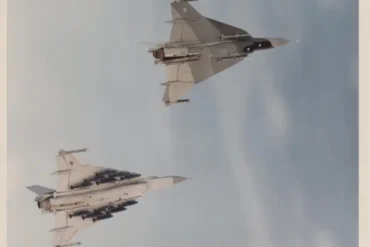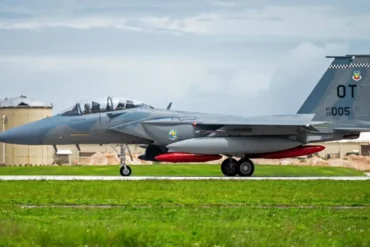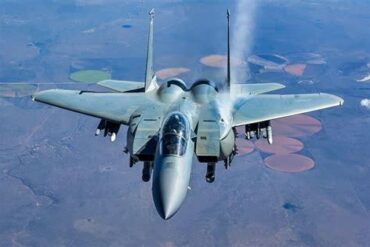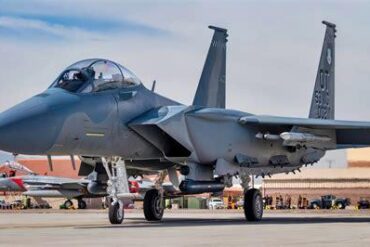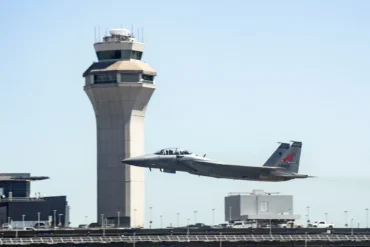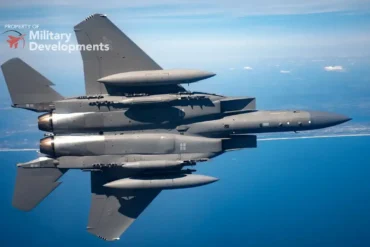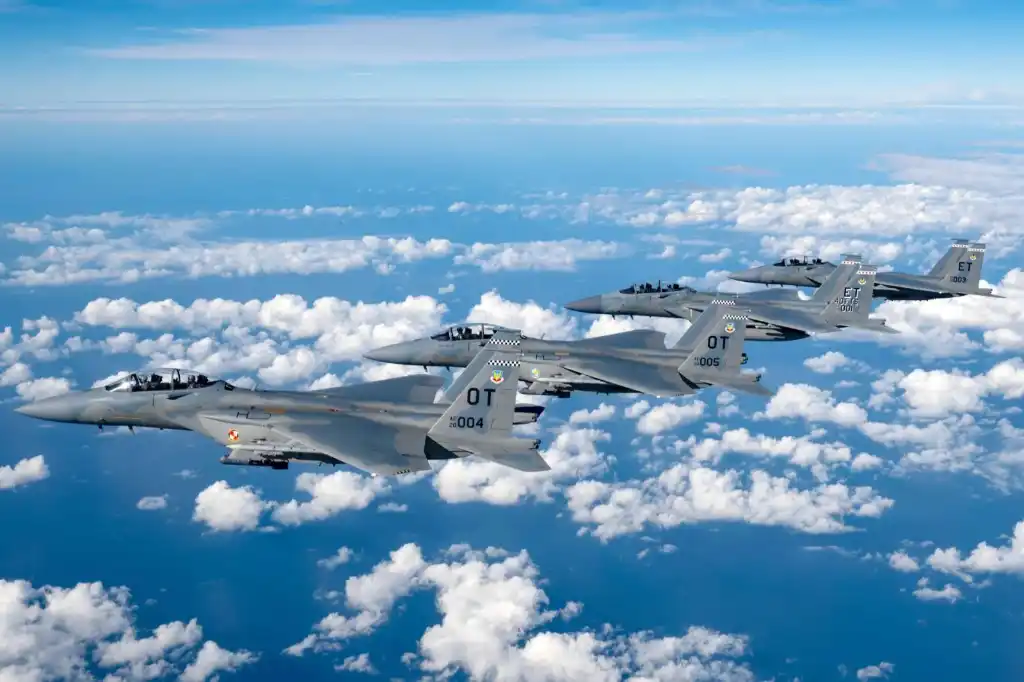
The F-15EX Eagle II has stepped decisively into the operational spotlight as four aircraft from Eglin Air Force Base executed a high-visibility demonstration over the Gulf of America, carrying Secretary of the Air Force Troy E. Meink in the rear cockpit of the lead jet. The flight, conducted on November 21 and publicly revealed four days later, signals a major transition point in the Eagle II’s journey from test article to frontline multirole combat asset. The sortie also marks a meaningful moment for U.S. airpower strategy, combining symbolic leadership presence with the practical validation of a platform designed to anchor American strike volume well into the 2030s.
A Defining Demonstration Over Strategic Waters
Flying over the Gulf of America—a region intertwined with critical energy infrastructure and essential commercial sea routes—the four-ship formation showcased advanced avionics, networked combat systems, and the raw payload capacity that distinguishes the Eagle II from its predecessors. The demonstration was far more than a ceremonial pass. It served as an integrated evaluation of systems performance, weapons employment tactics, and sortie-generation feasibility, all under the scrutiny of the Air Force’s top civilian official.
The presence of Secretary Meink underscores the platform’s rising strategic relevance. Washington has increasingly embraced a force mix pairing fifth-generation stealth jets with high-capacity non-stealth platforms capable of carrying larger missile arsenals. This week’s flight provided a tangible preview of that integrated combat model—stealth fighters penetrating contested zones and F-15EX units acting as heavily armed standoff “missile trucks,” ready to unleash salvos guided by networked targeting data.
A Next-Generation Evolution of the F-15 Legacy
The F-15EX Eagle II represents the culmination of decades of iterative engineering traced through the Advanced Eagle programs built for partners such as Saudi Arabia and Qatar. Its upgraded structural foundation is rated for an impressive 20,000 flight hours, a lifespan designed around sustained high-tempo operations. A fully digital fly-by-wire system replaces older mechanical linkages, while the open mission systems architecture ensures far more rapid integration of emerging technologies.
Central to the aircraft’s combat advantages are its advanced sensors. The AN/APG-82(V)1 AESA radar offers long-range detection and tracking across congested and contested airspace. The EPAWSS electronic warfare suite adds deep survivability, using digital techniques to counter airborne and surface threats while improving pilot situational awareness. With a payload capacity nearing 29,500 pounds and the ability to carry up to 12 air-to-air missiles, the Eagle II stands as one of the most heavily armed fighters in U.S. history.
These characteristics position the F-15EX not merely as a successor to aging F-15C/D airframes but as a transformational leap in the fighter’s role—from pure air superiority roots to a flexible platform capable of air dominance, stand-off strike, and battle-network support.
From Testing to Deployment: A Development Timeline Accelerating Toward Combat Readiness
The F-15EX development arc has progressed rapidly. Delivered to Eglin AFB in 2021, the first operational test airframes were immediately folded into combined developmental and operational test campaigns. These early trials validated weapons separation, avionics integration, and cross-platform connectivity with stealth aircraft. By mid-2024, the Oregon Air National Guard’s 142nd Wing achieved initial operational capability, marking the first real infusion of the Eagle II into homeland air defense missions.
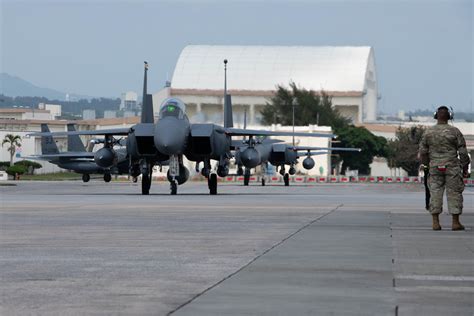
Forward deployment activities have since deepened the aircraft’s operational footprint. In July 2025, two F-15EX airframes traveled to Kadena Air Base in Japan, foreshadowing a rotational presence expected to reach up to 36 jets as they replace retiring F-15C/Ds. This shift contributes to the Indo-Pacific’s evolving deterrence posture, where sortie rate, range, and missile capacity are critical to countering regional threats.
Complementing Fifth-Generation Fighters in a Modernized Strike Ecosystem
The F-15EX’s operational niche emerges clearly when contrasted with the F-35 and F-22. While it lacks stealth characteristics, it compensates with endurance, simplicity of maintenance, acquisition cost efficiency, and sheer payload mass. In envisioned combat roles, stealth aircraft would act as forward sensors and targeting nodes, passing data to F-15EX formations stationed farther from high-threat zones. The Eagle II would then execute long-range missile releases or deploy heavy stand-off munitions such as JASSM or future hypersonic weapons.
This synergy creates a layered strike architecture: stealth aircraft shape the battlespace, and the Eagle II delivers volume—an approach that strengthens resilience and complicates adversary planning.
A New Backbone for U.S. Homeland and Indo-Pacific Posture
The Gulf of America demonstration reveals more than the aircraft’s operational maturity. It underscores its intended strategic positioning along the southern continental approaches, where air sovereignty and quick-reaction interception missions remain vital. National Guard units currently flying upgraded F-15C/Ds are slated to transition to the F-15EX by 2030, giving homeland defenders a modernized capability aligned with the threats of the next decade.
In parallel, Indo-Pacific force structure planning places the F-15EX at the front of massed-fires deterrence strategies. Its presence in Okinawa will ensure sustained sortie generation and regional reinforcement capacity during times of rapid escalation involving China or North Korea. Pentagon planning documents reflect a growing commitment: after initially planning for 98 airframes, the U.S. now aims for 120–130 units to meet global demand and preserve a competitive industrial base.
A Strategic Shift Takes Flight
This month’s demonstration confirms that the F-15EX has moved beyond conceptual diagrams and test data. It is now a fully realized operational platform with a defined strategic role in America’s evolving airpower architecture. By blending a proven airframe with next-generation avionics, open architecture, and unmatched payload potential, the Eagle II expands the U.S. Air Force’s options across both air-defense and strike missions.
The Gulf of America flight serves as a clear message: the future U.S. fighter force will not rely on stealth aircraft alone. It will integrate highly networked, heavily armed, fast-deploying platforms like the F-15EX—jets designed for the volume, flexibility, and industrial resilience needed in high-intensity conflict environments. Every rival and ally watching the Gulf demonstration understands that this expanded strike tier represents a fundamental shift in how the United States intends to project airpower in the decade ahead.