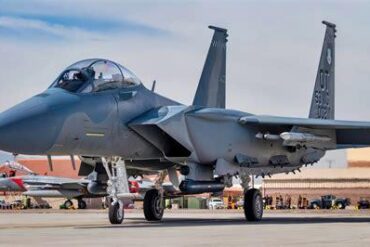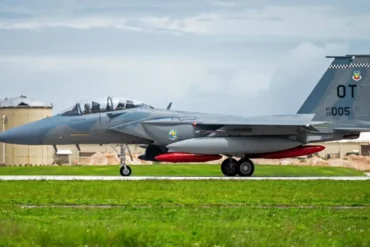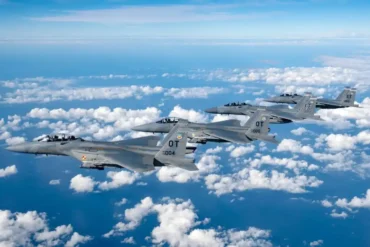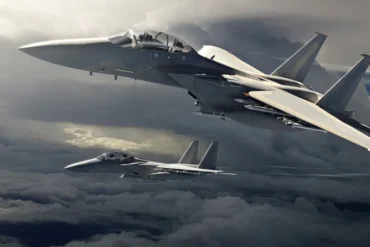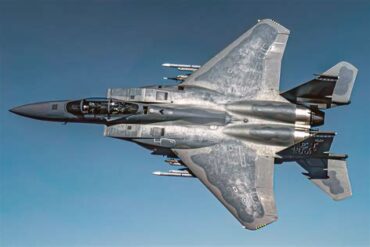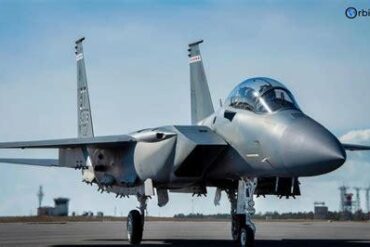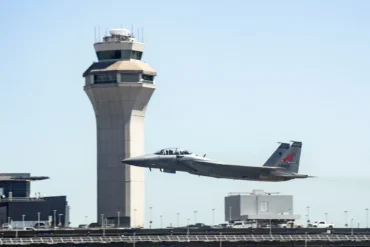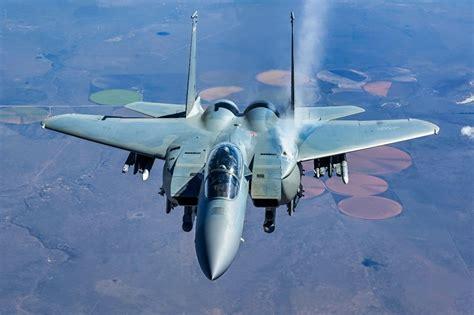
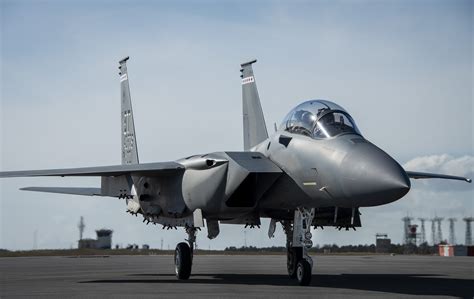
The decision by the United States Air Force to more than double its planned procurement of the F-15EX Eagle II is one of the clearest signs yet that modern air warfare is not solely about stealth. While fifth-generation fighters such as the F-35 Lightning II and the upcoming Next Generation Air Dominance (NGAD) program dominate headlines, the Air Force is quietly investing billions into a heavily upgraded fourth-generation aircraft whose origins stretch back to the Cold War.
That choice is not accidental. It reflects a harsh strategic reality facing the Pentagon: the United States needs more combat aircraft, more missile-carrying capacity, and more operational flexibility as tensions rise across the Indo-Pacific. In that environment, the F-15EX is no longer viewed as an aging legacy fighter. Instead, it has become one of the Air Force’s most practical answers to a rapidly expanding Chinese military presence.
The USAF’s planned acquisition has now surged from 129 aircraft to 267, a dramatic increase that signals long-term confidence in Boeing’s Eagle II platform. The aircraft is expected to remain operational well into the 2040s and possibly beyond, serving alongside stealth fighters rather than competing against them.
The move also highlights an uncomfortable truth about modern military procurement: stealth aircraft are extraordinarily capable, but they are expensive, maintenance-intensive, and not always optimized for every mission profile. The F-15EX fills many of those gaps with sheer payload capacity, range, speed, and operational endurance.
For military planners focused on deterring China in the Pacific, those traits matter enormously.
The Air Force’s Massive F-15EX Expansion Explained
The Air Force currently possesses roughly 25 F-15EX aircraft, but procurement is accelerating rapidly. Under the FY27 budget request, the service seeks another 24 aircraft for approximately $3 billion, part of a broader defense spending increase that could raise the USAF budget to $267.7 billion.
This procurement expansion is tied directly to concerns over force readiness and fleet size. For years, the Air Force has struggled with an aging fighter inventory while simultaneously trying to modernize around stealth platforms. The problem became increasingly severe as older airframes required more maintenance hours, more inspections, and more expensive repairs simply to remain mission capable.
The F-15EX provides a faster and lower-risk path toward rebuilding fighter numbers.
Unlike completely new aircraft programs, the Eagle II leverages an already mature production ecosystem. Pilots familiar with earlier F-15 variants can transition relatively quickly, maintenance crews already understand the aircraft architecture, and existing infrastructure can be adapted without massive investment.
That matters because the USAF wants to acquire approximately 72 new fighters annually, including both F-35As and F-15EXs. Air Force officials believe that production pace is necessary to reverse decades of shrinking fighter inventories.
Meanwhile, China is producing combat aircraft at extraordinary speed.
The rapid growth of the Chengdu J-20 stealth fighter fleet has become a major concern for Pentagon planners. Estimates suggest China could field over 1,000 J-20s by 2030, potentially reaching 1,500 aircraft by 2035. Chinese industrial output is now capable of producing advanced fighters at rates that challenge American manufacturing capacity.
That industrial reality changes the strategic equation. The United States no longer has the luxury of relying exclusively on smaller numbers of ultra-expensive stealth aircraft. Quantity, sustainability, and sortie generation are once again becoming critical components of deterrence.
Why The F-15EX Still Matters In The Age Of Stealth Fighters
At first glance, expanding procurement of a non-stealth fighter appears contradictory. The F-35 exists specifically to dominate contested airspace through low observability and advanced sensor fusion. So why would the Air Force double down on a platform derived from a 1970s fighter?
The answer lies in mission specialization.
The F-15EX is not intended to replace the F-35. It is designed to complement it.
Stealth aircraft excel at penetrating heavily defended airspace during the opening phases of conflict. They can destroy air defenses, gather intelligence, and strike high-value targets with minimal detection. But once those pathways are created, follow-on forces are needed to sustain operations at scale.
That is where the Eagle II becomes indispensable.
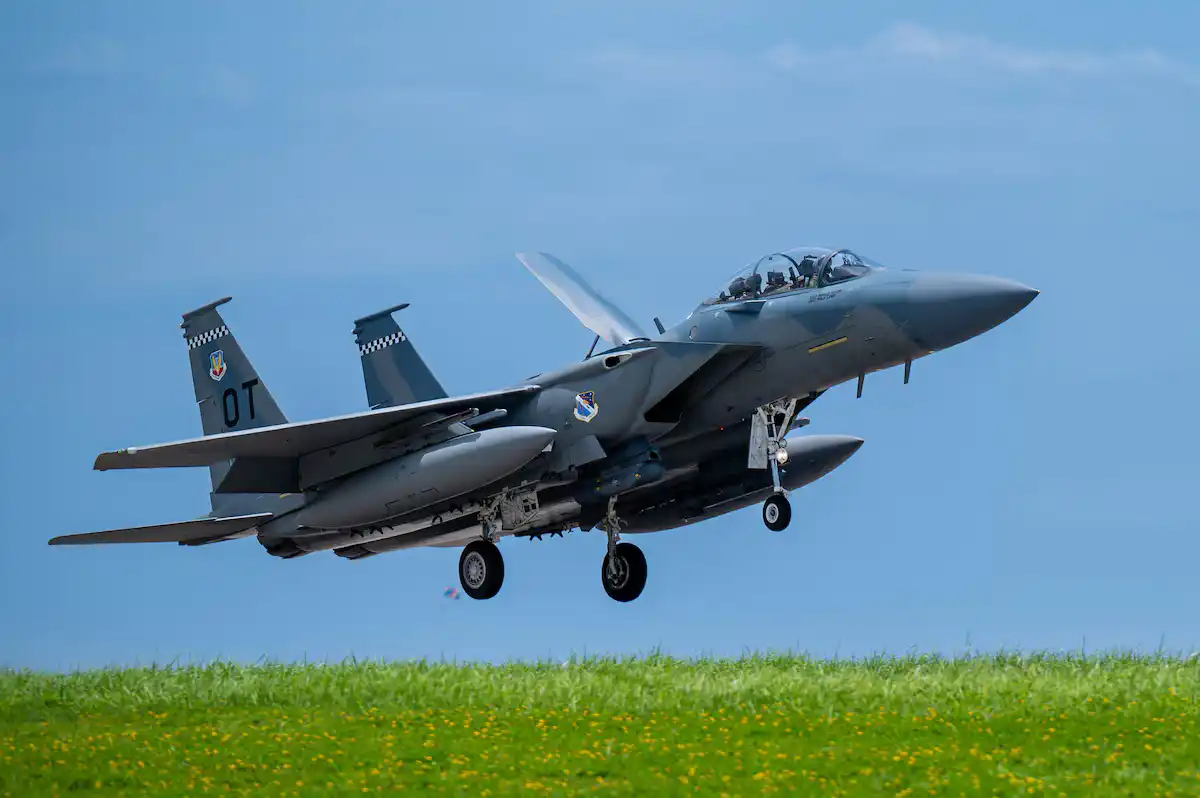
The F-15EX carries an astonishing 29,500-pound payload, making it the highest payload-capacity fighter currently in operational service. It can transport massive quantities of air-to-air missiles, precision-guided bombs, hypersonic weapons, and anti-ship missiles simultaneously.
This transforms the aircraft into what many analysts describe as a “missile truck.”
Instead of relying exclusively on stealth aircraft to carry limited internal weapons loads, the Air Force can use F-35s as forward sensors while F-15EXs remain farther back carrying enormous quantities of munitions. In practical terms, stealth fighters can identify and designate targets while Eagle IIs unleash large-scale missile strikes from safer stand-off distances.
That cooperative model significantly expands overall combat power.
Replacing An Aging Fighter Fleet Before It Breaks
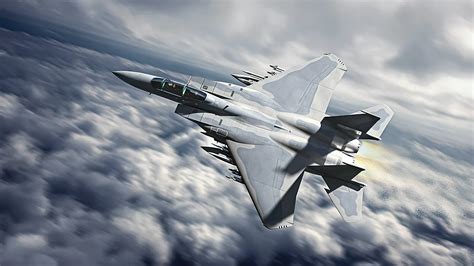
Another major driver behind the F-15EX expansion is the deteriorating condition of the Air Force’s older F-15C and F-15D fleets.
Many of these aircraft are now nearly four decades old. Structural fatigue, wiring degradation, corrosion, and obsolete components are increasingly difficult to manage. Some aircraft have exceeded their certified service life of 9,000 flight hours, forcing extensive inspections and repairs.
The Department of Defense has repeatedly warned that maintaining readiness targets for the older Eagles is becoming unsustainable.
Aircraft grounded for maintenance cannot contribute to deterrence. Worse, aging fleets consume resources that could otherwise be directed toward modernization.
The Eagle II solves that problem without forcing the Air Force into a total dependence on stealth fleets.
Importantly, the F-15EX also offers a projected service life exceeding 20,000 hours, dramatically longer than many existing tactical aircraft. That gives the USAF a durable platform capable of remaining relevant for decades.
The aircraft also integrates modern avionics, electronic warfare systems, fly-by-wire controls, and open mission architecture that allows rapid software and weapons upgrades.
In effect, the F-15EX combines the reliability of an established airframe with the digital backbone of a modern combat aircraft.
The Indo-Pacific Is Driving The Entire Strategy
The Air Force’s growing interest in the F-15EX cannot be separated from the broader strategic competition unfolding in the Indo-Pacific.
China’s military modernization campaign has accelerated at breathtaking speed over the past decade. The People’s Liberation Army Air Force and Navy are fielding advanced destroyers, long-range missiles, stealth fighters, and carrier strike groups designed specifically to challenge American power projection.
Chinese operations around Taiwan, the South China Sea, and near Japanese territory have become increasingly aggressive. Naval patrols now extend deeper into the Pacific, while large-scale exercises regularly test regional responses.
One particularly notable deployment occurred in 2025 when a Chinese naval task force circumnavigated Australia while conducting live-fire exercises in the Tasman Sea. The operation demonstrated not only growing Chinese naval confidence, but also Beijing’s willingness to project military power far from its mainland coastline.
For Washington and its regional allies, these developments demand credible military responses.
The F-15EX is becoming a central part of that answer.
The Air Force has already begun preparing Kadena Air Base in Okinawa for the aircraft’s permanent arrival. Eventually, 36 Eagle IIs are expected to operate from the strategically vital installation.
Kadena sits within the First Island Chain, one of the most important geographic barriers in the Western Pacific. From there, American aircraft can rapidly respond to crises involving Taiwan, the East China Sea, or contested maritime regions.
Deploying F-15EXs to Okinawa significantly strengthens America’s ability to sustain airpower close to potential flashpoints.
The LRASM Missile Turns The F-15EX Into A Naval Threat
One of the most important aspects of the Eagle II’s Indo-Pacific mission is its integration with the AGM-158C Long Range Anti-Ship Missile (LRASM).
This missile fundamentally changes the aircraft’s operational role.
Developed by Lockheed Martin, the LRASM was specifically designed for contested maritime warfare. It possesses a range of roughly 200 nautical miles, carries a powerful 1,000-pound warhead, and incorporates advanced autonomous targeting systems capable of identifying and attacking enemy warships even in heavily jammed environments.
The missile’s survivability features are especially important in a future Pacific conflict where electronic warfare and long-range air defenses would dominate the battlefield.
When combined with the F-15EX’s payload capacity and conformal fuel tanks, the result is a formidable maritime strike platform capable of patrolling enormous sections of ocean.
This creates major complications for Chinese naval planners.
An F-15EX formation carrying multiple LRASMs can threaten surface combatants across wide operational areas while remaining supported by tanker aircraft and allied airbases throughout the Pacific theater.
The aircraft’s sheer weapons load also means fewer sorties may be needed to achieve significant combat effects. That efficiency matters enormously in high-intensity warfare where logistics and sortie generation become decisive.
Additionally, using F-15EXs for maritime strike missions frees stealth platforms like the F-35 to focus on penetrating missions, intelligence gathering, and suppression of enemy air defenses.
The division of labor enhances overall force effectiveness.
The F-15EX Is Also About Affordability And Readiness
Despite its advanced systems, the F-15EX remains significantly cheaper to operate than many stealth aircraft.
While exact operating costs vary depending on mission profiles, the Eagle II benefits from decades of logistical maturity and established maintenance practices. The aircraft does not require the same level of stealth coating maintenance or specialized infrastructure demanded by fifth-generation fighters.
That translates into higher operational availability and potentially faster sortie generation rates during prolonged conflicts.
The Air Force understands that future wars may not be short.
In a sustained Pacific conflict involving massive distances and high attrition rates, the ability to rapidly regenerate combat power could become more valuable than possessing a smaller fleet of highly sophisticated but maintenance-heavy stealth jets.
The F-15EX therefore represents a practical balancing act between technological sophistication and wartime sustainability.
It is modern enough to survive and contribute in advanced combat environments while remaining affordable enough to acquire in meaningful numbers.
America’s Fighter Strategy Is Becoming A Hybrid Model
The expansion of the F-15EX fleet reflects a broader transformation in American airpower doctrine.
For years, defense discussions centered around stealth as the singular future of aerial warfare. The assumption was that older fighter concepts would gradually disappear as fifth-generation aircraft dominated every mission category.
That assumption is now evolving.
Instead of replacing every aircraft with stealth platforms, the Air Force is building a layered force structure where different aircraft specialize in different mission sets.
Stealth fighters penetrate defended zones. Bombers conduct deep strategic strikes. Drone swarms provide reconnaissance and attrition capabilities. Meanwhile, aircraft like the F-15EX deliver overwhelming missile capacity, air superiority support, and maritime strike firepower.
This hybrid approach acknowledges both strategic and economic realities.
The United States faces simultaneous challenges involving China, Russia, and multiple regional flashpoints. Building enough fifth-generation aircraft to handle every contingency alone would be extraordinarily expensive and operationally risky.
The F-15EX helps close that gap.
Far from being obsolete, the Eagle II is emerging as one of the most important bridge platforms in the Air Force’s future combat ecosystem.
The F-15EX Could Become One Of America’s Most Important Pacific Warfighters
The Air Force’s decision to double its F-15EX order is ultimately about preparing for the demands of large-scale conflict in the Indo-Pacific.
The Eagle II delivers exactly what military planners increasingly need: range, payload, reliability, affordability, and rapid fielding capacity. It complements stealth aircraft instead of competing with them, creating a more resilient and flexible combat force.
As China continues expanding its military reach, the Pentagon appears increasingly convinced that winning future conflicts will require more than stealth alone. It will require depth, sustainability, and the ability to generate overwhelming firepower across vast distances.
The F-15EX was once viewed by critics as a relic of an earlier era. Today, it is becoming one of the defining aircraft of America’s next-generation Pacific strategy.
And judging by the Air Force’s rapidly expanding procurement plans, the Eagle still has plenty of fight left in it.