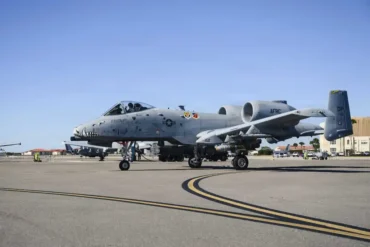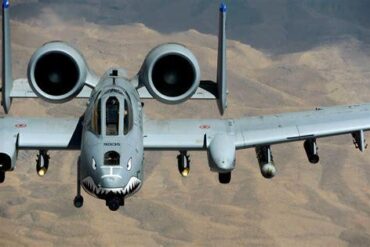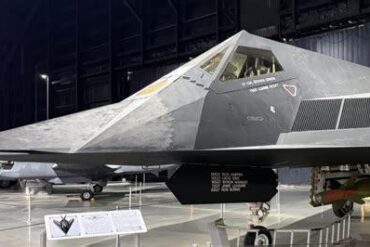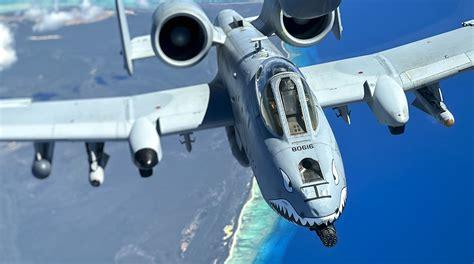
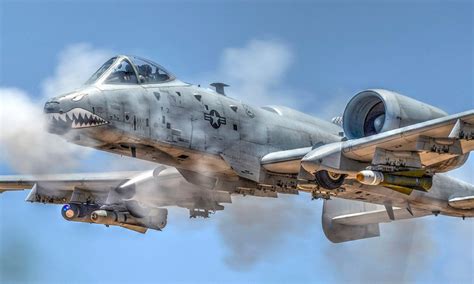
The Fairchild Republic A-10 Thunderbolt II, better known as the Warthog, has spent decades earning an unmatched reputation as one of the world’s most recognizable close air support aircraft. Built around its devastating GAU-8/A Avenger 30mm cannon, the aircraft became synonymous with low-altitude attacks, battlefield survivability, and unwavering support for troops on the ground. Yet despite its legendary status, the U.S. Air Force has repeatedly attempted to retire the aircraft since the very year production ended.
Rather than marking a dramatic reversal of policy, the decision to retain 54 A-10 Warthogs following Operation Epic Fury reflects a carefully calculated compromise between operational necessity, congressional oversight, and military modernization. The aircraft is no longer viewed as the centerpiece of American close air support doctrine. Instead, it has evolved into a specialized platform capable of filling limited but valuable missions while the Air Force transitions toward next-generation combat systems.
The continued presence of the Warthog therefore says less about nostalgia and more about changing military priorities. Although only three squadrons are expected to remain active through roughly 2030, these aircraft continue to provide capabilities that newer fighters cannot always replicate efficiently.
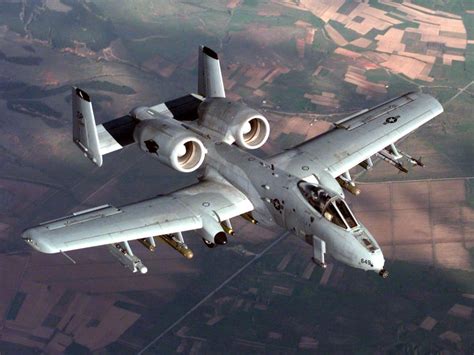
The Origins of the A-10 Warthog Trace Back to an Inter-Service Rivalry
Understanding why the A-10 still exists requires looking far beyond the aircraft itself. Its history is deeply rooted in the post-World War II struggle between the newly independent U.S. Air Force and the U.S. Army over who would control battlefield aviation.
Following the creation of the independent Air Force in 1947, nearly all Army fixed-wing aviation assets were transferred to the new service. The 1948 Key West Agreement attempted to define responsibilities by allowing the Army to retain helicopters while assigning fixed-wing tactical aviation primarily to the Air Force.
This division quickly became controversial as helicopter technology matured.
During the 1960s, Lockheed developed the revolutionary AH-56 Cheyenne, an attack helicopter capable of speeds approaching those of some fixed-wing aircraft. Its impressive performance alarmed Air Force leadership because it appeared capable of performing traditional close air support missions that the Air Force considered its own responsibility.
Political opposition, technical setbacks, and shifting defense priorities eventually led to the cancellation of the Cheyenne program. The Army later pursued a more conventional design that ultimately became the AH-64 Apache, a helicopter specifically designed to avoid reigniting the inter-service conflict.
Ironically, by insisting that close air support remained an Air Force responsibility, Air Force leadership strengthened the argument for developing a dedicated fixed-wing attack aircraft. That aircraft became the A-10 Thunderbolt II.
Designed for the Fulda Gap and a War That Never Came
The A-10 emerged during the Cold War with an exceptionally focused mission.
NATO planners believed that if war erupted in Europe, Soviet armored divisions would likely surge through the Fulda Gap in West Germany—a relatively flat corridor considered the most likely invasion route into Western Europe.
Everything about the A-10 reflected that single mission.
Unlike sleek fighters optimized for speed, the Warthog prioritized survivability, firepower, and endurance. Engineers literally designed the aircraft around the enormous GAU-8 Avenger cannon before building the rest of the airframe around the weapon.
Its distinctive characteristics included:
- A titanium armored cockpit, often called the “bathtub,” capable of protecting pilots from heavy ground fire.
- Twin high-mounted engines positioned to reduce infrared signature and improve survivability.
- Redundant flight control systems that allowed the aircraft to continue flying after sustaining severe battle damage.
- Long loiter times, enabling extended support for friendly ground forces.
- Excellent low-speed handling, allowing pilots to identify and engage enemy vehicles with remarkable precision.
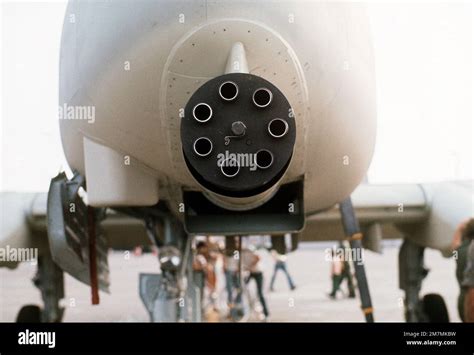
The expectation was never that the A-10 would avoid enemy fire. Instead, designers assumed it would absorb punishment while destroying Soviet armored formations advancing into Western Europe.
Combat Experience Changed How the Warthog Was Used
Although originally intended as a tank killer, real-world combat demonstrated that the A-10’s strengths extended well beyond its famous cannon.
During Operation Desert Storm in 1991, the aircraft destroyed significant numbers of Iraqi armored vehicles. However, many of these kills came through precision-guided missiles rather than repeated gun attacks.
This distinction proved important.
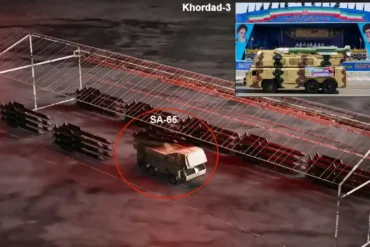
Flying low enough to employ the cannon effectively often exposed the aircraft to anti-aircraft artillery and surface-to-air missiles. Even against Iraq’s comparatively dated air defenses, dozens of A-10s suffered combat damage, while several aircraft were lost entirely.
These experiences gradually shifted tactical doctrine.
Instead of relying primarily on repeated strafing runs, pilots increasingly used guided weapons from safer stand-off distances whenever possible. The aircraft remained highly effective, but combat revealed that even the famously rugged Warthog possessed clear vulnerabilities against modern air defense systems.
Why the Air Force Wanted to Retire the A-10 for Decades
Despite widespread public admiration, the Air Force has consistently argued that maintaining the A-10 diverts funding from higher-priority capabilities.
Its concerns extend well beyond maintenance costs.
Modern warfare increasingly emphasizes operations against technologically advanced adversaries equipped with:
- Integrated air defense systems
- Mobile surface-to-air missiles
- Long-range radar networks
- Electronic warfare capabilities
- Advanced fighter aircraft
In such environments, slow-flying aircraft operating at low altitude become exceptionally vulnerable.
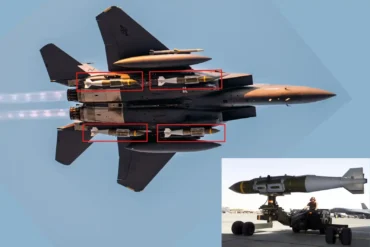
Meanwhile, multirole fighters such as the F-35A Lightning II, F-15EX Eagle II, and future F-47 platforms can deliver precision weapons from significantly greater distances while operating inside complex sensor networks.
The Air Force therefore views future close air support as a mission performed through integrated systems rather than dedicated attack aircraft.
Operation Epic Fury Highlighted Valuable Niche Capabilities
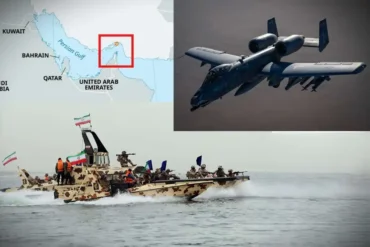
Although the A-10 is no longer considered suitable for penetrating heavily defended battlefields, Operation Epic Fury demonstrated that it continues to excel in several specialized missions.
Rather than leading attacks against sophisticated enemy defenses, the aircraft supported broader operations by engaging targets in relatively permissive environments.
Its missions reportedly included attacking:
- Armed militant positions
- Small maritime vessels
- Fast attack boats
- Support targets during combat search-and-rescue operations
These scenarios allowed the aircraft to exploit its strengths without exposing it to the full threat posed by integrated modern air defenses.
The operation also reinforced another emerging role.
Recent upgrades have enabled the A-10 to contribute to counter-drone operations, an increasingly important mission as inexpensive unmanned aerial systems proliferate across modern battlefields.
This represents a significant evolution from the aircraft’s original Cold War purpose.
Why Exactly 54 Warthogs Will Remain
The planned retention of 54 aircraft is closely tied to force structure rather than renewed enthusiasm for the platform.
Instead of preserving the entire fleet, the Air Force intends to maintain only three operational squadrons, each equipped with approximately 18 aircraft.
The proposed structure includes:
- One active-duty squadron at Moody Air Force Base, Georgia
- One active-duty squadron at Whiteman Air Force Base, Missouri
- One reserve squadron at Whiteman Air Force Base
This arrangement provides sufficient aircraft for limited operational requirements while dramatically reducing maintenance costs compared to sustaining the larger fleet.
Current planning anticipates:
| Fiscal Year | Planned Inventory |
|---|---|
| 2026 | 103 |
| 2027 | 54 |
| 2028 | 54 |
| 2029 | 36 |
| 2030 | 0 |
Although congressional approval ultimately determines retirement schedules, the long-term direction remains unchanged.
Congress Has Slowed the Retirement Process
One reason the A-10 continues flying is congressional oversight.
Lawmakers have repeatedly resisted rapid retirement proposals, arguing that eliminating the aircraft too quickly could create gaps in close air support capability before replacement systems are fully operational.
Congress has therefore favored gradual reductions that allow:
- Pilot retraining
- Maintenance workforce transition
- Operational testing of replacement concepts
- Budget stability
- Preservation of combat capability during modernization
The resulting compromise explains why retirement has stretched across multiple fiscal years instead of occurring all at once.
The Future Battlefield Leaves Little Room for Traditional Tank Busting
The romantic image of A-10s charging across the battlefield while firing thousands of 30mm rounds remains popular, but modern warfare has changed dramatically.
Recent conflicts have demonstrated the increasing lethality of portable air-defense systems, mobile missile launchers, and networked surveillance.
Aircraft operating at low altitude face threats from multiple directions simultaneously.
Even Russia’s Su-25 Frogfoot, an aircraft often compared with the A-10, has experienced substantial losses during high-intensity combat, forcing changes in operational tactics that increasingly favor stand-off weapons instead of repeated low-level attack runs.
Consequently, future close air support is expected to rely on interconnected capabilities that include:
- Fifth-generation fighters
- Collaborative Combat Aircraft (CCA)
- Precision-guided stand-off weapons
- Armed drones
- Long-range artillery
- Real-time battlefield networking
Within this framework, no single aircraft is expected to replace the Warthog directly.
Instead, multiple systems will collectively perform missions once handled by dedicated attack aircraft.
The Warthog’s Legacy Will Outlast Its Retirement
Few military aircraft have inspired the level of loyalty enjoyed by the A-10 Thunderbolt II.
Its unmistakable silhouette, enormous cannon, battlefield resilience, and close relationship with ground troops transformed it into a symbol of American close air support. Veterans frequently credit the aircraft with saving lives during conflicts in Iraq and Afghanistan, where permissive airspace allowed it to operate exactly as originally intended.
Nevertheless, sentiment alone cannot determine force structure.
The strategic environment facing the United States increasingly centers on competition with technologically sophisticated adversaries capable of denying access to traditional low-altitude attack aircraft. Investing in survivable next-generation systems therefore takes precedence over extending the service life of aging platforms indefinitely.
Keeping 54 A-10 Warthogs in service after Operation Epic Fury does not represent a reversal of Air Force modernization. Instead, it reflects a pragmatic recognition that the aircraft still delivers meaningful value in carefully selected missions while newer capabilities mature.
As retirement gradually approaches around 2030, the Warthog’s final years will likely showcase an aircraft adapting one last time—transitioning from Cold War tank hunter to specialized support platform. Its legendary reputation was forged by meeting the demands of one era. Its remaining service demonstrates an equally important lesson: even iconic aircraft must evolve alongside the changing character of war.