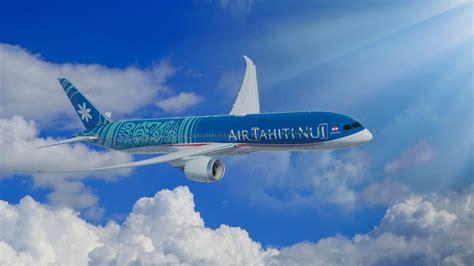
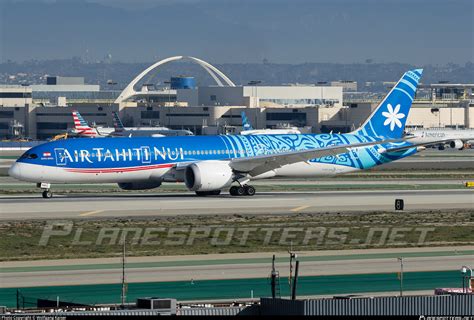
French Polynesia’s boutique international carrier Air Tahiti Nui is preparing to reconnect Tahiti with Australia in a move that marks the airline’s return to the market after nearly two decades. The airline has confirmed that it will relaunch nonstop flights between Papeete and Sydney using its modern Boeing 787-9 Dreamliner fleet, restoring a long-absent link between the islands of the South Pacific and one of the region’s busiest aviation gateways.
The revival is scheduled to begin December 14, when the airline’s distinctive blue-and-white widebody jets once again touch down at Sydney Kingsford Smith Airport (SYD). The service will operate twice weekly from Papeete’s Faa’a International Airport (PPT), providing Australian travelers with a direct connection to Tahiti and strengthening the airline’s modest yet strategic network across Oceania.
The decision reflects a renewed push by Air Tahiti Nui to expand its reach beyond traditional markets in North America, Europe, and Asia. With Sydney returning to the map, the airline deepens its presence in the South Pacific region where tourism flows and cultural ties have been steadily growing.
A Long-Awaited Return To Australia
Air Tahiti Nui’s previous flights between Tahiti and Sydney disappeared from schedules in 2009, leaving Australian travelers to reach the islands via connecting flights in New Zealand or other regional hubs. The reintroduction of the route restores a direct corridor that once served as a vital bridge between French Polynesia and Australia’s eastern seaboard.
The new schedule has been carefully structured to fit international aviation seasons defined by the International Air Transport Association (IATA). Flights departing Papeete will leave at 12:10 pm local time, arriving in Sydney the following day. Arrival times will vary slightly depending on the season, landing at 5:45 pm during the IATA winter season and 5:00 pm during the summer period.
Return flights from Sydney will depart in the evening, either 8:10 pm in winter or 7:10 pm in summer, touching down in Papeete early the same morning. Because the aircraft crosses the International Date Line, the return journey appears to travel backward in time, arriving on the same calendar day it departed.
For travelers, the route delivers a straightforward journey across the vast Pacific without requiring detours through intermediate hubs.
Strengthening Oceania Connections
The Sydney relaunch is not an isolated expansion. Air Tahiti Nui already maintains twice-weekly flights between Papeete and Auckland, making New Zealand its existing foothold in Oceania. Together, the Auckland and Sydney routes create a triangular network that links Tahiti with the two largest aviation markets in the southwestern Pacific.
According to Air Tahiti Nui Chief Executive Officer Lionel Guérin, the strategy is about both accessibility and collaboration.
“With two direct flights per week and our codeshare agreement with Qantas, this service offers Australian travelers greater comfort and additional frequencies,” he noted when confirming the route’s return.
That partnership with Qantas allows passengers arriving in Sydney to connect onward across Australia’s extensive domestic network, turning the Tahiti service into a practical gateway for travelers from cities such as Melbourne, Brisbane, and Perth.
Flying The Pacific On The Boeing 787 Dreamliner
Air Tahiti Nui’s modern fleet is central to the route’s revival. The airline now operates four Boeing 787-9 Dreamliners, each averaging around seven years in age. These aircraft replaced the airline’s earlier Airbus A340-200 and A340-300 quadjets, completing a fleet transformation that finished in 2019.
The Boeing 787-9 is well suited to the airline’s network. Its long range and improved fuel efficiency allow carriers with relatively small fleets to operate distant routes economically while offering a noticeably quieter and smoother cabin environment.
Inside the aircraft, Air Tahiti Nui has installed a three-class configuration accommodating 294 passengers, balancing premium comfort with high-density economy seating for leisure travelers heading to Tahiti’s beaches and lagoons.
Inside Air Tahiti Nui’s Three-Class Cabin
The most exclusive section of the aircraft is the “Poevara” business class cabin, which features 30 fully flat seats arranged in a 2-2-2 staggered layout. Unlike many angled business seats on older aircraft, these beds are oriented toward the windows, offering a more private and scenic experience for passengers flying overnight across the Pacific.
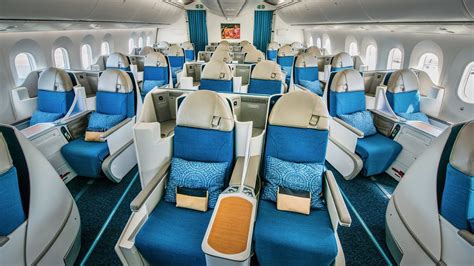
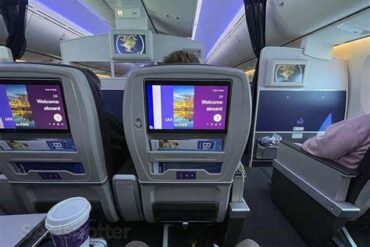
Travelers seeking enhanced comfort without committing to business-class fares can choose the airline’s “Moana” premium economy cabin. This section includes 32 reclining seats arranged in a 2-3-2 layout, delivering extra legroom, wider seats, and upgraded dining options compared with standard economy.
The largest cabin onboard is Moana economy, where 232 passengers are seated in the familiar 3-3-3 configuration typical of the Dreamliner. Although denser than premium cabins, the 787’s improved air pressure and humidity levels help reduce fatigue during long transoceanic journeys.
A Route With A Unique Aviation History
The last time Air Tahiti Nui operated regular Sydney flights, the airline relied on the Airbus A340-300, a four-engine widebody that was once common on ultra-long routes but has largely vanished from modern airline fleets.
Historical schedule data shows that in January 2009, the airline operated nine round trips between Tahiti and Sydney. The frequency quickly declined to four monthly round trips in February and March, before the route quietly ended with a single flight in April 2009.
Those A340 aircraft carried 296 passengers in a two-class layout, consisting of 32 business-class seats and 264 in economy. While capable aircraft for their time, the four-engine jets were significantly less fuel-efficient than today’s twin-engine Dreamliners.
A Strategic Comeback For A Boutique Airline
For a relatively small carrier with just four aircraft, every new route represents a strategic calculation. The return to Sydney signals that Air Tahiti Nui believes demand between Australia and French Polynesia is strong enough to sustain direct flights once again.
Tourism trends support that view. Australian travelers have increasingly sought out remote island destinations across the Pacific, and Tahiti’s reputation for turquoise lagoons, coral reefs, and luxury overwater resorts continues to attract international visitors.
With the Boeing 787 Dreamliner now powering the journey, Air Tahiti Nui’s comeback to Australia blends modern aircraft technology with a revived route that once faded from the map. After seventeen years of absence, the airline’s distinctive flower-branded jets will again bridge Tahiti and Sydney—reopening a Pacific connection that many travelers thought had quietly vanished.