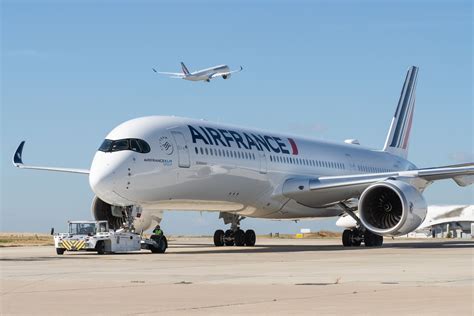
Air France’s deployment of the Boeing 787 Dreamliner in 2025 illustrates a network strategy built on precision, efficiency, and a keen understanding of global demand patterns. The aircraft’s versatility makes it a core element of the airline’s long-haul structure, allowing balanced growth across multiple continents. Its operational presence extends from North America to Asia, Africa, and South America, creating a finely tuned structure that supports both premium and leisure travel. The Boeing 787’s continued prominence within the Air France fleet reflects both economic logic and customer-centered design, positioning the aircraft as a reliable workhorse for medium- to long-haul operations.
The airline’s global reach continues to evolve out of Paris Charles de Gaulle (CDG), an airport central to European and intercontinental connectivity. The 2025 network sustains extensive transatlantic and transpacific links, along with vital connections to Africa and South America. What emerges is a long-haul map shaped by frequency depth and geographic precision.
In North America, the Dreamliner connects CDG with destinations such as Montreal, New York, Atlanta, and Minneapolis, bolstering joint-venture coordination with Delta Air Lines and satisfying strong business demand across the Atlantic. In Asia, key hubs including Beijing, Tokyo, Singapore, and Osaka continue to receive consistent long-haul service. Africa remains a central component of Air France’s long-haul footprint as well, with Nairobi, Zanzibar, Cairo, and Johannesburg shaping a robust intercontinental presence. Meanwhile, Buenos Aires and Mexico City strengthen the airline’s South American reach, rounding out a diverse long-range portfolio aligned with global travel flows.
This vast network is supported by a carefully optimized fleet strategy. Ultra-long-haul services rely primarily on the Airbus A350 and Boeing 777, while the Boeing 787-9 fills a distinctive niche bridging high-frequency intercontinental sectors and thinner long-range markets. Equipped with 279 seats across Business Class, Premium Economy, and Economy, the Dreamliner balances premium offerings with operational efficiency. Its long range and modest capacity make it ideal for routes where demand fluctuates but profitability remains critical.
The Dreamliner As A Mid-Capacity Long-Haul Workhorse
The Boeing 787-9 sits at the intersection of technical sophistication and flexible deployment. Its fuel-efficient design, composite structure, and optimized aerodynamics allow Air France to operate competitively on routes that require agility rather than maximum density. While the Airbus A330 supports certain mid-range transoceanic services, the 787 remains the preferred choice for markets demanding higher premium content and consistent reliability.
Air France’s cabin layout reflects this balance. With 30 Business Class seats, 21 Premium Economy seats, and 228 Economy seats, the aircraft provides a wide-ranging product mix suitable for both corporate travelers and leisure passengers. The Dreamliner’s quiet cabin, advanced humidity control, and improved pressurization also enhance passenger comfort, aligning with the carrier’s brand positioning.
In 2025, routes such as Paris–Montreal, Paris–Beijing, and Paris–Osaka showcase the aircraft’s ability to manage varying market sizes while maintaining efficiency. Emerging markets such as Nairobi and Buenos Aires further demonstrate the Dreamliner’s role as a strategic asset capable of supporting network expansion.
Paris–Montreal: The Most Frequently Operated Boeing 787 Route
According to flight data from Cirium, the most frequently operated Boeing 787 route for the airline in 2025 is the Paris–Montreal segment. With 373 flights scheduled in each direction, Air France generates more than 358 million available seat miles annually on this pairing.
The route’s consistent business traffic, strong leisure appeal, and manageable stage length make it ideally suited for the Dreamliner. Its performance characteristics ensure high utilization rates, and the balanced demand profile aligns perfectly with the aircraft’s capacity.
High-Frequency Long-Haul Operations Across Asia And Africa
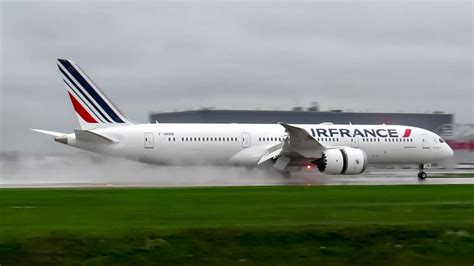
Following Montreal, Beijing Capital International Airport (PEK) and Nairobi’s Jomo Kenyatta International Airport (NBO) rank among the next most frequently served destinations. Each receives more than 200 annual Boeing 787 flights in each direction.
Beijing continues to anchor Air France’s presence in northern Asia, requiring a mix of premium seating and long-range capability. Nairobi, on the other hand, represents a fast-growing African hub, linking France with one of the continent’s most significant aviation markets.
Additional Asian and African cities—including Cairo (CAI), Singapore (SIN), and Osaka (KIX)—receive between 150 and 190 Dreamliner flights annually. Each destination benefits from the aircraft’s mid-capacity structure, which suits markets where year-round demand supports frequency but not the density of a Boeing 777 or Airbus A350.
South American And Secondary North American Deployments
South America remains a unique long-haul region for Air France, with Buenos Aires (EZE) receiving a comparable number of Dreamliner operations. The route’s distance and premium-heavy demand make the Boeing 787 a natural fit, avoiding excess capacity while offering consistent long-haul comfort.
In the United States, Minneapolis–St. Paul (MSP) and Denver (DEN) showcase the Dreamliner’s role in secondary markets. These routes highlight the aircraft’s ability to serve important transatlantic connections without requiring the extra seating found on the airline’s larger aircraft types.
Capacity, Distance, And Network Patterns
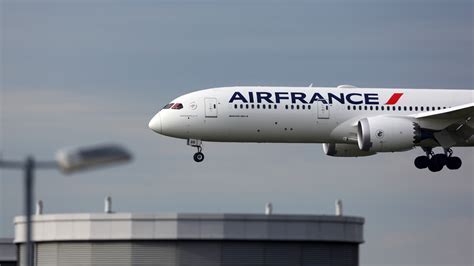
Air France’s Dreamliner network reflects a deliberate operational pattern built around route length and demand stability. In 2025, the airline’s Boeing 787 routes generally fall between 3,000 and 7,000 miles, aligning with the aircraft’s ideal operating range. Annual seat counts per route vary from approximately 10,000 to over 100,000, depending on frequency, seasonality, and local demand patterns.
Medium-range routes such as Montreal, Nairobi, and Cairo benefit from year-round stability and strong utilization rates. Meanwhile, longer flights—such as those to Singapore, Osaka, and Buenos Aires—highlight the aircraft’s efficiency on distances exceeding 6,000 miles. The Dreamliner’s engineering supports consistent performance on these extended segments, ensuring the airline can maintain profitability even in markets where demand fluctuates.
Notably, Air France avoids deploying the Boeing 787 on ultra-long-haul routes, despite the aircraft’s ability to fly more than 8,500 miles. Instead, it reserves such missions for the Airbus A350, whose larger capacity and advanced design suit extremely long routes demanding a higher seat count. This illustrates Air France’s clear fleet segmentation strategy and optimal asset allocation based on route characteristics.
Comparison With Competing European Carriers
Air France’s Boeing 787 deployment differs notably from those of British Airways and Lufthansa. While these competitors tend to centralize their Dreamliner fleets on high-yield trunk routes—London–New York or Frankfurt–Singapore—Air France disperses its aircraft more widely.
Its strategy mirrors that of KLM, although with different geographic emphasis. KLM’s Dreamliner network leans more heavily into trans-American and Asia–Pacific travel flows. Air France instead spreads its aircraft across North America, Africa, and Asia with a more balanced footprint.
The Dreamliner is not Air France’s flagship model. Its primary role is to serve as a flexible connector between long-range premium markets and mid-demand intercontinental routes. It works in tandem with the A350 and 777, providing the right-size capacity that supports network stability throughout seasonal and economic cycles.
The Broader Implications Of Boeing 787 Deployment
The airline’s Boeing 787 route strategy symbolizes a broader shift toward data-driven decision-making and operational precision. By aligning aircraft capabilities with the specific needs of each destination, Air France maximizes productivity while minimizing risk.
The Dreamliner’s flexibility allows the airline to bridge gaps between medium-haul trunk routes and thinner long-range markets. Its efficiency supports both sustainability targets and financial resilience, reflecting a commitment to responsible growth.
On a strategic level, assigning the Dreamliner to markets that fall between the A330 and A350 size categories enables the airline to tailor capacity with fine-grained accuracy. This ensures continuity during fluctuating travel demand while maintaining premium service standards.
As Air France continues to strengthen its global network, the Boeing 787 remains central to maintaining competitive advantage. Its ability to serve diverse markets—from Montreal to Beijing, from Nairobi to Buenos Aires—cements its position as a core element of the airline’s 2025 fleet plan.
The Dreamliner’s contribution extends beyond operational efficiency. It reinforces Air France’s identity as a long-haul carrier capable of balancing commercial logic with customer experience, offering a modern cabin environment that meets evolving traveler expectations.
Across all continents, the Boeing 787 Dreamliner stands as an embodiment of Air France’s disciplined yet dynamic global vision, shaping its intercontinental structure for the year 2025 and beyond.