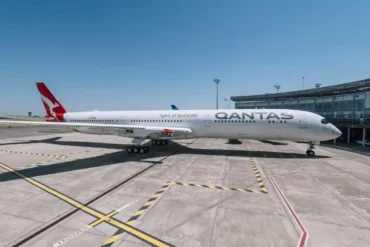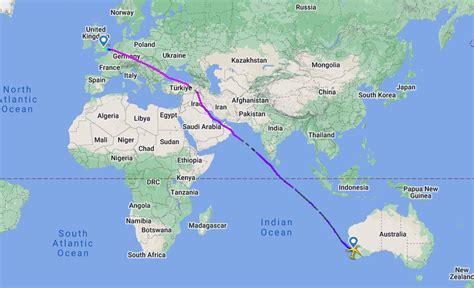
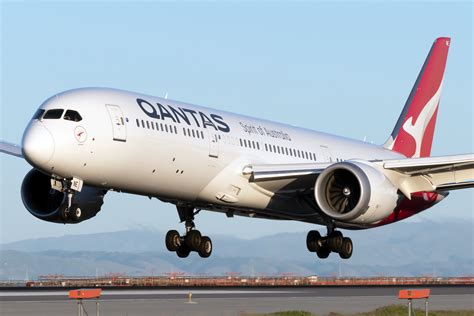
Qantas has long positioned itself as a pioneer in ultra-long-haul aviation, and nowhere is this more evident than in its flagship non-stop Perth to London Heathrow route. Stretching nearly 9,000 miles and served daily by the Boeing 787-9 Dreamliner, this route not only holds the title for Qantas’ longest flight, but also for its most frequently operated 787 sector. With the Dreamliner’s advanced technology and Qantas’ premium-focused cabin configuration, this intercontinental service has become a defining symbol of endurance, luxury, and strategic route planning.
A Transcontinental Leap: The Numbers Behind the Route
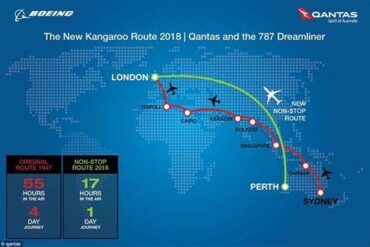
Launched in March 2018, the QF9/QF10 service has evolved into a cornerstone of Qantas’ international network. Covering 8,988 miles (14,465 km), the journey from Perth (PER) to London Heathrow (LHR) typically lasts just over 17 hours eastbound, with the return westbound leg pushing beyond 16 hours.
Flight QF9 departs Perth at 7:15 PM, touching down in London at 5:05 AM the following day, while QF10 makes the reverse journey at 11:50 AM, landing in Perth by 12:30 PM the next afternoon. These carefully chosen timings maximize connectivity on both ends, particularly targeting European and domestic Australian feeder traffic.
This strategic route design, combined with the Dreamliner’s fuel efficiency and performance, enables Qantas to maintain daily service, making it the most frequently operated 787 route in its schedule. As per Cirium’s December 2025 data, Qantas scheduled 502 Dreamliner flights, down slightly from 512 in December 2024 — yet QF9/QF10 remains untouched in its daily consistency.
Dreamliner of the Skies: Inside the Aircraft
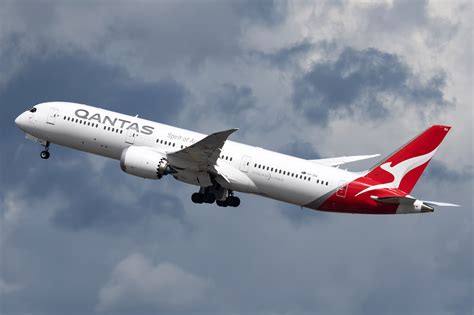
The Boeing 787-9 Dreamliner used on this ultra-long-haul route is tailored for endurance and passenger comfort. Qantas’ configuration of the aircraft, as per aeroLOPA, reflects a deliberate lean towards premium travel, offering a total of 236 seats:
- 42 Business Class flatbeds designed for long-haul luxury
- 28 Premium Economy recliners with additional space and enhanced service
- 166 Economy Class seats with optimized legroom and ergonomic support
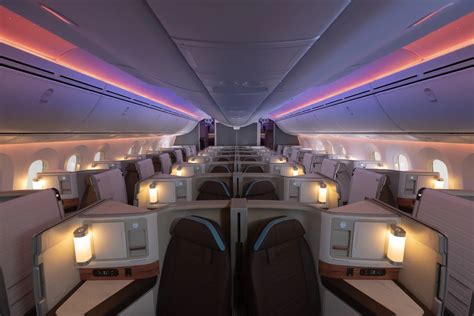
This layout ensures a balance between profitability and comfort — crucial for routes where passengers are onboard for nearly an entire day. At the route’s launch, Qantas Group CEO Alan Joyce highlighted the Dreamliner’s game-changing features: reduced jet lag, minimized turbulence, and quieter cabins, all of which are amplified by Qantas’ own cabin innovations.
Strategic Value: Why Perth–London Matters So Much
This is more than just a flagship route — it is a strategic bridge linking Australia directly with Europe, bypassing traditional stopovers in Asia or the Middle East. It significantly shortens total travel time and removes transfer headaches.
Moreover, Perth’s position on Australia’s west coast makes it uniquely suited for these Europe-bound flights, offering operational efficiency in fuel load, crew rotations, and maintenance scheduling. For Qantas, this route is not just a triumph of engineering, but a commercial advantage in the high-stakes market of long-haul air travel.
Beyond London: Qantas’ Other 787 Workhorses
While Perth–London dominates in frequency and distance, Qantas leverages its fleet of 14 787-9 Dreamliners across several other high-value routes. These include:
- Melbourne (MEL) – Dallas/Fort Worth (DFW): 24 flights monthly
- Melbourne – Los Angeles (LAX): 22 outbound, 24 inbound
- Sydney (SYD) – New York JFK via Auckland (AKL): 21 flights in each direction
- Brisbane (BNE) – Los Angeles (LAX): 39 total flights (20 outbound, 19 inbound)
- Brisbane – Auckland: A shorter but capacity-driven route
These routes exemplify the versatility of the Dreamliner, with operations tailored to balance long-haul range and market demand. While not all operate daily, they serve critical international gateways, many of which are key hubs for oneworld partners, such as American Airlines in the U.S.
Domestic Distance: Perth–Sydney’s Frequent Flyer Status
Interestingly, the second most frequent 787 route is not international, but domestic. The Perth–Sydney corridor, covering 2,041 miles (3,285 km), sees 17 westbound and 18 eastbound flights this month. Though a shorter segment, its strategic use of the Dreamliner indicates strong premium demand and scheduling convenience, as widebody aircraft offer additional cargo capacity and schedule flexibility on busy transcontinental routes.
To the Edge of the World: Sydney–Santiago
Rounding out the Dreamliner’s most frequent routes is the transpacific trek from Sydney to Santiago (SCL) in Chile — a 7,061-mile (11,364 km) odyssey that operates four times weekly. Often flying near Antarctica, this service underscores the Dreamliner’s resilience and endurance, navigating remote oceanic airspace with minimal diversion options. It is one of the most isolated scheduled passenger flights in the world.
Its unique flight path also highlights Qantas’ ambition to strengthen ties between South America and Australia, offering Australians a direct link to the Southern Cone and beyond, in collaboration with LATAM and other regional partners.
Looking Ahead: Expansion and Modernization
Qantas is not resting on its laurels. The airline has four additional 787-9s and eight 787-10s on order, indicating that the Dreamliner fleet will play an even more central role in the years to come. These aircraft will enable route expansion and increased frequency on high-performing sectors, reinforcing Qantas’ commitment to long-haul leadership.
While Project Sunrise — the initiative to launch direct flights from Sydney to London and New York using Airbus A350-1000s — is on the horizon, the 787-9 remains the workhorse of Qantas’ ultra-long-haul strategy. Until those next-gen routes debut, the Perth–London Dreamliner service continues to stand as the ultimate embodiment of distance, demand, and design.
Conclusion: Where Frequency Meets Endurance
Qantas’ Perth–London route aboard the Boeing 787-9 Dreamliner represents a masterclass in operational excellence, passenger comfort, and strategic foresight. As the longest and most frequent 787 service in the airline’s network, it is more than just a flight — it’s a statement of what’s possible when innovation meets vision at 35,000 feet.