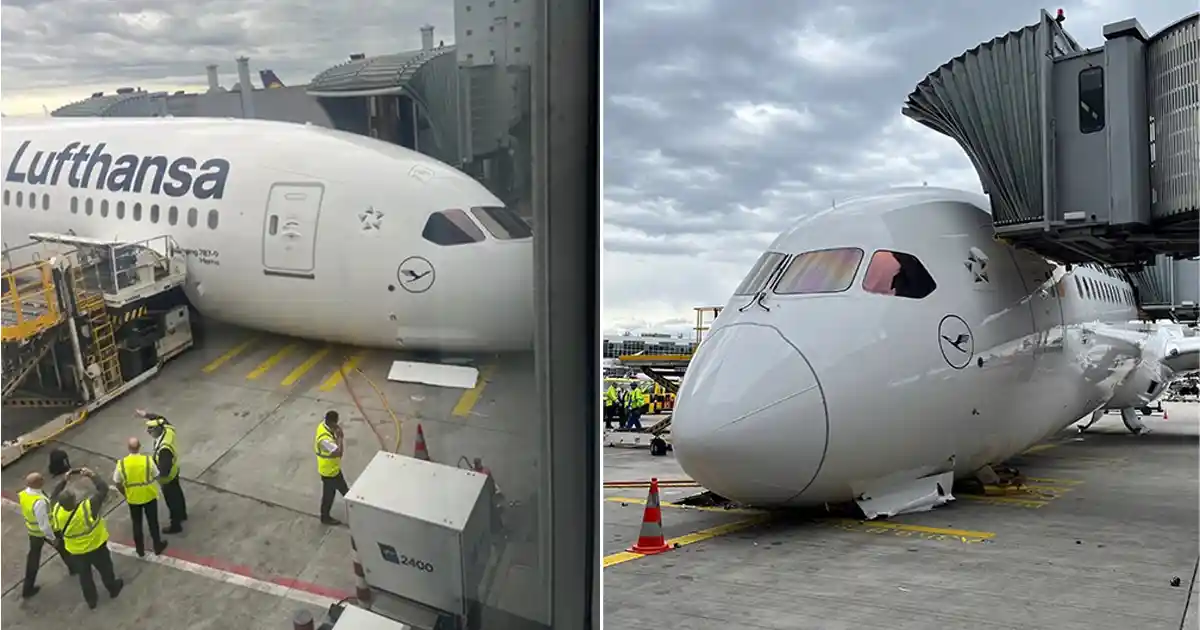
On June 4, a nearly new Lufthansa Boeing 787-9 Dreamliner suffered a dramatic nose gear collapse at Frankfurt Airport, reigniting discussion across the aviation industry about a remarkably similar incident involving a British Airways Boeing 787 almost five years earlier. While investigators have yet to determine the cause of the Lufthansa event, the parallels between the two accidents have inevitably drawn attention to the Dreamliner’s nose landing gear system and the maintenance procedures surrounding it.
Lufthansa Dreamliner Nose Gear Collapse Grounds Los Angeles Flight
The incident occurred at Frankfurt Airport as Lufthansa flight LH450 was being prepared for departure to Los Angeles International Airport. The aircraft involved, registration D-ABPQ and named “Herne,” had only entered commercial service four months earlier after being delivered in January 2026.
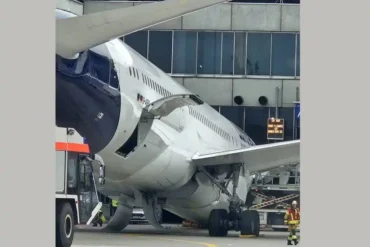
Ground crews were carrying out routine pre-departure activities when the aircraft’s nose landing gear unexpectedly retracted, causing the front section of the Boeing 787-9 to drop abruptly onto the tarmac. Several employees reportedly sustained injuries and required medical attention, although no passengers were onboard at the time because boarding had not yet begun.
The sudden collapse immediately halted preparations for the transatlantic flight, forcing Lufthansa to cancel the service and reaccommodate travelers onto alternative flights. Technical teams quickly secured the area and began assessing the extent of the damage to the aircraft’s forward fuselage and landing gear assembly.
For passengers waiting inside the terminal, the incident unfolded in full view. Images and videos rapidly circulated online, showing the Dreamliner resting nose-down on the airport apron while emergency and maintenance personnel surrounded the aircraft.
A Modern Dreamliner With Minimal Service History
What makes the Frankfurt incident particularly striking is the age of the aircraft involved. D-ABPQ was delivered to Lufthansa on January 17, 2026, making it one of the newest widebody aircraft in the airline’s fleet.
Configured with 28 Business Class seats, 28 Premium Economy seats, and 231 Economy seats, the aircraft was designed to carry 287 passengers on long-haul international routes. Powered by two Rolls-Royce Trent 1000 engines, it represented one of Lufthansa’s newest-generation assets intended to support the carrier’s growing intercontinental network.
Because of the aircraft’s limited operational history, investigators are expected to closely examine maintenance procedures, ground handling activities, and any recent work performed on the nose landing gear system before the collapse occurred.
The aircraft will likely remain out of service for an extended period while engineers assess structural damage and complete the complex recovery process required to safely lift the aircraft’s nose from the ground.
The British Airways Dreamliner Accident That Mirrors Frankfurt
The Frankfurt event immediately reminded aviation observers of a nearly identical occurrence involving a British Airways Boeing 787-8 Dreamliner at London Heathrow Airport on January 18, 2021.
That aircraft, registration G-ZBJB, experienced an unexpected nose landing gear retraction while parked at a remote stand. Like the Lufthansa event, the aircraft was stationary when the incident occurred, and the collapse caused the front section of the fuselage to strike the ground.
Minor injuries were reported, including injuries to a co-pilot and a cargo loading crew member. The damage to the aircraft appeared severe enough that some observers initially questioned whether the Dreamliner would ever return to service.
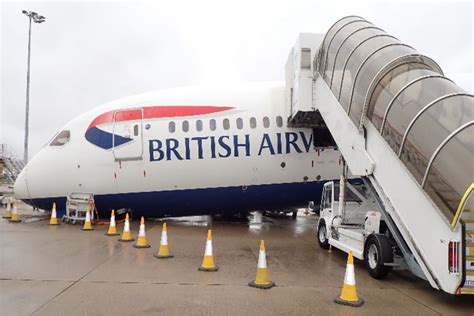
G-ZBJB had been delivered to British Airways in 2013 and was configured with 204 seats across Business Class, Premium Economy, and Economy cabins. Like Lufthansa’s aircraft, it was powered by Rolls-Royce Trent 1000 engines.
Although the visual similarities between the two incidents are striking, the British Airways accident eventually revealed a very specific technical cause rather than a broader structural failure.
Investigation Revealed A Critical Maintenance Error
Following an extensive investigation, the United Kingdom’s Air Accidents Investigation Branch determined that the collapse was triggered by an incorrectly positioned nose landing gear downlock pin.
Investigators discovered that maintenance personnel had inserted the safety pin into the wrong opening within the downlock assembly. The pin was placed into the link assembly apex pin bore rather than the designated locking hole intended to secure the gear during maintenance procedures.
As engineers later carried out operational checks, the improperly secured mechanism allowed the nose gear to retract unexpectedly. Without support, the aircraft’s forward fuselage dropped onto the ground, crushing sections of the lower nose structure.
The findings highlighted how a seemingly minor maintenance mistake could produce major consequences for a large commercial aircraft.
Design Concerns Added Another Layer To The Investigation
The AAIB investigation went beyond identifying human error. Investigators also examined the design of the nose landing gear downlock assembly itself and found that the proximity of the two openings created a significant opportunity for incorrect pin placement.
According to the investigation, service bulletins and airworthiness directives existed that could have reduced the likelihood of such an error occurring. However, those modifications had not yet been incorporated into the affected aircraft before the accident.
This conclusion shifted part of the focus from individual maintenance actions to broader questions about system design and error prevention. In modern aviation safety philosophy, equipment should ideally be engineered to make mistakes difficult or impossible rather than relying solely on procedural compliance.
What The Lufthansa Incident Could Mean
At this stage, there is no evidence that Lufthansa’s Frankfurt incident resulted from the same cause identified in the British Airways accident. Investigators will need to analyze maintenance records, technical data, and physical evidence before reaching any conclusions.
Nevertheless, the similarities are difficult to ignore. Both incidents involved Boeing 787 Dreamliners parked on the ground, both featured unexpected nose gear retractions, and both resulted in injuries and substantial aircraft damage.
For Lufthansa, the focus now centers on recovering and repairing a nearly new widebody aircraft. For the wider aviation industry, the event serves as another reminder that even the most advanced airliners remain dependent on meticulous maintenance practices, robust engineering safeguards, and constant vigilance. Until investigators determine exactly why D-ABPQ collapsed at Frankfurt, comparisons with the British Airways case will continue to shape discussion surrounding one of the Boeing 787 program’s most unusual ground incidents.