Alaska Airlines has taken another major step in reshaping its Pacific Northwest network, breaking ground on a $135 million widebody-capable maintenance hangar at Portland International Airport (PDX). While the project is officially a maintenance investment, its strategic significance reaches far beyond aircraft servicing. The new facility underscores Portland’s growing importance within the Alaska Air Group system and highlights the airline’s efforts to create operational flexibility as it integrates Hawaiian Airlines and manages increasing pressure at its flagship hub in Seattle.
For decades, Seattle-Tacoma International Airport (SEA) has served as the undisputed center of Alaska Airlines’ operations. However, rapid growth, increasing congestion, and the addition of Hawaiian Airlines’ long-haul fleet have prompted the carrier to strengthen its secondary hubs. Portland now appears positioned to play a much larger role in the airline’s future strategy, and the new maintenance complex represents one of the clearest signs yet of that ambition.
Alaska Airlines officially celebrated the groundbreaking ceremony on June 16, marking the beginning of a project that will dramatically expand the carrier’s technical footprint at PDX. The facility will be located adjacent to the existing Horizon Air Operations Center and Maintenance Hangar, creating a larger and more capable maintenance campus capable of supporting both current and future fleet requirements.
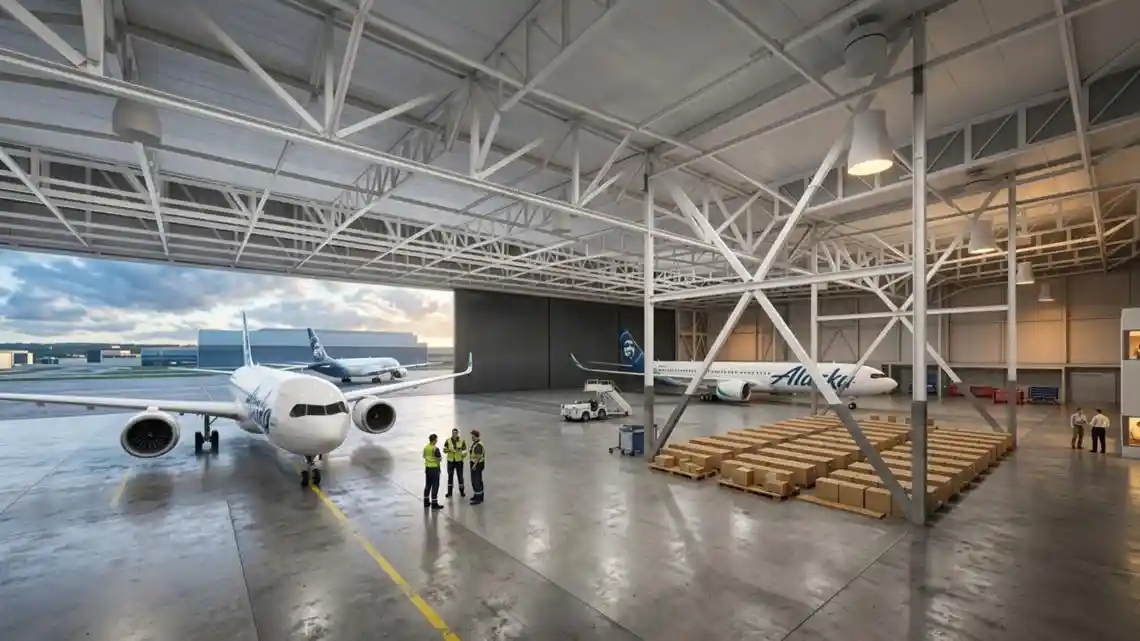
The development will include approximately 125,000 square feet of indoor aircraft maintenance space alongside an additional 60,000 square feet dedicated to offices, engineering facilities, machine shops, sheet metal workshops, engine support areas, and operational infrastructure. Once completed, the complex will rank among the most significant aviation maintenance investments in Oregon in recent years.

What makes the project particularly noteworthy is its ability to accommodate larger aircraft. Alaska Airlines confirmed that the hangar will be capable of servicing up to three narrowbody aircraft simultaneously or two widebody aircraft at the same time. This capability significantly expands the airline’s maintenance options across its growing network.
The timing is especially important following Alaska Air Group’s acquisition of Hawaiian Airlines. Through the merger, Alaska gained access to a fleet of long-haul aircraft, including the Airbus A330 and Boeing 787-9 Dreamliner. Prior to the acquisition, Alaska Airlines primarily operated a narrowbody fleet focused on domestic and regional routes. The addition of widebody aircraft has transformed the company’s operational requirements, creating a need for expanded maintenance infrastructure capable of handling larger, more complex aircraft.
By establishing widebody maintenance capacity in Portland, Alaska gains valuable flexibility in scheduling aircraft servicing, reducing reliance on a single maintenance location and creating operational resilience throughout the network. In an era where airline reliability increasingly depends on efficient maintenance planning, the new facility provides an important competitive advantage.
Benjamin Brookman, Alaska Airlines’ Vice President of Real Estate and Airport Affairs, described the project as both a strategic investment in Portland and a key enabler for future growth throughout the airline’s system. His comments reflected a broader corporate vision focused on improving efficiency while creating new opportunities for network expansion.
Beyond infrastructure improvements, the project is expected to deliver meaningful economic benefits to the Portland region. Alaska estimates that the facility will create more than 100 highly skilled aviation jobs, including positions for maintenance technicians, engineers, aircraft specialists, and operational support professionals. These roles will contribute to the airport’s growing importance as a center for aerospace employment in the Pacific Northwest.
Portland’s Growing Importance Within Alaska Airlines’ Network
The new hangar is not an isolated investment. Instead, it represents the latest chapter in a broader expansion strategy that has steadily elevated Portland’s status within Alaska Airlines’ network.
Alaska has served Portland since 1979, but the city’s role has evolved dramatically over the past several years. Today, the airline operates roughly one-third of all flights at Portland International Airport, making it the airport’s dominant carrier. During the current summer season, Alaska expects to operate more than 130 daily departures, connecting travelers to over 60 destinations across North America.
These numbers illustrate how Portland has progressed from a secondary market into a genuine hub capable of supporting significant passenger flows. The airport now functions as a critical connection point for travelers moving throughout the West Coast, Mountain West, and beyond.
The airline’s route network continues to expand as well. New year-round services to Everett Paine Field and Pasco strengthen regional connectivity, while seasonal additions to cities such as Baltimore, Philadelphia, St. Louis, and Jackson Hole broaden Alaska’s national reach from Portland.
Perhaps even more striking is the pace of growth. By the fall season, Alaska expects to offer approximately 50 percent more seats in Portland than it did only two years ago. Such expansion reflects confidence in the market’s long-term potential and demonstrates that the airline views Portland as far more than a supporting hub.
Passenger-facing investments reinforce the same message. Earlier this year, Alaska unveiled a newly redesigned Portland Lounge spanning approximately 14,000 square feet and offering nearly 250 seats. The upgraded facility is roughly double the size of its predecessor and provides a significantly enhanced experience for premium travelers.
Taken together, the new lounge, expanded route network, increased capacity, and massive maintenance investment paint a clear picture: Alaska Airlines is building a comprehensive hub ecosystem in Portland rather than merely increasing flight frequencies.
Relieving Pressure on Seattle While Building Network Flexibility
One of the most practical benefits of Portland’s expansion is its ability to reduce operational pressure on Seattle.
Seattle remains Alaska Airlines’ primary hub and the center of its international ambitions. However, the airport faces growing challenges associated with congestion, infrastructure constraints, and increasing demand. As passenger volumes continue rising, maintaining operational efficiency becomes increasingly difficult.
Portland provides an attractive alternative. Located within the same regional market, PDX offers room for growth while remaining close enough to support Alaska’s broader Pacific Northwest strategy. By shifting some operational functions southward, the airline can create additional flexibility without sacrificing network connectivity.
The new maintenance facility directly supports this objective. Aircraft that previously may have required servicing in Seattle can potentially be maintained in Portland, helping distribute workloads more effectively across the system. This diversification reduces operational bottlenecks and improves overall network resilience.

Could Portland Become an International Long-Haul Gateway?
The most intriguing question raised by the project concerns Portland’s future role in international aviation.
A widebody-capable hangar naturally fuels speculation about potential long-haul routes. While maintenance infrastructure alone does not guarantee international expansion, the capability certainly creates new possibilities.
Currently, Alaska Airlines continues to prioritize Seattle for long-haul growth. Seattle benefits from a larger metropolitan population, stronger corporate demand, and greater premium travel volumes. These factors make it the logical choice for international expansion involving widebody aircraft.
Nevertheless, Portland possesses several advantages of its own. The airport already supports successful long-haul operations by international carriers, including flights from British Airways connecting to London Heathrow and services from KLM linking Portland with Amsterdam Schiphol. These routes demonstrate that the market can sustain transatlantic demand under the right conditions.
As Alaska continues expanding domestic feed into Portland, the possibility of future international service becomes increasingly plausible. Carefully selected destinations in Asia, Europe, or the Pacific could eventually emerge as viable opportunities, particularly if Seattle’s capacity constraints intensify.
For now, however, the more immediate significance of the new hangar lies in operational flexibility rather than route announcements. The facility provides the infrastructure necessary to support a larger and more diversified airline while strengthening Portland’s position within the Alaska Air Group network.
What is already clear is that Alaska Airlines no longer views Portland merely as a supporting station. Through substantial investments in maintenance, passenger facilities, route growth, and workforce development, the airline is transforming PDX into a strategic pillar of its future. The $135 million hangar stands as the most visible symbol yet of that transformation, signaling that Portland’s role in the Pacific Northwest aviation landscape is only beginning to expand.