Alaska is distant, rugged, and magnificently untamed, sitting apart from the continental United States like a self-contained outpost of wilderness and air travel. In this land carved by glaciers and crowned by endless sky, aviation does not simply connect cities — it binds worlds. The longest US domestic flights from Alaska are more than timetables and mileage statistics. They represent lifelines, business corridors, and holiday pipelines stretching thousands of miles from the far north into the most thriving hubs of America. These long-haul domestic routes define how Alaska communicates with the rest of the nation, and in December 2025, they have reached extraordinary distances few expect from domestic fleets.
Anchorage (ANC), Alaska’s aviation heartbeat, serves as the origin point for most extensive coast-to-coast journeys. Remote but vital, the airport functions like the hinge between polar frontiers and southern metropolises, handling widebody workhorses and fuel-efficient narrowbodies alike. When a jet carves through eight hours of sky from ANC to the American southeast, the scale of Alaska’s separation from the mainland becomes tangible. The numbers are immense, but the operational precision behind these schedules is even more dramatic.
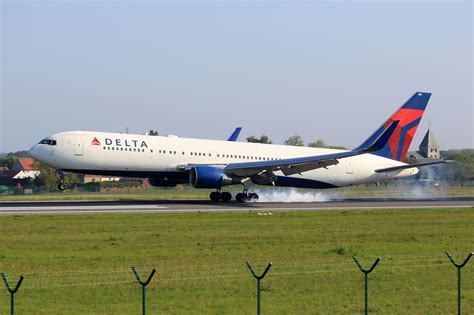
Delta Air Lines: Anchorage to Atlanta – The Longest Route
The crown belongs to Delta Air Lines, operating the longest internal US route from Alaska. From Anchorage to Atlanta (ANC-ATL), the journey stretches 3,416 miles (5,497.5 km) — an aerial marathon linking alpine tundra directly to the heart of the American southeast. The route relies exclusively on the Boeing 767-300ER, a widebody equipped with 216 total seats across three carefully divided cabins. For travelers, this means long-haul comfort on a domestic ticket: international-style layout, larger cabins, dual aisles, and breathing room for those seven-plus hours above the continent.
December scheduling reveals 12 flights each way during the month, slowly ramping from weekly service to five rotations per week as holiday demand builds. The southbound journey averages 7 hours 42 minutes, while the return leg benefits from tailwinds, trimming the flight to 7 hours 03 minutes. What makes this route particularly noteworthy is its seasonal expansion. Previously confined to summertime, 2025 finally saw the ANC-ATL connection extended into winter, opening more travel opportunity for holiday flyers, snow-seekers, and those connecting deeper into southeastern markets.
American Airlines Anchorage to Dallas/Fort Worth – Narrowbody Range on Display
Second only in distance is American Airlines’ Anchorage to Dallas/Fort Worth (ANC-DFW) route, measuring a formidable 3,042 miles (4,895.6 km). The aircraft here tells its own story: instead of a widebody, American deploys the Airbus A321neo, a next-generation narrowbody stretching operational endurance to long-distance limits. Onboard, 20 domestic first-class seats contrast with 176 in economy, packing a total of 196 travelers onto a long, slim fuselage pointed south toward Texas.
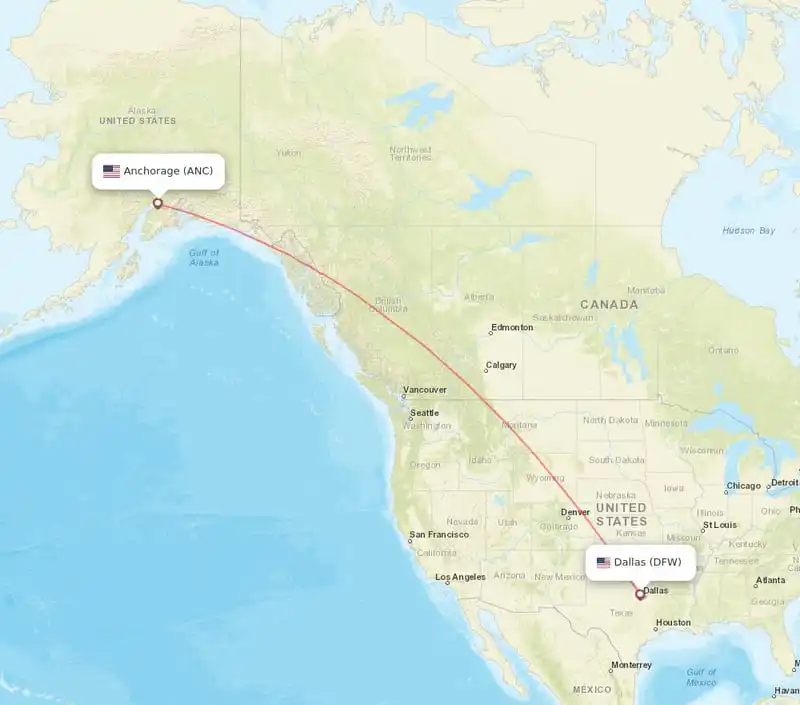
Flight frequency across December paints an unusual but deliberate pattern. Early-month operations run December 1–2, then no flights occur until December 18, when service returns daily through month’s end. Across the period, American offers 3,136 seats each direction, a significant capacity investment considering winter demand profiles. Flight AA2572 departs Texas late afternoon at 3:04 pm, reaching Alaska just after 7 pm local time. The return leaves at 8:21 pm for an overnight cruise, touching down in Dallas at 5:58 am — a spread designed for onward morning connections.
The 2,800-Mile Club: Alaska Airlines & United Feed the Middle Tier
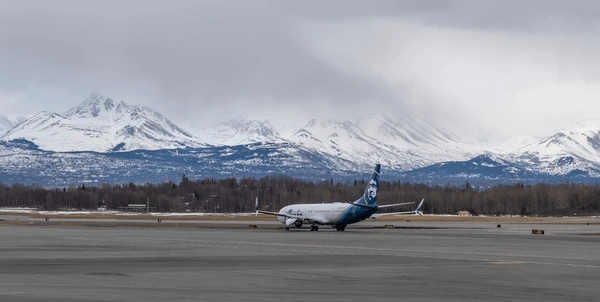
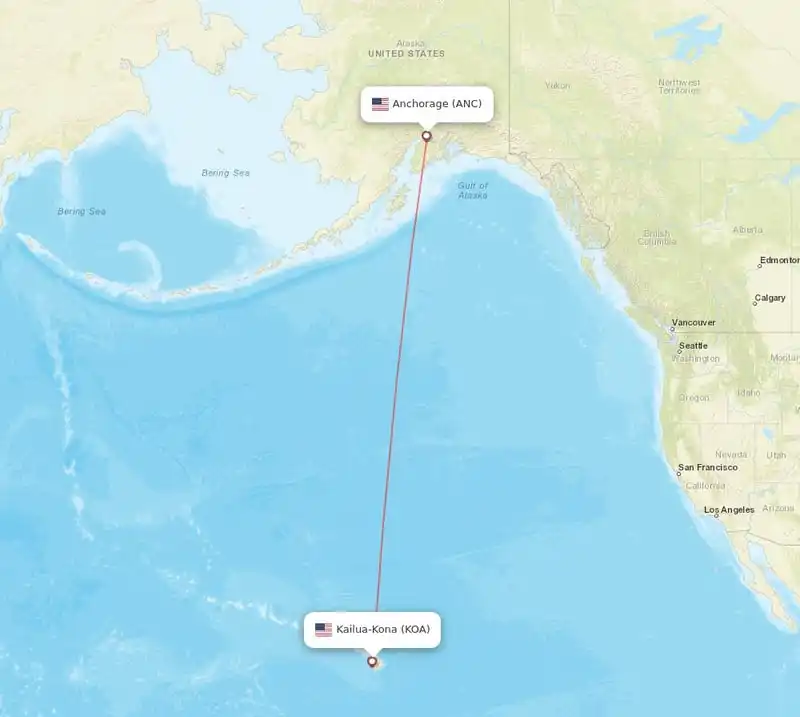
Beneath the 3,000-mile mark but still stunning in range stand two other domestic giants. Alaska Airlines links Anchorage to Kona, Hawaii (KOA) at 2,874 miles (4,625 km), operated by the Boeing 737 MAX 9. Thirteen round trips are scheduled for December — roughly three per week — pushing narrowbody efficiency across the Pacific to warm volcanic shores. Hawaiian traffic has always pulsed strong from Alaska, and this monthly footprint reinforces winter demand for sunlit escape.
Not far behind is United Airlines’ Anchorage to Chicago O’Hare (ORD) at 2,846 miles (4,580 km) aboard the Boeing 737 MAX 8. The route launches with one December rotation, pauses, then resumes December 18 onward for a total of fifteen round trips. Weather, operational bandwidth, and mid-month travel demand form the backbone of this irregular but purposeful scheduling.
Why These Routes Matter Beyond Mileage
Distance alone does not explain why these flights matter. Alaska depends on air networks like other states depend on roads. These ultra-long domestic sectors shape tourism flows, military deployment logistics, seafood exports, and holiday migration patterns. A seat on any of these aircraft is not just a journey — it is participation in a strategic artery connecting America’s northern edge to its populous core. Long-range narrowbodies and efficient widebodies turn what once required two or three connections into a direct pipeline of commerce and community.
From Atlanta to Dallas, Chicago to Kona, Alaska’s skybridges stretch far, allowing its residents and industries to breathe as freely as any mainland city. The longest domestic flights from the Last Frontier remain feats of endurance, engineering, and economic necessity — vivid proof that distance can be conquered with steel wings and runway lights burning through Arctic darkness.