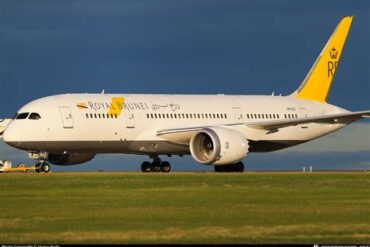
Antarctica has long existed beyond the edges of conventional aviation. Vast, frozen, and unforgiving, it is a continent without cities, without paved highways, and without permanent commercial airports. Yet despite these obstacles, aircraft have been piercing its icy skies for decades, carrying scientists, supplies, and—more recently—a select number of adventurous travelers. Understanding which airlines have flown to Antarctica reveals a story of technological progress, operational bravery, and the gradual transformation of polar aviation from purely military logistics into a hybrid world that now includes modern commercial airliners.
For most of its aviation history, Antarctica relied almost entirely on military airlift and ski-equipped aircraft, specially designed to land on snow and ice. These flights were slow, capacity-limited, and often dependent on complex staging routes. In recent years, however, that model has begun to change. Advances in aircraft design, navigation systems, and the development of naturally occurring blue-ice runways have opened the door for large wheeled aircraft—something once thought impractical, if not impossible, at the bottom of the world.
This shift has allowed a small number of commercial airlines to achieve what was previously the exclusive domain of air forces. These carriers operate under strict charter conditions, flying only when weather, runway conditions, and logistical planning align perfectly. Their missions are not routine flights but carefully orchestrated operations where every kilogram of fuel, every alternate plan, and every minute on the ground is calculated in advance.
Antarctica remains hostile to mass tourism and scheduled airline service, and that is unlikely to change. But the fact that modern widebody jets can now land on the continent at all marks a profound evolution in aviation capability. It signals a future where access is faster, safer, and more efficient—without compromising the fragile polar environment.

Why Flying to Antarctica Is Unlike Anywhere Else on Earth
Flying to Antarctica is not simply an extension of long-haul operations; it is an entirely different discipline of aviation. There are no diversion airports, no maintenance hangars, no fuel farms waiting if something goes wrong. Temperatures can plunge well below operational minima, affecting hydraulics, batteries, and even the elasticity of aircraft materials. Winds can shift rapidly, creating whiteout conditions that erase visual references in seconds.
Runways themselves defy traditional definitions. Most Antarctic airfields are either compacted snow surfaces or blue-ice runways—areas where constant wind prevents snow accumulation, exposing dense, ancient ice capable of supporting heavy aircraft. These surfaces demand precise braking calculations, modified landing techniques, and absolute confidence in runway condition assessments.
Because of these challenges, only aircraft with exceptional range, performance margins, and reliability are considered suitable. Equally important is the human factor: crews undergo specialized training for polar navigation, cold-weather operations, and emergency scenarios where self-sufficiency is not optional but mandatory.
The Role of Military Aviation in Antarctic Access
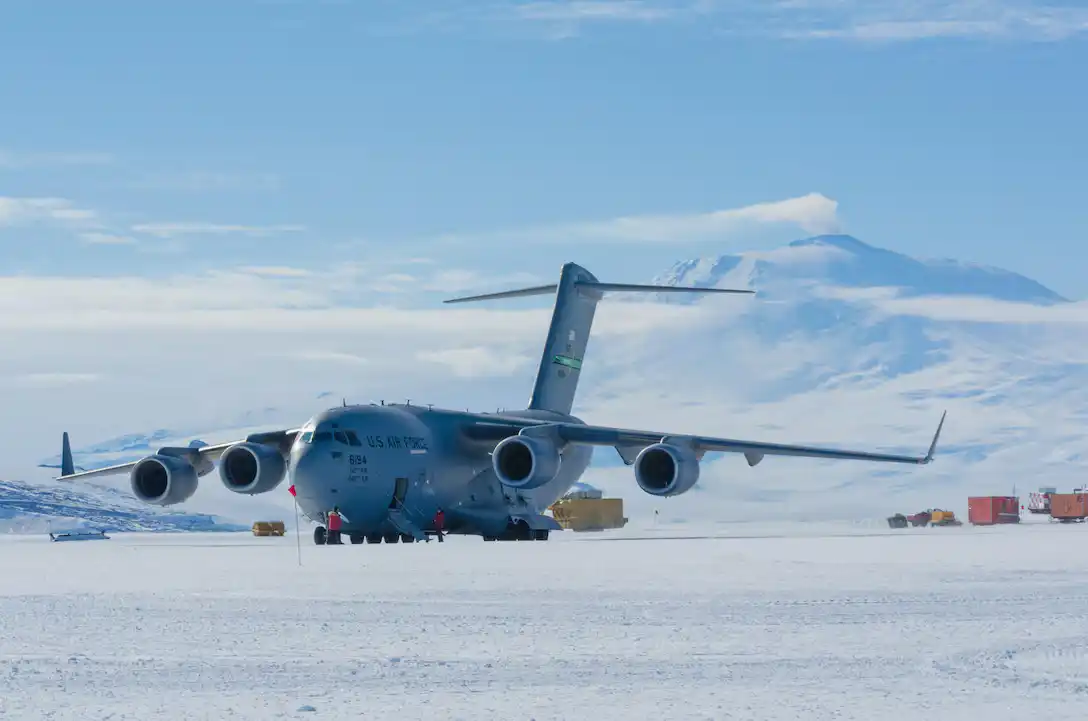
Before commercial airlines ever considered Antarctica, military aircraft established the backbone of polar logistics. The United States Air Force has been particularly central, operating aircraft like the Lockheed C-5 Galaxy and Boeing C-17 Globemaster III to support research stations, especially McMurdo Station.
The C-5 Galaxy remains the largest aircraft ever to land in Antarctica, delivering enormous payloads of vehicles, fuel bladders, and infrastructure components. The C-17, meanwhile, has become the workhorse of Antarctic logistics, valued for its short-field performance, reliability, and ability to operate from ice runways with remarkable precision.
These military operations proved that large, wheeled aircraft could function safely in Antarctica, laying the groundwork for commercial operators to follow—albeit under far more constrained and risk-managed conditions.
Commercial Airlines That Have Successfully Flown to Antarctica
Only a handful of commercial airlines have crossed the threshold from theory to execution. Their success represents a convergence of aircraft capability, meticulous planning, and evolving Antarctic infrastructure.
Hi Fly: Pioneering Commercial Widebody Operations
The Portuguese charter airline Hi Fly stands as one of the most influential names in modern Antarctic aviation. Operating under non-scheduled charter arrangements, Hi Fly has flown to Antarctica for several consecutive years, supporting scientific missions, logistics, and high-end tourism.
Initially, Hi Fly relied on the Airbus A340, a four-engine aircraft whose redundancy and long range provided added safety margins in an environment with no diversion options. The A340’s success demonstrated that blue-ice runways like Wolf’s Fang could support large commercial jets without compromising safety.

In December 2025, Hi Fly made history again by landing an Airbus A330 in Antarctica—the first time this twin-engine widebody achieved such a feat. The flight departed Cape Town and landed on Wolf’s Fang, remaining on the ground only briefly before departing, a standard practice designed to minimize cold-soak risks and logistical exposure.

This transition from the A340 to the more fuel-efficient A330 reflected broader improvements in runway maintenance, navigation accuracy, and ground coordination. It also showed that modern twin-engine aircraft, once considered unsuitable for Antarctica, could now operate safely under the right conditions.
Norse Atlantic Airways and the Boeing 787 Dreamliner
Norse Atlantic Airways joined the elite list of Antarctic operators in November 2023, when one of its Boeing 787-9 Dreamliners touched down at Troll Airfield. Operating from Oslo via Cape Town, the aircraft carried scientists and more than ten tons of research equipment for the Norwegian Polar Institute.
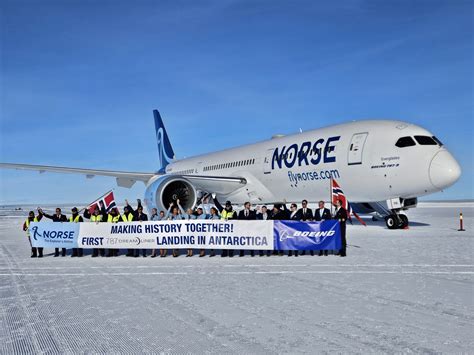
What made this flight particularly significant was not just the landing itself, but the operational efficiency behind it. The Dreamliner completed the Cape Town–Antarctica–Cape Town sector without refueling, underscoring the aircraft’s exceptional fuel efficiency and range.
Norse returned to Antarctica in November 2024, proving the operation was not a one-time demonstration. The airline highlighted the 787’s advanced avionics, optimized performance in extreme cold, and reduced fuel burn as key enablers for safe and repeatable Antarctic missions.
Together, these flights cemented the Boeing 787’s reputation as one of the most capable commercial aircraft ever to operate in polar environments.
Where Do These Aircraft Land in Antarctica?
Antarctica’s airfields are functional, temporary, and purpose-built for survival rather than comfort. There are no terminal buildings, jet bridges, or control towers in the traditional sense. Instead, operations revolve around weather windows, ice conditions, and seasonal viability.
McMurdo Station Aviation Complex
The McMurdo Station Complex is the largest aviation hub on the continent, operated by the U.S. Antarctic Program. It consists of three interconnected airfields with varying surface conditions, allowing flexibility when weather or ice quality changes. The complex routinely handles C-17 Globemasters and supports the largest year-round human presence in Antarctica.
Wolf’s Fang Runway
Wolf’s Fang is a private blue-ice runway capable of accommodating large widebody aircraft. It has become central to commercial charter operations, particularly those involving Hi Fly. Beyond scientific logistics, Wolf’s Fang also serves as a gateway for luxury Antarctic expeditions, offering rapid access to the interior of the continent.
Troll Airfield
Operated by the Norwegian Antarctic Program, Troll Airfield features a runway long enough for aircraft as large as the Boeing 787. Its seasonal connection to Cape Town has earned it a reputation as the closest thing Antarctica has to an international aviation link, balancing research support with limited tourism access.

King George Island
Located near South America, King George Island is Antarctica’s most accessible airfield and operates year-round. While it does not typically handle the largest widebody jets, it plays a critical role in regional access, especially for cruise-based tourism and smaller aircraft operations.
Why Only a Few Airlines Can Do This
The question is not why more airlines don’t fly to Antarctica—it is why any do at all. These operations demand extraordinary planning, from fuel calculations that account for extreme cold to contingency strategies that assume complete isolation.
Aircraft must be capable of operating far from maintenance support, crews must be trained for polar emergencies, and airlines must accept that flights can be scrubbed at the last moment due to weather shifts. Financially, these missions make sense only as high-value charters, not as scheduled passenger services.
Environmental stewardship also plays a role. Antarctic operations are governed by strict international agreements designed to minimize human impact. Every flight must justify its presence, ensuring that scientific value or tightly controlled tourism benefits outweigh environmental risk.
The Largest Aircraft Ever to Land in Antarctica
While commercial airlines attract attention, military aircraft still dominate the extremes of Antarctic aviation. The Lockheed C-5 Galaxy remains unmatched in size and payload, while the C-17 Globemaster III continues to be indispensable.
Commercial widebodies like the Airbus A340, A330, and Boeing 787 now occupy a middle ground—larger and more capable than traditional ski-equipped aircraft, yet operating under constraints that require absolute precision.
What This Means for the Future of Antarctic Aviation
The successful operations of Hi Fly and Norse Atlantic signal a broader shift in what is possible. Modern, fuel-efficient widebody aircraft are proving that Antarctica no longer belongs exclusively to military logistics. Instead, it is becoming accessible through a carefully balanced partnership between science, technology, and specialized commercial aviation.
This does not mean mass tourism or daily flights. Antarctica will remain one of the most exclusive destinations on Earth. But it does mean faster transport for researchers, improved logistical efficiency, and safer operations overall.
In the context of aviation history, these flights represent more than isolated achievements. They mark the moment when the world’s last frontier became reachable not just by necessity, but by innovation—one precisely planned landing at a time.