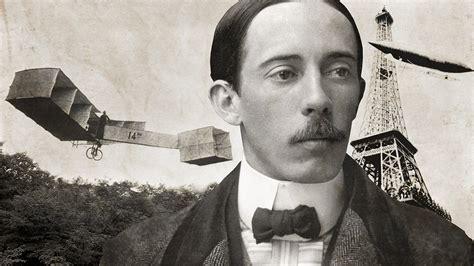
Alberto Santos-Dumont, born on 20 July 1873 in Palmira, Minas Gerais, was a pioneering Brazilian aviator whose bold experiments in both lighter-than-air and heavier-than-air flight placed him among the earliest true visionaries of aviation. A polymath in the realm of mechanics, chemistry, and aeronautical innovation, Santos-Dumont combined curiosity, daring, and precise engineering in a career that dazzled early 20th-century Europe. From orbiting the Eiffel Tower in a dirigible to flying the first publicly witnessed airplane, his legacy endures as that of a dreamer who shaped the future with courage and ingenuity.
A Childhood Rooted in Engineering and Imagination
Santos-Dumont was the sixth of eight children born to Henrique Dumont, a prosperous coffee baron and engineer, and Francisca de Paula Santos, whose family name he would later honor by hyphenating it with his own. Raised in São Paulo after the family moved from their railroad enterprises, Santos-Dumont was immersed in a world of machines from an early age.
By age seven, he was already driving steam tractors on the family estate, while his infatuation with ballooning and mechanics began even earlier. A famous anecdote recounts how he punctured a toy balloon as an infant, curious about the physics within. As a teenager, he found inspiration in the pages of Jules Verne, whose science fiction ignited a love of invention. At fifteen, he witnessed his first balloon ascent in São Paulo—an experience that left an indelible mark.
Although he briefly attended engineering courses in Brazil, Santos-Dumont preferred autodidactic pursuits. The classroom could not contain the fire of his curiosity.
Arrival in Europe and the Dawn of Aeronautical Passion
In 1891, Santos-Dumont made his first European voyage, which included an ascent of Mont Blanc, reinforcing his passion for heights and exploration. A year later, he returned to Paris to study chemistry, mechanics, and electricity—fields essential to the burgeoning domain of flight.
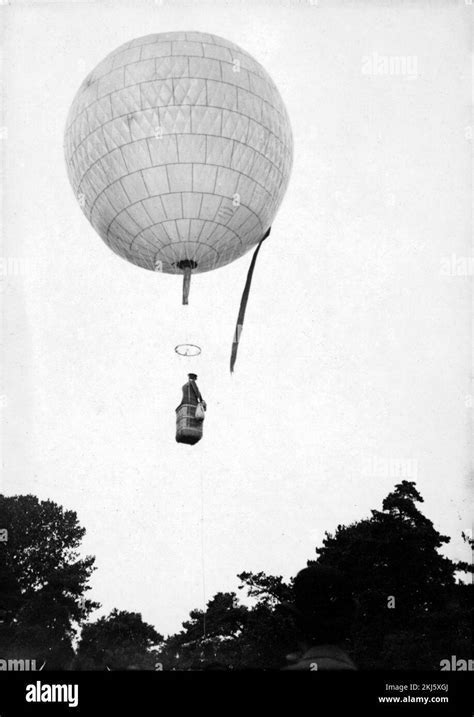
Paris, then the epicenter of innovation, suited him. He entered the scene with flair, engaging in automobile and bicycle races across France and the United States, but it was ballooning that captured his imagination most fully. In 1898, he began ballooning lessons and, within two years, had built nine balloons.
His small but functional craft, such as the Brazil and Amérique, combined elegance with daring. The Brazil, only six meters in diameter, allowed for short personal flights of over 100 meters, while the larger Amérique could carry passengers and earned him a French Aeroclub prize for atmospheric research.
Revolution in the Skies: The Airship Experiments
No. 1–3: Failures That Instructed
In 1898, Santos-Dumont built his first airship, No. 1, a 25-meter-long cigar-shaped balloon powered by a small motor. Its maiden flight ended in failure, the envelope folding midair, nearly killing him. Undeterred, he designed No. 2 with added structural innovations like an aluminum fan to prevent envelope collapse. Yet, its tethered trial was also unsuccessful.
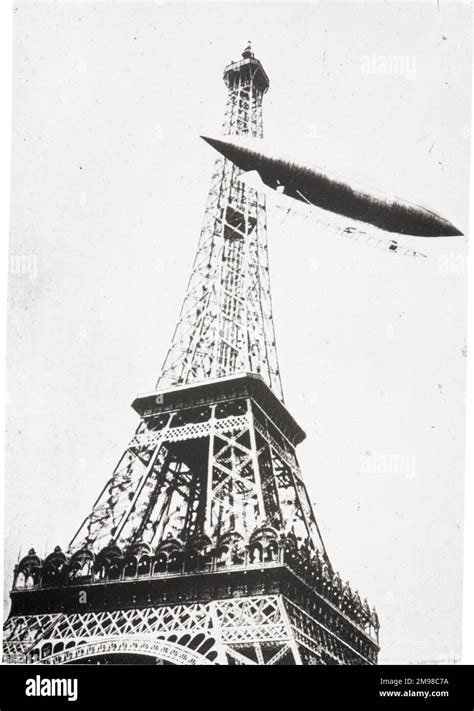
By September 1899, with No. 3, he found success. The craft featured a bamboo keel, better balance, and a larger 500 m³ envelope. On 13 November 1899, he completed a controlled flight around the Eiffel Tower, stunning Parisians and the scientific elite alike. Encouraged, he constructed a workshop and private hangar in Paris, signaling his commitment to revolutionizing aerial navigation.
Nos. 4–6 and the Deutsch de la Meurthe Prize
Between 1900 and 1901, Santos-Dumont built airships No. 4, 5, and the now legendary No. 6. In March 1900, No. 4 flew into headwinds, displaying windward maneuverability—an unprecedented capability for airships. No. 5 made the circuit around the Eiffel Tower but exceeded the Deutsch Prize time limit.
No. 6, built with a larger 622 m³ envelope and a 20 hp engine, marked his greatest triumph in dirigible aviation. On 19 October 1901, he flew from Saint-Cloud around the Eiffel Tower and back in 29 minutes 30 seconds, completing the 11 km course.
Despite an initial committee controversy over timing and landing procedures, the prize of 100,000 francs—plus interest—was eventually awarded. True to his egalitarian ideals, Santos-Dumont donated the winnings to his staff and to aid the unemployed of Paris.
Beyond Personal Glory: Later Airships and Public Innovation
Following his prize-winning success, Santos-Dumont pushed the boundaries further with No. 7, a racing airship boasting a 1,257 m³ envelope and a powerful 45 hp engine. It was tragically sabotaged in St. Louis during an American exhibition. Nonetheless, he continued developing passenger-focused airships, such as the No. 9, which famously carried Aida de Acosta, the first woman to fly a powered aircraft, on 29 June 1903.
His No. 10, designed as a public transportation airship, envisioned a skybound commuter future. Though commercially impractical at the time, these ideas prefigured modern aerial mobility. His later experimental machines, including unmanned monoplanes, hybrid balloons, and a helicopter concept, showed remarkable prescience.
Heavier-Than-Air Flight: The 14-bis Breakthrough
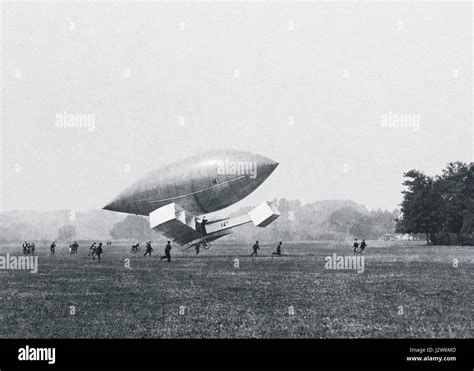
As the race for powered heavier-than-air flight intensified, Santos-Dumont turned his focus to airplanes. Inspired by the French prizes for sustained flight, he began constructing a new type of hybrid aircraft—the 14-bis.
Initially designed to be towed aloft by a balloon, it soon evolved into a fully autonomous flying machine. On 23 October 1906, at Bagatelle, Santos-Dumont made aviation history. Before a crowd of officials and spectators, the 14-bis flew 60 meters at a height of 2–3 meters—the first powered, unassisted, and officially observed heavier-than-air flight in Europe.
Just three weeks later, on 12 November 1906, he improved that performance dramatically, flying 220 meters at 6 meters altitude, all under observation from the Aero-Club de France and the Fédération Aéronautique Internationale (FAI).
A Legacy Etched into the Fabric of Aviation History
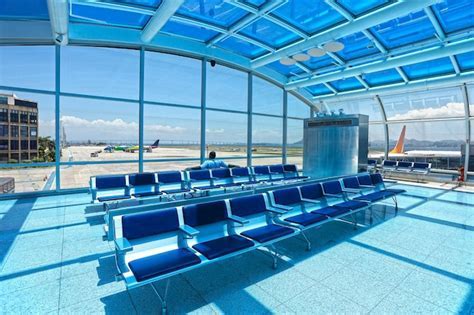
While the Wright brothers had flown earlier, their flights were not publicly observed nor immediately certified, leading many—especially in Brazil and parts of Europe—to recognize Santos-Dumont as the first true public aviator. His contributions are commemorated in monuments, airport names, and national tributes throughout Brazil.
He was inducted into the Brazilian Academy of Letters in 1931, honored not only for his engineering genius but also his eloquent writings and vision for peaceful aerial progress. Yet his life ended tragically; stricken by multiple sclerosis and disturbed by the militarization of aviation, he died by suicide on 23 July 1932.
Conclusion: A Hero Whose Skyward Dreams Still Soar
Alberto Santos-Dumont did not merely invent; he democratized flight. His willingness to test his machines before the public, to risk failure without secrecy, and to share his successes made him a singular figure in the story of aviation. Where others operated in obscurity, he embraced visibility and accountability, ushering the human race into the age of aerial navigation.
His machines—often whimsical, always visionary—remain more than curiosities. They are artifacts of a future imagined and, through his legacy, partially realized. His name, etched in history and carried by the skies of Brazil, reminds us that the dream of flight was not born in secrecy but in open-air, public triumphs that soared above Paris and beyond.