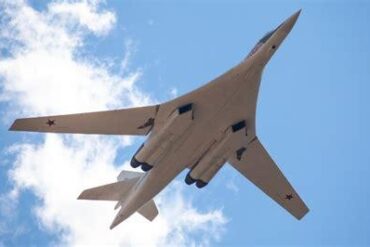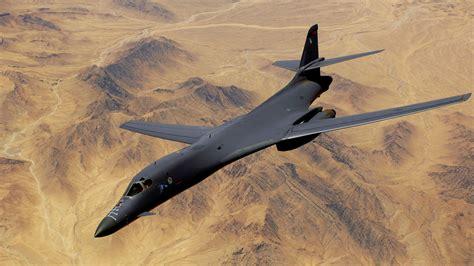
The story of the Rockwell B-1B Lancer is not just about metal, thrust, and payload capacity. It is about political brinkmanship, shifting doctrines of nuclear deterrence, and the brutal mathematics of modern air defense. Few aircraft in American history have been canceled, resurrected, stripped of their primary mission, and then reborn as an indispensable warfighting asset. Yet the bomber affectionately known as “The Bone” did exactly that—emerging from near extinction to become one of the most heavily relied upon conventional strike platforms in the United States Air Force.
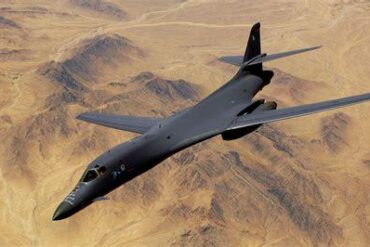
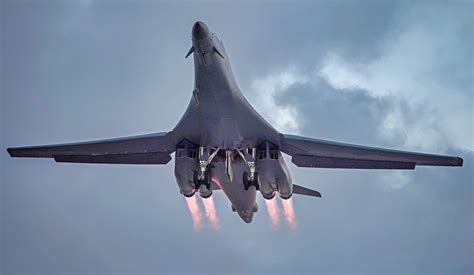
The B-1B is the second-largest supersonic aircraft ever to enter mass production. It was conceived in the tense geometry of the Cold War, when American planners imagined penetrating dense Soviet radar networks at low altitude and high speed. Its very shape—sleek fuselage, sweeping wings, muscular stance—announced a singular purpose: to outrun and outmaneuver the deadliest air defenses on Earth. But before it could fully realize that mission, politics intervened.
In 1977, President Jimmy Carter canceled the original B-1A program. His administration believed that air-launched cruise missiles carried by the venerable B-52 Stratofortress made a supersonic penetrator redundant. Why risk pilots in hostile skies when missiles could do the job from a safe distance? It was a reasonable strategic argument. It was also a decision that nearly erased the Bone from history.
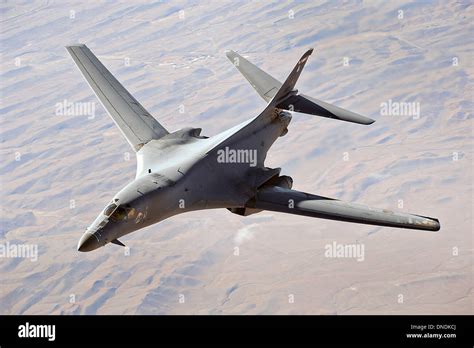
The Cold War Cancellation That Nearly Killed The B-1
To understand why the B-1 made a comeback, you have to grasp the technological panic of the late 1970s. Soviet air defenses were evolving at alarming speed. Advanced “look-down/shoot-down” radars could detect aircraft flying below radar horizons, while new surface-to-air missile systems such as the S-300 threatened to swat down high-speed bombers at previously unreachable ranges.
The original B-1A had been designed for Mach 2.2 dashes at high altitude before dropping to terrain-hugging flight profiles. But intelligence assessments suggested that even this blistering speed might not be enough. Meanwhile, the development of the Air-Launched Cruise Missile (ALCM) allowed the aging B-52 to remain safely outside Soviet airspace while delivering nuclear payloads with precision.
From a budgetary perspective, the B-1A looked like an expensive indulgence. From a strategic perspective, it appeared increasingly vulnerable. Critics labeled it a white elephant before it even entered service.
Yet history rarely follows clean logic. The cancellation became a political symbol during the 1980 presidential campaign. Ronald Reagan argued that shelving the B-1 represented weakness in the face of Soviet expansion. Once in office, he revived the program—but not as it had been.
The reborn aircraft became the B-1B Lancer, optimized for reduced radar cross-section rather than extreme top speed. Its maximum velocity was lowered to around Mach 1.25, but it gained improved survivability and—crucially—a dramatically expanded payload capacity. It was no longer just a nuclear spear. It was becoming something far more flexible.
Resurrection And Reinvention: From Nuclear Spear To Conventional Hammer
The end of the Cold War delivered another twist. With the collapse of the Soviet Union and the signing of the START I Treaty, the B-1B was stripped of its nuclear weapons capability. On paper, this looked like another existential blow. An aircraft designed to deliver nuclear deterrence suddenly had its central mission removed.
In practice, that decision saved it.
Freed from treaty limitations, the B-1B was reimagined as a conventional “bomb truck” with unparalleled internal payload capacity. It can carry up to 75,000 pounds of ordnance, the highest internal load of any U.S. Air Force aircraft. That is not a marginal advantage; it is operational dominance.
When the United States entered prolonged conflicts in Afghanistan and Iraq, the B-1B proved its value in a way few had predicted. During the first six months of Operation Enduring Freedom, B-1Bs dropped nearly 40 percent of coalition munitions. A platform once designed for nuclear Armageddon became a precision instrument of close air support.
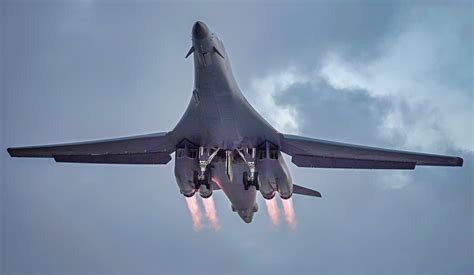
The Air Force’s Heaviest Conventional Hitter
What makes the B-1B uniquely lethal is not just how much it carries—but how it flies and how it thinks.
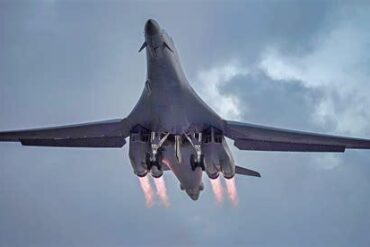
Its variable-geometry wings allow it to change shape mid-flight. Fully extended, they maximize lift, enabling efficient loitering over battlefields and shorter takeoff distances. Swept back, they transform the aircraft into a supersonic penetrator. This mechanical choreography allows a single aircraft to transit quickly to a crisis zone, orbit patiently while coordinating with ground forces, and then strike with overwhelming force.
Despite its size, the B-1B is remarkably precise. Equipped with the Sniper Advanced Targeting Pod, Link 16 data links, and Synthetic Aperture Radar (SAR), crews can receive real-time coordinates from troops on the ground. The SAR capability allows it to identify and track moving vehicles even through clouds, darkness, or dust storms.
Precision matters in close air support. Speed matters even more. A fast response window can mean survival for friendly forces pinned down by enemy fire. The B-1B’s combination of speed and payload turned it into a responsive airborne arsenal.
Its ability to deploy advanced weapons such as the Joint Air-to-Surface Standoff Missile-Extended Range (JASSM-ER) and the Long Range Anti-Ship Missile (LRASM) has further expanded its role. It is no longer merely a land-attack bomber. It has become a formidable maritime strike platform capable of targeting enemy ships from hundreds of miles away.
Hammer And Scalpel: The B-1B And B-2 Partnership
Modern air campaigns are rarely single-platform affairs. The U.S. Air Force often deploys bombers in complementary roles. In this doctrine, the B-2 Spirit functions as the stealthy scalpel, penetrating advanced anti-access/area-denial (A2/AD) environments protected by systems like the S-400.
The B-2’s job is to blind the enemy—neutralizing radar installations, command nodes, and high-end surface-to-air missile batteries. Once those defenses are degraded, the B-1B enters as the hammer.
Where the B-2 might carry 16 heavy bombs, the B-1B can deliver 24 to 48 depending on configuration. It is optimized for saturation—airfields, industrial complexes, troop concentrations, logistical hubs. If stealth opens the door, mass closes the argument.
Even when air defenses remain active, the B-1B can launch long-range standoff weapons without entering the most dangerous zones. In this sense, it straddles both phases of a campaign: contributing to surgical strikes while retaining the brute force to overwhelm broader targets.
The Maintenance Burden And Structural Fatigue Problem
No story of the B-1B comeback is complete without confronting its Achilles’ heel.
Decades of intensive deployment in the Middle East pushed the fleet hard. Low-altitude profiles and swing-wing mechanics impose immense structural stress. The aircraft was not “overbuilt” in the conservative manner of the 1950s-era B-52. It was engineered for high performance, and high performance extracts a cost.
At one point, readiness rates fell so dramatically that as few as six aircraft across the fleet were mission-capable. Maintenance demands ranged from 74 to 150 hours of work per flight hour—roughly double that of the B-52.
Meanwhile, the B-52 Stratofortress—a bomber older than most of its pilots—proved astonishingly resilient. Designed with conservative margins and simpler geometry, it is slated to remain in service into the 2050s, potentially approaching a century of operational life. With new Rolls-Royce F130 engines and plans to integrate hypersonic missiles, the B-52 is evolving yet again.
The B-1B, by contrast, faces retirement in the early 2030s. Structural fatigue and cost pressures have narrowed its future.
And yet, its operational legacy explains why resistance to retirement has been fierce. It delivered when called. It absorbed mission after mission. It proved adaptable in ways critics never anticipated.
The B-21 Raider: Successor To The Supersonic Legacy
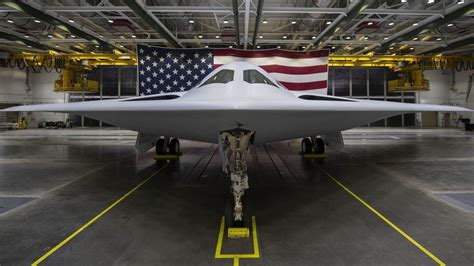
The future of American long-range strike lies with the B-21 Raider, a stealth platform designed from the ground up for survivability in contested airspace. Unlike the B-1B, which must rely on speed or standoff weapons to survive, the B-21 is built for persistent penetration.
Its 360-degree stealth profile allows it to loiter directly over high-threat zones. Its digital architecture integrates advanced sensor fusion and artificial intelligence to identify and engage moving targets in real time. It is optimized for Agile Combat Employment (ACE), meaning it can operate from austere or dispersed bases rather than centralized mega-installations.
The B-21 addresses the readiness challenges that plagued both the B-1B and B-2. Its design emphasizes maintainability, reduced logistical footprint, and modular open systems that allow rapid integration of new weapons.
In many ways, it inherits the B-1B’s mission set—particularly in close air support and surgical conventional strikes—but executes it with greater survivability and efficiency.
Why The B-1B Comeback Mattered
The B-1B’s return was not merely a political gesture. It represented a philosophical hedge in American airpower doctrine. Military planners understood that stealth might dominate future battlefields—but mass still mattered. Payload still mattered. Responsiveness still mattered.
The Bone filled the gap between the indestructible myth of the B-52 and the ghostlike invisibility of the B-2. It combined speed, flexibility, and raw carrying capacity in a way no other platform could.
When nuclear deterrence faded from its mission, it reinvented itself as the premier conventional strike asset in the U.S. arsenal. When critics doubted its relevance, it delivered nearly half the munitions in a major war. When maintenance challenges mounted, it still found ways to expand into maritime strike and long-range standoff operations.
Its comeback story reveals something deeper about military innovation. Platforms designed for one era can find new life if leaders are willing to rethink their purpose. Technology evolves, threats evolve, and doctrine evolves. Survival belongs not to the fastest or stealthiest alone, but to the most adaptable.
The Rockwell B-1B Lancer may not remain in service for another half-century like the B-52. It may not possess the spectral invisibility of the B-2 or B-21. But its resurrection reshaped the trajectory of American conventional airpower.
For decades, when overwhelming force was required at speed and scale, the answer was clear: send the Bone.