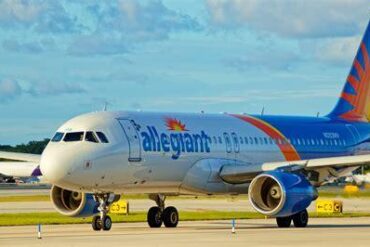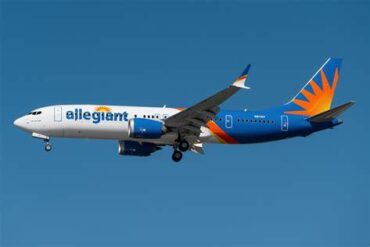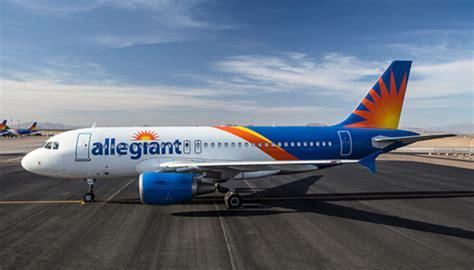
Allegiant Travel Company has delivered a remarkable performance in May 2025, reinforcing its position as one of the fastest-growing airlines in the U.S. aviation sector. The Las Vegas-based low-cost carrier reported substantial growth in both passenger traffic and operational capacity, signaling its ability to meet the sustained demand for budget-friendly, non-stop flights to popular leisure destinations.
The airline announced a 9.2% year-over-year increase in scheduled service passengers, transporting 1,545,033 travelers in May 2025 compared to 1,414,692 during the same period last year. This significant rise underscores Allegiant’s strategic focus on affordable, point-to-point travel, which continues to resonate with cost-conscious travelers seeking reliable options to major vacation hubs.
Strong Performance in Passenger Miles and Capacity Expansion
In addition to impressive passenger growth, Allegiant posted substantial gains in revenue passenger miles (RPMs), a vital industry metric that reflects the number of miles flown by paying customers. In May 2025, RPMs surged by 10.2%, reaching 1.39 billion miles, marking a clear indication of the airline’s ability to attract and serve more travelers over longer distances.
Meanwhile, available seat miles (ASMs)—a measure of total seating capacity—climbed by 16.3%, totaling 1.73 billion miles for the month. This expansion reflects Allegiant’s proactive approach to scaling operations, introducing more flights, and enhancing its route network to meet escalating consumer demand.
Despite the notable increase in capacity, the airline experienced a slight dip in its load factor, which tracks the percentage of seats filled on flights. Allegiant’s load factor for May 2025 stood at 80.3%, down 4.5 percentage points from 84.8% a year prior. The decrease, though moderate, highlights the challenge of balancing rapid capacity growth with optimal seat utilization.
Record Flight Departures Reflect Growing Market Demand
Allegiant’s operational expansion extended to flight activity, with the airline operating 11,174 flights in May 2025—a 16.2% increase compared to the same month last year. This uptick in departures showcases the airline’s ability to mobilize its fleet efficiently while tapping into the robust appetite for domestic leisure travel.
When accounting for both scheduled service and fixed-fee contract operations, Allegiant’s total system performance presents an even stronger narrative. The combined passenger tally reached 1,563,294 travelers, representing a 9.4% year-over-year increase, while system-wide ASMs rose by 16.5% to 1.79 billion miles. The airline’s total departures also grew by 16.7%, totaling 11,641 flights for the month.

Stable Stage Length and Fuel Cost Challenges
Allegiant maintained a consistent average stage length—the average distance flown per flight—recording 884 miles for scheduled services and 878 miles across the total system. This stability aligns with Allegiant’s strategic focus on operating medium-haul, direct flights that connect underserved markets with popular vacation destinations.
However, the airline continues to grapple with elevated fuel costs, a persistent challenge facing the broader aviation sector. For May 2025, Allegiant reported an average fuel price of $2.37 per gallon, reflecting ongoing volatility in global energy markets. Fuel expenses remain a critical variable impacting the airline’s operating margins, especially for carriers with price-sensitive business models like Allegiant.
Exceeding Q1 2025 Earnings Expectations Despite Revenue Headwinds
Allegiant’s operational momentum translated into robust financial performance, with the airline surpassing Wall Street’s earnings expectations for the first quarter of 2025. The company reported earnings per share (EPS) of $1.81, outperforming the consensus forecast of $1.70, signaling effective cost management and operational efficiency.
While total revenue for the quarter reached $699.1 million, slightly below analyst projections of $701.23 million, Allegiant’s prudent financial strategy and focus on cost containment helped sustain profitability. The airline’s net income stood at $33.4 million, with $39 million attributed to the core airline segment, reinforcing the strength of its passenger-focused operations.
Capacity also grew by 14%, supported by a 3-percentage point increase in operating margin, further illustrating Allegiant’s resilience in navigating rising costs while meeting growing travel demand.

Market Outlook: Analyst Caution Amid Economic Uncertainty
Despite its robust quarterly results, Allegiant faces a cautious market outlook. Investment bank Goldman Sachs maintained a Neutral rating on the airline’s stock, setting a price target of $56.00. Analysts expressed concerns over the company’s second-quarter 2025 guidance, which projects an EPS range from break-even to $1.00, falling short of the broader market’s expectation of $1.85.
In response to prevailing economic headwinds and unpredictable market dynamics, Allegiant opted to withdraw its full-year EPS guidance for 2025, introducing a layer of uncertainty for investors. Nonetheless, the airline emphasized its commitment to leveraging operational flexibility and cost management to preserve profitability amid macroeconomic fluctuations.
April 2025 Performance Highlights Strengthening Market Confidence
The preliminary results from April 2025 provided additional optimism regarding Allegiant’s growth trajectory. The airline reported a 15.0% increase in system-wide passenger traffic, with 1,543,689 total passengers, including those traveling under fixed-fee contracts. This strong performance mirrored May’s momentum and further validated Allegiant’s competitive positioning.
However, Allegiant faced heightened fuel expenses in April, with average costs reaching $2.51 per gallon, underlining the broader inflationary pressures impacting airline profitability. Despite this, the carrier’s adaptable business model—designed to adjust capacity during off-peak periods while maximizing efficiency during high-demand seasons—has proven instrumental in safeguarding its market share.
Future Prospects: Operational Efficiency and Strategic Market Focus
Looking ahead, Allegiant is poised to capitalize on the rising demand for budget-friendly, non-stop travel to top U.S. vacation destinations. Its strategy emphasizes operational efficiency, fleet optimization, and responsive route management, all essential for maintaining growth in an evolving aviation landscape.
As the airline navigates the second half of 2025, its ability to adapt to shifting economic conditions, manage fuel price volatility, and sustain demand for leisure travel will be critical. Allegiant’s focus on underserved markets and its reputation for reliable, affordable service positions it favorably to withstand competitive pressures and economic challenges.
While uncertainties persist, particularly regarding earnings forecasts, Allegiant’s recent performance underscores its strength as a nimble, growth-oriented carrier committed to expanding its footprint in the U.S. aviation market.
The coming months will serve as a crucial test for Allegiant’s operational model, with its success likely hinging on continued efficiency, prudent cost control, and strategic alignment with evolving traveler preferences. For now, Allegiant’s May 2025 results firmly establish it as a leading player in the domestic travel space, signaling confidence in its long-term growth potential.