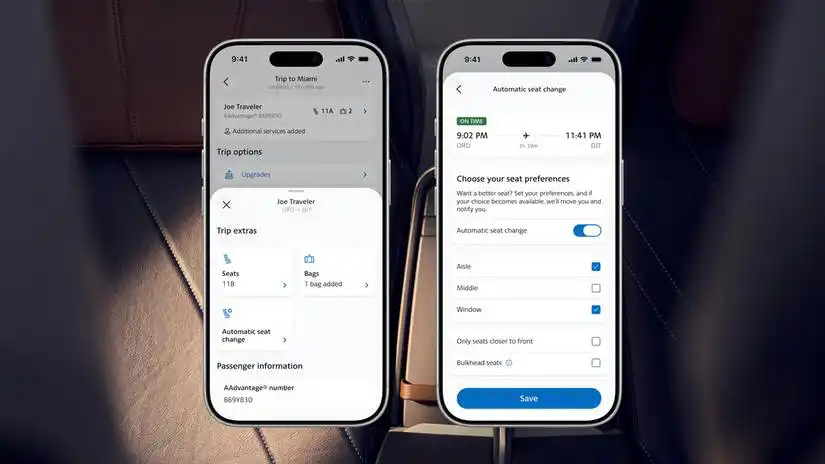
American Airlines is introducing a new automated seat-monitoring feature designed to take one of the more tedious parts of preparing for a flight out of passengers’ hands. Eligible AAdvantage members will be able to tell the airline what type of seat they prefer, such as a window or aisle, and the system will continue monitoring the seat map after booking. If a matching eligible seat becomes available, American can automatically move the traveler into it without requiring the customer to repeatedly check the reservation.
The change targets a familiar frustration for frequent flyers. A desirable seat may be occupied when a reservation is first made, only to become available later when another passenger changes their seat, cancels a trip, upgrades, or otherwise modifies a reservation. Until now, travelers who wanted to capture that newly available seat generally had to keep returning to the airline’s website or app and checking the seat map themselves.
American’s new approach turns that repeated manual process into an automated one. Instead of asking passengers to remember to check their reservations every few days, the system monitors availability in the background and applies the preferences selected by the traveler. For someone initially stuck in a middle seat, that could mean receiving an aisle or window seat later without having to notice the opening first.
How American Airlines’ Automatic Seat Selection Works
The new feature is available to AAdvantage members who opt in after completing an eligible booking. During the process, travelers can identify the characteristics they want in their seat, allowing the system to search for an appropriate match as the departure date approaches.
The monitoring is not limited to a single check. American’s system can revisit the seat map multiple times and automatically assign a qualifying seat when one becomes available. Once the change is made, the reservation is updated and the customer receives a notification, removing the need to repeatedly open the American Airlines app simply to see whether something better has appeared.
The system can consider preferences such as a window seat, aisle seat, middle seat, or a position toward the front of the aircraft, depending on the options available for the particular booking. The important distinction is that travelers are not simply placed into any newly opened seat. The automated reassignment is intended to follow the preferences established during enrollment.
This makes the feature particularly useful for passengers who care about where they sit but do not necessarily want to pay more for a premium seat. A traveler might accept an initially available seat because it is the only practical option at booking, then allow American’s technology to search for a preferred eligible seat later.
American Airlines Seat Changes Have Important Limits
There are several restrictions that passengers need to understand before assuming the system can deliver any seat they want. Automatic changes are limited to eligible seats within the passenger’s confirmed cabin. The feature does not turn a standard economy reservation into a premium-cabin upgrade, nor does it automatically unlock every paid seating option on the aircraft.
American also says the automated process will not generate additional seat-selection charges for an eligible reassignment. However, higher-priced seats and certain paid preferred-seat products remain outside the scope of the feature. Passengers who specifically want a seat that carries a separate charge would still need to follow the applicable purchase process.
Timing is another important limitation. The automatic monitoring is available up to 24 hours before departure. Once the flight enters that final 24-hour period, the system stops making these automated changes. The same applies if the traveler manually changes the seat after enrolling, meaning passengers cannot necessarily expect the system to continue overriding their subsequent choices.
These restrictions create a fairly defined role for the technology: it is designed to improve the seat that a traveler already has within the conditions of the existing reservation, rather than functioning as an unrestricted seat-upgrade system.
Why American Airlines Is Automating Seat Monitoring
Seat selection may look like a small part of the airline journey, but it creates a disproportionate amount of repetitive work for travelers. Passengers often know exactly what they want but have no way of knowing when that seat will become available. The result can be repeated searches across days or weeks, particularly for flights where preferred seats are initially occupied.
American’s new system addresses that problem by moving the monitoring responsibility from the passenger to the airline’s technology. Instead of requiring customers to remember to check, the system continuously watches qualifying seat availability and acts according to the preference that was previously provided.
American Chief Customer Officer Heather Garboden described the initiative as an effort to make travel more personalized while reducing the work required from customers. The concept is straightforward: passengers specify what they want once, and the technology handles the repeated checking afterward.
American Airlines Links the Feature to Its Technology Strategy
The automated seat-monitoring project is part of American Airlines’ ADEPT program, which focuses on developing technology talent and giving employees opportunities to solve practical business and customer problems. The airline says the project combines hands-on technology development with an understanding of operational and customer requirements.
American Chief Digital and Information Officer Ganesh Jayaram also connected the project to the carrier’s broader use of artificial intelligence-enabled tools. AI is being used to support development workflows and help technology teams work more efficiently, while the resulting products are aimed at specific customer problems rather than technology for its own sake.
That distinction is important because the seat-monitoring feature is relatively simple from the passenger’s perspective. There is no complicated interface to learn and no need to repeatedly interact with an AI system. The technology is largely invisible after the preference is established, working in the background until an eligible opportunity appears.
A Small Change That Could Make Seat Selection Easier
American Airlines’ automated seat monitoring does not eliminate every limitation associated with airline seat selection, particularly when passengers want premium or separately priced seats. It does, however, address a very specific inconvenience that many travelers encounter: finding a better seat only after they have already completed their booking.
For eligible AAdvantage members, the biggest benefit is therefore convenience rather than an expanded selection of seats. A passenger who initially receives a middle seat can specify an aisle or window preference and allow American’s system to keep watching for an eligible opening. If the right seat becomes available before the monitoring deadline, the airline can make the change automatically and notify the passenger.
The feature reflects a broader shift in airline technology toward removing repetitive tasks from customers. Rather than making passengers constantly monitor their reservations for small improvements, American is attempting to let its digital systems perform that work in the background. For travelers who care about their seat but would rather not spend the weeks before a flight refreshing a seat map, that could make an otherwise mundane part of the booking process considerably easier.