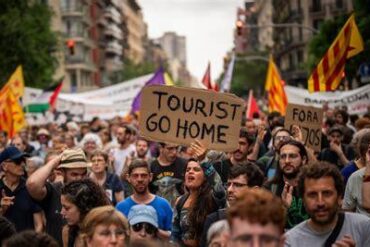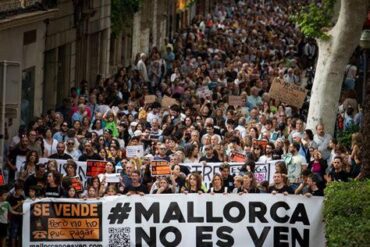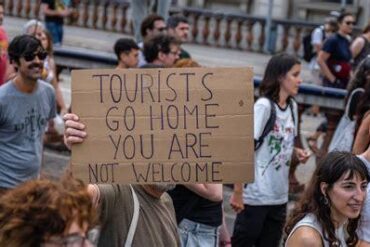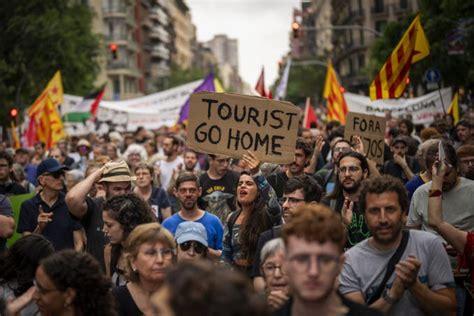
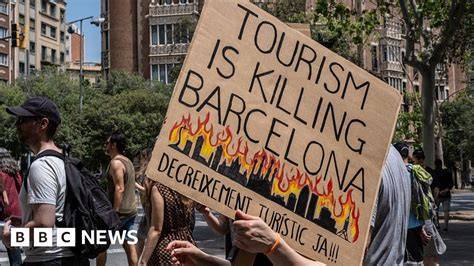
Barcelona’s simmering discontent with mass tourism erupted once again on Sunday, June 15, 2025, as thousands of residents and activists flooded the streets, demanding immediate structural changes to the city’s tourism model. Under the banner “Tourism steals our bread, homes, and future,” demonstrators gathered at Jardinets de Gràcia, sparking a powerful movement of resistance marked by color, defiance, and a growing call for “tourism degrowth.”
The march, organized by the Assembly of Neighborhoods for Tourism Degrowth, represents more than a moment of protest—it is the latest flare-up in a prolonged battle against what locals describe as the devastating consequences of unchecked visitor influx. Barcelona, once celebrated for its vibrancy and architectural marvels, has become a battleground where residents confront the consequences of a city designed for outsiders, not those who live within it.
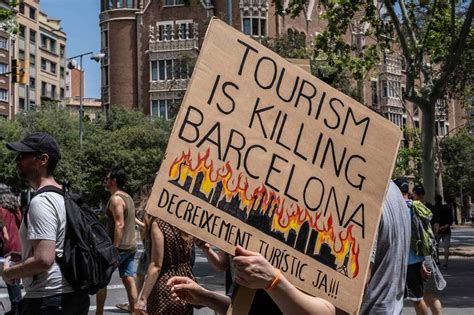
The Growing Anti-Tourism Movement: From Margins to Mainstream
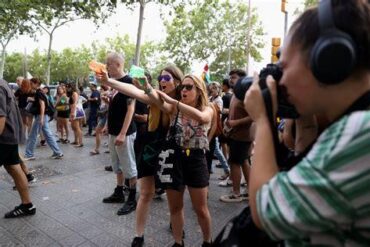
While similar protests took place in 2024, the 2025 rally revealed an intensified anger. Protesters, armed symbolically with colorful water pistols, took to the streets once more to challenge what they see as the commodification of their neighborhoods and livelihoods. Water pistols, now emblematic of peaceful resistance, represent both playfulness and pointed criticism—spraying not bullets, but a message that cannot be ignored: “enough is enough.”
Local police estimated the turnout at around 600, while organizers claimed closer to 3,000 participants. Regardless of the exact number, the message carried weight. From the Passeig de Gràcia to Sagrada Família, chants of “One more tourist, one less neighbor” echoed through the narrow lanes and bustling plazas, a harsh but honest encapsulation of public sentiment.
Housing Crisis: Locals Priced Out by Vacation Rentals
Perhaps the most viscerally felt consequence of overtourism is the spiraling housing crisis. Residents of long-established neighborhoods like El Raval and Gràcia have seen rent prices skyrocket, driven by the proliferation of short-term rentals listed on platforms like Airbnb. Apartments that once housed families now serve as weekend getaways for visitors.
Long-term residents, especially the elderly and low-income families, are being displaced by landlords chasing higher tourist profits. Gentrification is accelerating at an unsustainable pace, and the city’s character—once defined by intergenerational communities and Catalan traditions—is eroding under the weight of market forces.
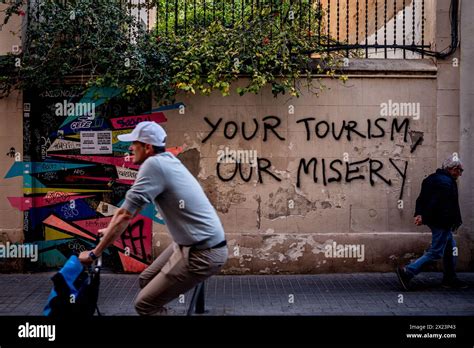
Worker Exploitation in the Tourism Sector: Hidden Suffering Behind the Glamour
While Barcelona’s economy reaps billions from its booming tourism sector, the laborers behind the scenes remain in precarious conditions. Groups like the Kellys, an association of hotel cleaning staff, joined the protest to spotlight their struggle. Many of these workers, mostly women and often migrants, endure low wages, unsafe conditions, and zero-hour contracts.
Their voices are often drowned by the glamour of luxury hotels and Michelin-starred dining, but on Sunday, they stood front and center, backed by labor unions and grassroots collectives. Alongside them were members of Top Manta, Barcelona’s informal street vendors—many of whom are undocumented migrants navigating an economy that criminalizes their livelihoods while profiting from their cultural contributions.
Protest Turns Symbolic and Confrontational
As the protest weaved through Barcelona’s main arteries, specific symbols of luxury tourism and gentrification were targeted. Outside a prominent hostel, protesters plastered stickers, blocked the entrance with tape, and sprayed water in symbolic protest. A brief confrontation with hostel staff drew police attention but did not halt the march.
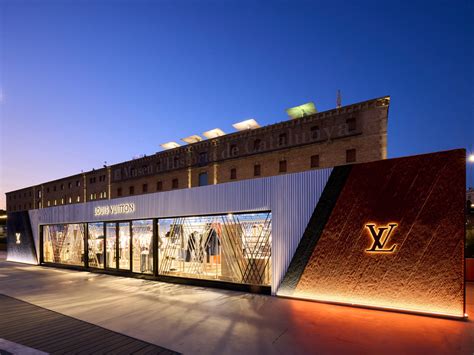
The Louis Vuitton store on Passeig de Gràcia, a high-end emblem of Barcelona’s transformation into a luxury playground, was also targeted. Smoke bombs and water jets colored its opulent facade, reflecting the growing chasm between the wealth brought by tourism and the poverty experienced by those servicing it.
From Local Anger to National and International Solidarity
Barcelona is not alone in its outcry. The city’s protest was part of a broader, transnational wave of demonstrations across Spain and beyond. In cities like Ibiza, San Sebastián, Palma, Granada, and even the Pyrenees, similar movements called attention to the degradation of local life by mass tourism.
Beyond Spain’s borders, solidarity actions occurred in Lisbon, Venice, and Florence, where overtourism has similarly warped urban economies and destroyed housing stability. The synchronization of these demonstrations reveals that the tourism crisis is not a localized nuisance—it’s a global structural problem demanding systemic reform.
The Airport Controversy: Expanding Capacity, Igniting Resistance
A focal point of tension is the proposed expansion of Barcelona-El Prat Airport, a project backed by industry interests as a means to boost international arrivals. Yet to protesters, this represents a betrayal of the city’s climate goals and a blatant prioritization of tourists over residents.
The Zeroport movement, which participated in the protest, described the project as ecologically destructive and economically short-sighted. Their slogans and speeches made clear that resistance is not anti-tourist per se, but anti-system: “Our protest is directed at policies and politicians, not individuals booking holidays.”
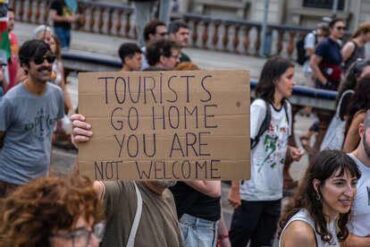
Still, the nuance of that distinction is often lost in the heat of protest, where slogans like “Tourist, go home” capture the visceral rage of those who feel silenced by polite discourse.
Politicians and Policymakers: Caught Between Industry and Citizens
City officials have long walked a political tightrope between encouraging tourism revenue and appeasing public frustration. The City Council’s attempts to regulate short-term rentals, restrict new hotel licenses, and redirect tourists away from overburdened neighborhoods have had mixed success.
Some view these measures as insufficient window dressing, designed more for optics than impact. Others believe incremental reforms are the only politically viable path forward. But with rising turnout at protests and increasing public engagement, calls for more radical changes—like capping tourist numbers or banning short-term rentals outright—are gaining ground.
Tourism Degrowth: A Radical but Rising Vision
The term “tourism degrowth” has moved from academic fringe to protest frontlines. Advocates argue that sustainability is incompatible with growth-based tourism models. Instead of maximizing arrivals, Barcelona should be rethinking what kind of tourism aligns with its social fabric, environmental capacity, and cultural identity.
This means promoting longer stays over quick visits, supporting cultural and ecological tourism, and shifting revenue models to benefit communities instead of corporations. It also means listening to those most affected—cleaners, renters, vendors, and lifelong residents who increasingly feel like strangers in their own city.
The Road Ahead: Conflict, Negotiation, and Potential for Change
Barcelona’s 2025 protest will not be the last. If anything, it signals a rising tide of urban resistance against extractive tourism economics. The challenge now is whether political leaders will heed these warnings or continue betting on the golden goose of tourism profits.
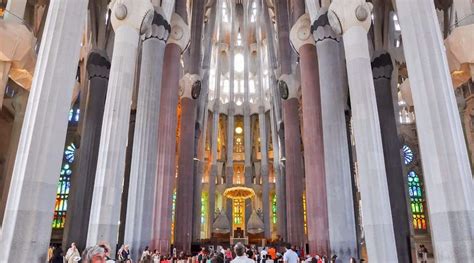
The city’s identity, economy, and livability hang in the balance. As tourists sip sangria beneath Gaudí’s spires, locals are asking whether their voices matter in a city increasingly built for someone else. The answer will shape not only the future of Barcelona but the very model of urban tourism worldwide.
Conclusion: A City at a Crossroads
Barcelona is no longer just a case study of successful tourism marketing—it is a living example of how success, when unregulated, can become its own undoing. The June 2025 protest, with its water pistols, chants, and smoke-filled symbolism, captured a truth that numbers alone cannot tell.
Behind the glossy brochures and Instagrammable streets, a battle for the soul of the city is raging. Whether the world listens will determine not just the fate of Barcelona, but the future of tourism as a whole.