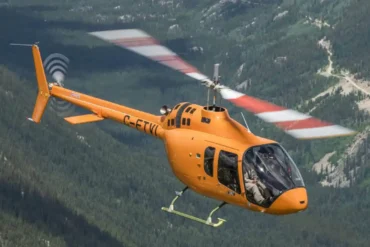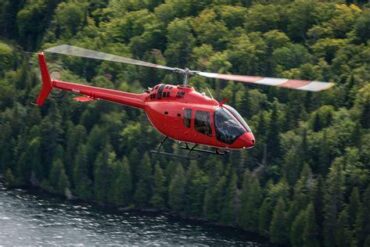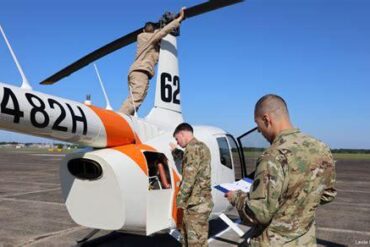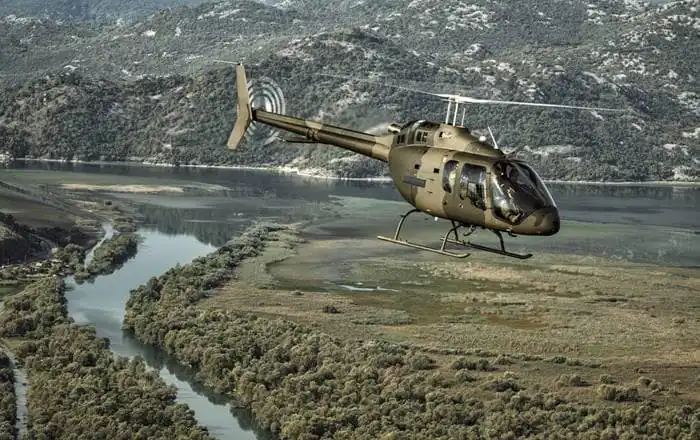
Bell is introducing a new version of its 505 Jet Ranger X, aiming to provide the U.S. Army with a tailored helicopter for training purposes. This variant is specifically designed to meet instrument flight rules (IFR) standards and supports the Army’s Flight School Next program. Bell’s proposal focuses on improving the quality of rotary-wing training while offering a more cost-effective alternative to the current fleet.
The Army’s current trainer, the UH-72 Lakota, is a twin-engine light utility helicopter. While it’s reliable and sophisticated, concerns have grown over its high operating costs and how its complexity may be affecting pilots’ fundamental flight skills. Bell believes its single-engine 505 can address both issues by providing a more basic, hands-on flying experience at a lower price point.
Carl Coffman, Vice President of Military Sales and Strategy at Bell, shared the company’s plans during the Vertical Aviation International’s Verticon event in Dallas. He explained that Bell’s 505 is not just a retrofit of an existing model but a “purpose-built” solution. The helicopter will use modern avionics, such as the Garmin suite, but still encourage manual flying skills, helping students master key maneuvers like tail rotor control.
Recent Army reviews noted several accidents tied to pilot errors involving tail rotor authority. In many cases, pilots didn’t apply full left pedal when needed, possibly because they had become too reliant on automated systems like those in the Lakota. Bell’s proposal aims to break that pattern by reintroducing a more traditional training platform that emphasizes stick-and-rudder flying.
The Army has already launched early trials with various industry partners, testing different training paths for small groups of pilots. However, Bell chose not to participate in this phase to avoid any advantage in the upcoming Flight School Next competition. Once the initial trials are complete, the Army will evaluate results and compare them to the current training model.
Even though Bell is keeping its IFR-capable 505 out of the early trials, it is actively working toward FAA certification for the aircraft. This variant will also be available to civilian buyers, expanding its reach beyond military contracts. If selected, the aircraft will continue to be built in Mirabel, Canada, where Bell’s commercial helicopters are currently produced. Coffman emphasized, though, that the aircraft still qualifies as American, noting that final assembly location doesn’t change its core identity.
The 505 Jet Ranger X is already used for military training in Iraq, Jordan, and South Korea. Its growing global presence helps strengthen Bell’s case for adoption by the U.S. Army. Compared to the Lakota, Coffman said the 505 could cut training costs in half while producing pilots with stronger manual flying skills.
The Army’s current reliance on the Lakota stemmed from the Aviation Restructuring Initiative, which determined that its glass cockpit made it a good stepping stone to operational platforms like the AH-64 Apache, UH-60 Black Hawk, and CH-47 Chinook. Before the Lakota, however, the Army used the Bell TH-67 Creek—a version of the Bell 206 Jet Ranger—as its primary training helicopter. Bell now wants to bring that full circle with a modern update to a familiar airframe.
Other companies are also eyeing the opportunity. Robinson Helicopters has confirmed its intent to offer the R66 turbine light helicopter as a competitor. In a February interview with Aviation Week, Robinson CEO David Smith pointed to the R66’s low operating costs—around $410 per hour—as a major advantage. He also highlighted its U.S. manufacturing credentials and high production rate as additional selling points.
Ultimately, the Army’s next training helicopter could go in several directions. But Bell believes its 505 Jet Ranger X stands out by offering a balanced mix of advanced technology and fundamental training value. The company is confident that its approach will resonate with Army leaders who are eager to improve pilot readiness while controlling training costs.