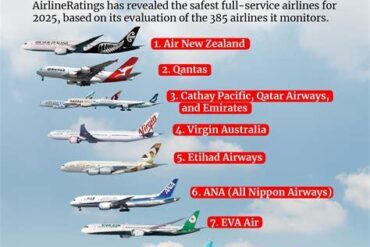
Flying has long been regarded as one of the safest modes of transportation, and airlines like Emirates, Oman Air, Qatar Airways, Swiss International, Vietnam Airlines, Virgin Atlantic, EasyJet, Ryanair, JetBlue, and Frontier Airlines exemplify this remarkable safety record. These airlines have consistently demonstrated outstanding performance in aviation safety, often without a single fatal accident throughout their operational histories. The safety of air travel is underpinned by rigorous pilot training, advanced aircraft maintenance, state-of-the-art navigation systems, and a steadfast adherence to international aviation standards. In a world where road, rail, and sea travel can pose significant risks, the data overwhelmingly supports the assertion that flying—especially with these top-performing carriers—is remarkably secure.
The Statistics Speak: Why Flying Is Safer
Despite the recent tragedies in aviation, such as the heartbreaking crash involving an Air India Boeing 787 Dreamliner, the statistics surrounding air travel remain compelling. The chances of being involved in a fatal plane crash are estimated to be lower than one in eleven million. This stark reality highlights the advancements in aircraft design, regulatory oversight, and maintenance procedures that have evolved over decades. Each incident, while tragic, acts as a catalyst for global reviews and improvements in flight protocols. The aviation industry’s commitment to passenger safety ensures that lessons are learned and shared worldwide, making air travel progressively safer.
The Impact of Recent Tragedies on Public Perception
The recent Air India disaster, which tragically resulted in the loss of two hundred and forty-one lives, has reignited public scrutiny around the safety of commercial aviation. While such events understandably evoke fear, it’s crucial to recognize that they are exceedingly rare in modern aviation. The overwhelming majority of flights operate without incident, and the safety records of numerous airlines reinforce this fact. It is essential to approach these tragedies with a balanced perspective, understanding that the aviation industry is resilient and continually improving.
Airlines with Unbroken Safety Records
Across the globe, numerous airlines have established impeccable safety records. Notably, Ryanair, EasyJet, Virgin Atlantic, Emirates, Southwest Airlines, JetBlue, Qatar Airways, and Swiss International have collectively transported millions of passengers without a single fatal accident. This impressive track record underscores that a strong commitment to safety is achievable, irrespective of the airline’s business model, whether budget or premium.
For instance, Ryanair, despite being known primarily for its low-cost, no-frills approach, has operated since 1985 without experiencing a fatal crash. Its only significant incident occurred in 2008 due to a bird strike during landing, resulting in injuries but no fatalities. Similarly, EasyJet, a UK-based carrier founded in the mid-1990s, has maintained a flawless safety history, serving millions of travelers across Europe with rigorous safety standards.
Virgin Atlantic, along with its affiliates, has also upheld a clean safety record since its inception in 1984. Their commitment to passenger comfort and innovation is matched by robust operational protocols, ensuring consistent safety through extensive pilot training and technical upgrades.
Beyond these well-known brands, lesser-known carriers such as Oman Airways, Frontier Airlines, Vietnam Airlines, and others have also built strong reputations based on reliability and a commitment to passenger safety. Each airline demonstrates that operational excellence is paramount, regardless of its market visibility.
Choosing the Right Airline for Enhanced Safety
For travelers feeling uneasy about flying, especially after high-profile accidents, selecting an airline with a proven safety record can significantly enhance passenger confidence. Airlines that prioritize safety are more likely to invest in the latest aircraft technologies, enforce strict maintenance routines, and continuously improve crew training and emergency response procedures.
Moreover, regulatory agencies in Europe, North America, and certain parts of Asia impose some of the highest safety standards globally. Airlines operating under these stringent jurisdictions are routinely inspected and held to international safety benchmarks. Thus, flying with reputable carriers from these regions substantially lowers the risk associated with air travel.
The Aviation Industry’s Commitment to Continuous Improvement
The aviation sector is one of the most rigorously regulated industries in the world. Every accident, however rare, undergoes thorough investigation, with findings shared internationally to prevent future occurrences. This culture of transparency and continuous improvement ensures that air travel becomes safer year after year. Technological advancements, such as real-time aircraft monitoring, predictive maintenance systems, and sophisticated autopilot controls, further bolster safety in aviation.
In high-traffic airspaces, pilots benefit from the support of air traffic controllers, weather analysts, and dispatch teams, all working collaboratively to ensure smooth operations from takeoff to landing. The combined efforts of these professionals contribute to the exceptional safety records maintained by airlines such as Emirates, Oman, Qatar, Swiss, Vietnam, Virgin, EasyJet, Ryanair, JetBlue, and Frontier.
The Final Verdict: Fly Smart, Fly Safe
While the loss of lives in the recent Air India crash is indeed tragic, it should not overshadow the broader reality that commercial aviation remains one of the safest methods of travel available today. The data, coupled with the impressive safety records of many airlines, underscores the effectiveness of stringent safety protocols and advancements in technology. By choosing to fly with one of the forty-two airlines that have never recorded a fatal accident, passengers can embark on their journeys with greater assurance and peace of mind. These carriers have demonstrated that achieving zero fatalities is possible through rigorous discipline, consistent oversight, and a culture that prioritizes safety above all else.