Flying long haul is not just about the aircraft type; it is about where you sit inside it. On Emirates’ Boeing 777-300ER fleet in 2026, seat choice can quietly determine whether a journey feels merely tolerable or genuinely exceptional. Emirates operates one of the world’s most diverse 777-300ER cabin portfolios, spanning First Class suites, Business Class lie-flat seats, Premium Economy recliners, and Economy Class seating that remains competitive by global standards. Each class has standout rows and subtle traps, and the differences are rarely obvious from a simple seat map.
This guide dissects the Emirates 777-300ER experience with an editor’s eye and a frequent flyer’s instinct, focusing on the best seats in each class, why they matter, and how small layout nuances translate into real comfort over ten-plus hours in the air. The emphasis here is practical, specific, and rooted in how the cabins are actually used in 2026, not how they look in marketing photos.
Emirates Boeing 777-300ER Cabin Overview in 2026
Emirates’ 777-300ER fleet is far from uniform. Aircraft operate in two-class, three-class, and four-class configurations, with Premium Economy increasingly standard as refurbished aircraft rejoin the network. Despite these variations, Emirates maintains a consistent design language: warm lighting, understated luxury, and an obsessive focus on in-flight service flow.
First and Business Class dominate the forward fuselage, while Premium Economy creates a meaningful buffer between premium and economy cabins. Economy Class, although denser than on the A380, benefits from excellent seat padding, generous entertainment screens, and polished cabin finishes that elevate the experience above most competitors in the same 3-4-3 layout.
First Class on the Emirates 777-300ER: Where Every Seat Feels Like the Best Seat
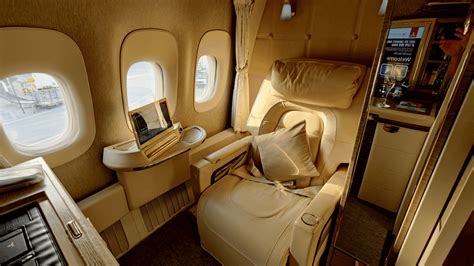
Emirates First Class on the 777-300ER is often described as a private hotel room at 40,000 feet, and in practical terms, that description is earned. Each aircraft offers fully enclosed suites with floor-to-ceiling sliding doors, arranged in a 1-1-1 configuration across the cabin.
From a purely technical standpoint, there is no “bad” First Class seat. Every suite includes a true lie-flat bed with mattress, zero-gravity seating position, personal minibar, vanity table, wardrobe, and customizable ambient lighting. Temperature controls are individual, not cabin-wide, which is rare even in First Class globally.
The subtle difference lies in window access. Outboard suites offer three real windows, a remarkable feature that enhances the sense of space and connection to the outside world. Center suites, by contrast, use virtual windows, high-definition screens that mirror exterior camera views. They are impressive, but travelers who value natural light tend to prefer the window suites.
Noise isolation is exceptional across the cabin, but suites closer to the cockpit are marginally quieter during meal preparation. For passengers who plan to sleep early on overnight sectors, forward suites deliver the calmest environment. Ultimately, Emirates has engineered First Class on the 777 so thoroughly that seat choice becomes a matter of personal philosophy rather than compromise.
Business Class on the Emirates 777-300ER: Strategic Seat Selection Matters
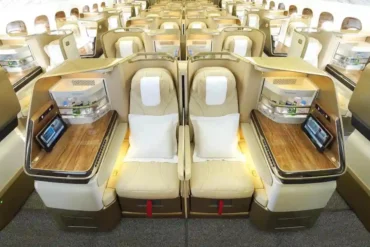
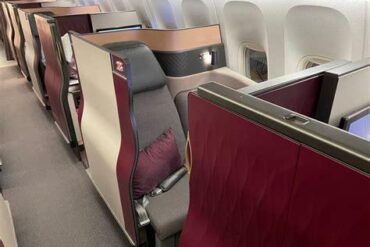
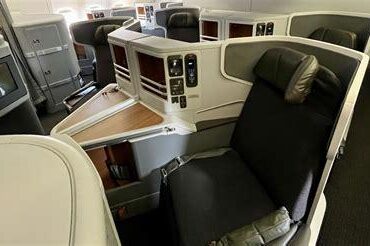
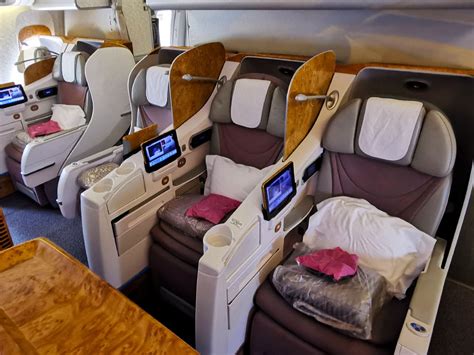
Business Class on the Emirates 777-300ER is where seat choice begins to materially affect the experience. Unlike the A380’s 1-2-1 layout, the 777 uses a 2-3-2 configuration with angled lie-flat seats, meaning not every passenger has direct aisle access.
In four-class configurations, the frontmost Business Class rows offer a quieter ride and faster service, as crew workflow naturally begins at the front of the cabin. These rows are also ideal for travelers with tight connections, minimizing disembarkation time.
On two-class extended-range aircraft, seats 2J and 2K stand out for an unusual reason: they face open crew areas, creating a sense of extra space ahead. This makes the footwell feel less confined, a small detail that becomes meaningful on flights exceeding twelve hours.
Rows adjacent to galleys and lavatories offer convenience but introduce light and movement during rest periods. Travelers sensitive to disruption should avoid these zones, particularly on overnight routes. Aisle seats remain the most practical choice, reducing the need to step over neighbors when the seat is in bed mode.
While the Business Class seat itself is not cutting-edge by 2026 standards, Emirates compensates with exceptional catering, refined service rituals, and a polished social area that reinforces the premium feel of the cabin.
Premium Economy on the Emirates 777-300ER: The Quiet Sweet Spot
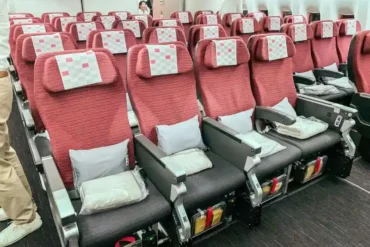
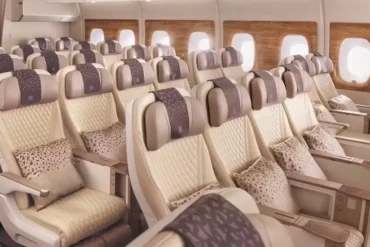
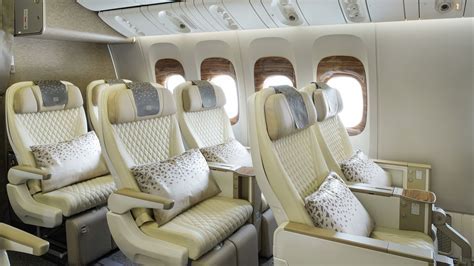
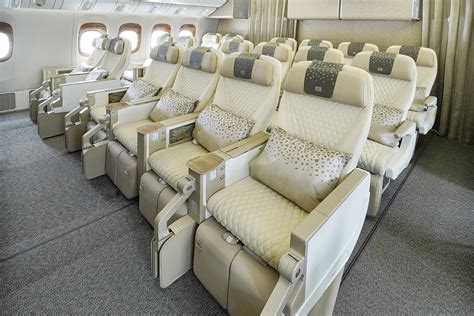
Premium Economy has emerged as one of Emirates’ strongest products, and on the 777-300ER, it occupies a carefully protected cabin zone. Seats feature leather upholstery, wide armrests, deep recline, calf and footrests, and up to 40 inches of pitch, a meaningful upgrade over Economy Class in every dimension.
In four-class aircraft, Row 14 is the most desirable. Positioned at the front of the Premium Economy cabin, it benefits from unobstructed space ahead, enhancing both legroom perception and ease of movement. There is no seatback immediately in front, which also improves screen viewing angles.
Because all Premium Economy rows share similar dimensions, seat choice revolves around traffic flow rather than physical comfort. Aisle seats simplify access to lavatories without disturbing neighbors, while window seats offer a calmer experience for those planning to sleep.
The cabin is separated by curtains rather than rigid bulkheads, but Emirates’ soundproofing and lighting design keep disturbances minimal. Meals are served on Royal Doulton china with proper cutlery, reinforcing the sense that Premium Economy is not merely an economy upgrade but a distinct product tier.
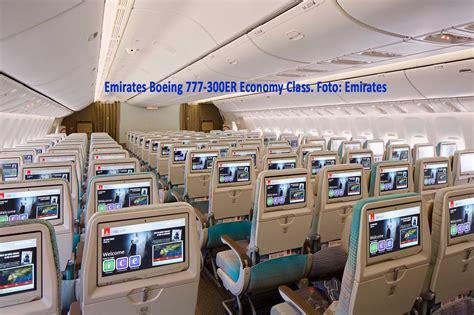
Economy Class on the Emirates 777-300ER: Choosing Wisely Pays Off
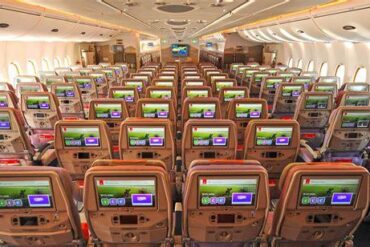
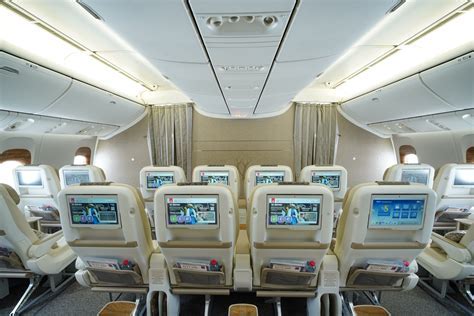
Economy Class on the 777-300ER is arranged in a 3-4-3 layout, with seat pitch ranging from 32 to 34 inches depending on configuration. While this density is unavoidable, Emirates mitigates it with high-quality seat cushioning, large HD screens, and one of the most comprehensive in-flight entertainment libraries in the industry.
Seat selection in Economy is highly configuration-dependent. Bulkhead and exit-row seats offer the most legroom, but often come with fixed armrests and limited under-seat storage. For taller passengers, the trade-off is usually worthwhile.
Mid-cabin rows such as Rows 37 to 45 tend to offer the best balance of stability, wing-level views, and distance from high-traffic galleys. Twin seats near the rear of the cabin, where available, are particularly appealing for couples seeking extra shoulder space without paying for an upgrade.
Seats near lavatories provide convenience but introduce noise and light during overnight flights. Travelers prioritizing sleep should aim for rows positioned between major service areas, where foot traffic is lighter and cabin lighting remains dimmer for longer periods.
Onboard Comfort Beyond the Seat Itself
Across all classes, Emirates invests heavily in the details that shape long-haul comfort. Complimentary amenity kits, sustainable materials, and thoughtfully designed cabin lighting contribute to reduced fatigue. Wi-Fi availability, while variable by route, allows messaging and browsing, particularly useful for Business and First Class passengers.
The ICE entertainment system remains a standout feature, offering thousands of hours of content across multiple languages. In Economy Class especially, this system plays an outsized role in perceived comfort, transforming long sectors into manageable experiences.
Dining quality scales naturally by class, but even Economy passengers benefit from multicourse meals, free beverages, and regionally inspired menus, reinforcing Emirates’ reputation for consistent service delivery.
Emirates Skywards and Seat Selection Strategy
Seat choice becomes easier with Emirates Skywards status. Even at entry-level tiers, members gain free seat selection and priority services, while higher tiers unlock lounge access, additional baggage allowance, and priority boarding.
For frequent travelers, Skywards status effectively expands the range of “best seats” by removing cost barriers to early selection. This is particularly valuable in Premium Economy and Business Class, where optimal rows sell out quickly on popular routes.
Emirates’ independence from major alliances does not diminish Skywards’ value. Partnerships with carriers such as Japan Airlines, United Airlines, and Air Canada broaden earning and redemption opportunities, making strategic seat selection part of a wider travel optimization approach.
Final Thoughts: Matching the Seat to the Journey
On the Emirates Boeing 777-300ER in 2026, the best seat is not defined solely by class but by how well it aligns with the traveler’s priorities. First Class offers uniform excellence with minor variations in window access. Business Class rewards careful selection with quieter rows and easier aisle access. Premium Economy shines as the most balanced option for comfort and value, while Economy Class becomes dramatically more pleasant when the right row is chosen.
Understanding these nuances transforms the 777-300ER from a familiar long-haul workhorse into a tailored travel experience. When seat choice is approached strategically, Emirates’ flagship twin-engine aircraft delivers comfort that extends well beyond its reputation, proving that in aviation, details are destiny.