Professional sports are built on inches, milliseconds, and margins so slim they might as well be drawn with a razor blade. Teams invest millions in nutrition, analytics, biomechanics, and recovery science to gain even the slightest edge. Yet one of the most decisive advantages happens long before tip-off or kickoff—at 35,000 feet. While most franchises rely on charter agreements with major carriers, a select few have taken control of their destinies in the sky. These organizations operate their own aircraft, transforming air travel from logistical necessity into strategic weapon.
Owning a jet is not about vanity. It is about time, control, and physiological optimization. Commercial charters, even premium ones, follow airline constraints. Team-owned aircraft operate on the team’s clock. Departure times adjust to overtime games. Routes shift with weather systems. Cabins are redesigned around seven-foot athletes whose knees were never meant to meet standard seatbacks. When a franchise invests in a widebody aircraft capable of crossing continents nonstop, it is making a declaration: recovery begins the moment the final whistle blows.
The modern era of pro-team aviation has quietly escalated into something extraordinary. From narrowbody Boeing 737s to twin-aisle 777s once flown by global airlines, these aircraft rival international business class—sometimes surpassing it. They are flying training rooms, mobile recovery labs, and branded statements of ambition. Below are five professional sports teams that have elevated private travel into a defining part of their competitive identity.
Arizona Cardinals: The NFL’s Boeing 777 Powerhouse
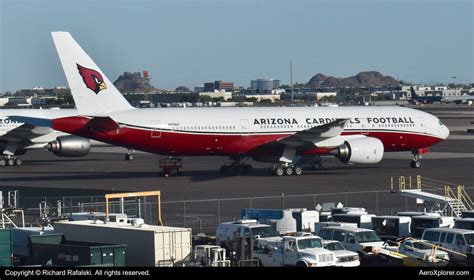
If private aviation were a competitive sport, the Arizona Cardinals would already have a championship ring. The franchise operates a Boeing 777-200ER widebody jet—an aircraft more commonly associated with intercontinental airline routes than football road trips. Since 2021, the Cardinals’ aviation arm, known as Gridiron Air, has built one of the most ambitious fleet programs in professional sports.
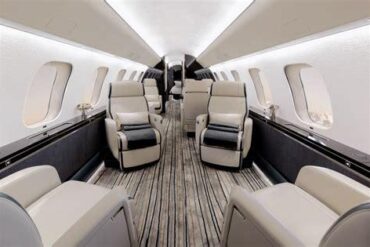
The flagship aircraft, registered as N777AZ, was originally delivered to Delta Air Lines in 2002 before beginning its second life in team service. Rather than settling for a typical charter interior, the Cardinals configured the jet into four distinct cabin zones capable of seating approximately 275 passengers. Twenty-eight lie-flat seats allow players to stretch fully horizontal, reducing spinal compression and promoting circulation after high-impact games. In-flight entertainment systems and premium dining facilities rival those found on international carriers.
The decision to deploy a Boeing 777 is significant. This aircraft was designed for long-haul, high-capacity routes and features powerful engines capable of transcontinental flights without refueling. For an NFL team, that means nonstop coast-to-coast travel with minimal fatigue. Physiologically, that matters. Research in sports science consistently shows that circadian rhythm disruption and dehydration can impair reaction time and cognitive processing. Eliminating unnecessary connections reduces stress and speeds recovery cycles.
Gridiron Air has reportedly operated multiple 777 aircraft, creating logistical redundancy and flexibility. In 2025, one similarly configured jet was even offered in an exclusive fan travel package, allowing supporters to experience road games aboard the same style of aircraft used by the team. It was a branding masterstroke—aviation as immersive fan engagement.
The Cardinals’ fleet signals a broader shift. Air travel is no longer an afterthought. It is integrated infrastructure, as deliberate as a training facility or analytics department.
New England Patriots: AirKraft and the Widebody Standard
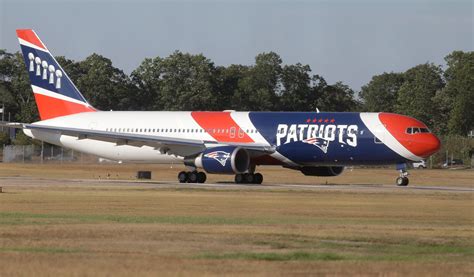
Before the Cardinals embraced the triple-seven, the New England Patriots had already rewritten the playbook. In 2017, the franchise purchased two Boeing 767-300ER aircraft, becoming the first NFL team to own and operate widebody jets outright. Branded “AirKraft,” a nod to owner Robert Kraft, the planes featured distinctive red, white, and blue liveries with Lombardi trophies painted proudly on the tail.
The Boeing 767 occupies an interesting niche in aviation history. It is smaller than the 777 but still offers a spacious twin-aisle cabin. For athletes, that means more generous seat width and aisle space. The Patriots reconfigured their aircraft into an all-first-class layout, adding approximately five inches of extra legroom beyond standard premium seating. For linemen weighing over 300 pounds, that adjustment is not cosmetic—it is essential.
The aircraft, registered as N36NE and previously N225NE for the backup, eventually transitioned into operation under Omni Air International. When not transporting the team, the jet has served humanitarian and military charter missions. In early 2026, one Patriots-branded 767 carried U.S. Marines and Navy sailors to Norway for a NATO Arctic exercise. That dual-use capability reflects an intelligent asset strategy: high-value aircraft rarely sit idle.
From a competitive standpoint, the Patriots’ adoption of a 767 years ago set a new expectation. When athletes can board a jet minutes after a game and stretch out in seats designed for their size, recovery begins immediately. Less stiffness. Better sleep. Faster readiness for the next contest. Margins again—always margins.
Houston Rockets: A Boeing 767 Built for Global Ambition
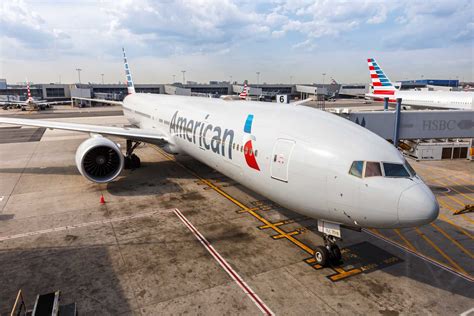
The Houston Rockets took a similarly bold approach in 2019, acquiring a Boeing 767-300ER registered as N625HR. Originally delivered to United Airlines in 1992, the aircraft underwent a second life transformation into a team-exclusive transport. Ownership by Tilman Fertitta, whose portfolio also includes the Houston Astros, ensures the jet remains in constant strategic rotation.
The Rockets’ selection of a widebody aircraft over a narrowbody alternative was deliberate. Wider cabins mean wider seats, more aisle mobility, and room for custom medical or recovery spaces. Athletes whose performance depends on joint health benefit from configurations that allow them to elevate legs, recline fully, and access therapeutic support mid-flight.
The aircraft’s global range becomes especially relevant as the NBA expands its international footprint. In October 2026, the Rockets are scheduled to travel to Macau for the NBA China Games, facing the Dallas Mavericks in preseason matchups. A 767 offers the endurance for such long-haul operations, reinforcing Houston’s brand presence abroad.
Beyond game travel, the aircraft serves community and philanthropic functions. Displayed during fundraising initiatives like the “Rockets Runway” campaign at Landry’s Hangar, the jet becomes a tangible symbol of franchise ambition. Aviation, in this case, is not only about transport—it is narrative architecture.
The Rockets demonstrate how a team jet can bridge domestic competition and global marketing strategy in one aerodynamic package.
Dallas Mavericks: The Reinvented Boeing 757 “Mavs 1”
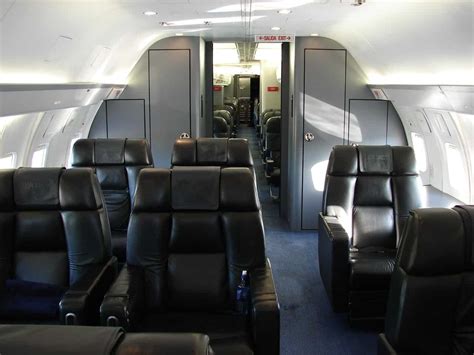
The Dallas Mavericks approached private aviation with entrepreneurial flair. Their Boeing 757-200, registered as N801DM and nicknamed “Mavs 1,” underwent an extensive VIP retrofit in late 2025. Originally a commercial narrowbody aircraft, the 757 was transformed into a purpose-built performance platform.
Mark Cuban’s long-standing fascination with aviation influenced every detail. The refurbished cabin features higher ceilings, reconfigured storage, and team-branded leather seating. Every seat includes touchscreen controls and 4K high-resolution monitors paired with high-speed WiFi. The emphasis is not merely comfort but continuity—coaches can review game film mid-flight while players recover.
What sets “Mavs 1” apart is its integration of performance infrastructure. The aircraft reportedly includes an onboard weight room and medical treatment space, along with dedicated conference areas. Imagine leaving an arena after a grueling overtime matchup and stepping into a mobile training facility at cruising altitude. Muscles are treated before landing. Tactical adjustments begin before dawn.
The Boeing 757 itself has a strong reputation in aviation for runway performance and mid-range efficiency. Though narrower than a 767, its adaptability makes it ideal for customization. Cuban’s previous aviation ventures—including setting a Guinness World Record for purchasing a Gulfstream V via email—underscore the Mavericks’ leadership in blending business acumen with operational innovation.
Here, aviation is not excess. It is engineered intentionality.
Detroit Tigers: The Only MLB Team with Its Own Jet
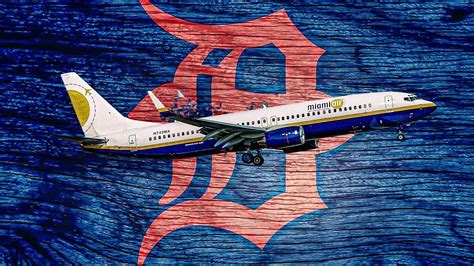
Major League Baseball schedules are relentless—162 games spanning months of cross-country travel. The Detroit Tigers stand alone in MLB with their own private aircraft, a Boeing 737-800 registered as N313TR and dubbed “Red Bird III.” Shared with the NHL’s Detroit Red Wings under Ilitch family ownership, the aircraft represents a pragmatic yet powerful travel solution.
The 737-800, delivered in 2008, replaced an aging MD-81 previously used by the franchise. Retrofitted into an all-VIP configuration accommodating roughly 70 to 80 passengers, the jet features lie-flat seating arranged in business-class style. The aircraft is operated by Olympia Aviation, a subsidiary of Ilitch Sports and Entertainment.
The choice of a 737 is strategic. While not a widebody, it offers operational efficiency and the ability to perform nonstop transcontinental routes. Equipment storage capacity supports baseball’s unique logistical demands, from bats to medical gear. With MLB and NHL seasons overlapping in spring and fall, the shared jet maximizes utilization while maintaining flexibility. When scheduling conflicts arise, supplemental charters fill the gap.
As the Tigers prepare for spring exhibitions in the Dominican Republic, the aircraft underscores an essential truth: consistency in travel reduces fatigue accumulation over a marathon season. In baseball, where reaction times are measured in fractions of a second against 95-mile-per-hour fastballs, freshness is currency.
The Competitive Edge at Cruising Altitude
Team-owned aircraft are more than airborne luxury lounges. They represent a fusion of sports science, branding, and logistical mastery. Widebody jets like the Boeing 777 and 767 deliver unparalleled space and range, supporting long-haul travel without sacrificing recovery protocols. Narrowbodies like the 757 and 737 provide efficiency and customization potential tailored to specific league schedules.
There is also psychological power in boarding an aircraft painted in team colors, configured exclusively for the roster. It reinforces identity. It signals investment. It communicates to players that ownership is committed to optimizing every controllable variable.
In 2026, as leagues explore centralized travel models and advanced charter partnerships, these five franchises demonstrate that control over the skies can translate into control on the field. The cabin at 35,000 feet becomes a laboratory of rest, strategy, and cohesion.
Professional sports are obsessed with measurable gains—fractional improvements in speed, strength, and precision. Owning a jet may appear extravagant, but in the calculus of elite competition, it is simply another instrument. When championships hinge on recovery cycles and travel efficiency, altitude becomes advantage.
The future of sports aviation is unlikely to shrink. As global schedules expand and player welfare receives greater emphasis, more franchises may follow this trajectory. Until then, these five teams glide above the pack—quite literally—proving that sometimes the shortest path to victory begins with a runway.