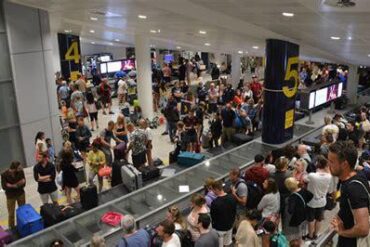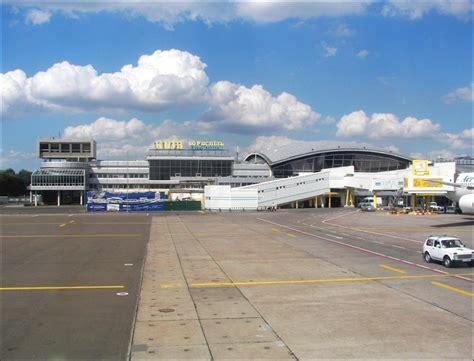
Boryspil International Airport, designated as IATA: KBP and ICAO: UKBB, stands as Ukraine’s largest and most significant air transport hub, located approximately 29 kilometers east of Kyiv. Before its closure in 2022, Boryspil was responsible for handling nearly 65% of the country’s passenger traffic, cementing its status as the primary gateway for both domestic and international travel. The airport’s strategic importance was underscored by its extensive connectivity, serving as the main hub for SkyUp Airlines and Ukraine International Airlines, with Windrose Airlines positioned as a key focus carrier. Its two robust runways—measuring 4,000 meters and 3,500 meters respectively—allowed the airport to handle everything from narrow-body aircraft to the largest wide-body jets.
In 2019, Boryspil achieved a record throughput of over 15 million passengers and 110,000 flights, showcasing the airport’s role as a critical artery for Eastern European air travel. However, the suspension of all operations on February 24, 2022, due to the Russian invasion, abruptly halted its momentum, leaving its runways quiet and terminals dormant.
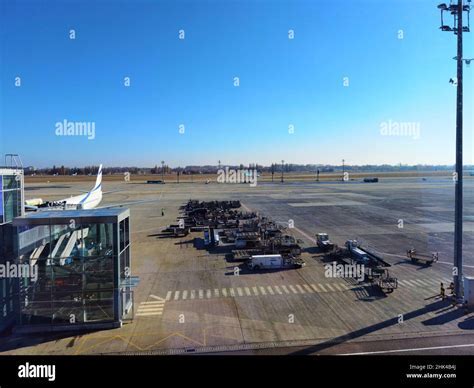
Early Development and Soviet Legacy
The airport’s origins date back to July 1959, when it was inaugurated as Kyiv-Tsentralnyi Airport on the site of a former military airfield. Initially, operations were limited to flights like Aeroflot’s Tu-104 service to Moscow, but rapid expansion followed through the 1960s, marked by the addition of a passenger terminal and advanced landing systems. By the 1970s, Boryspil had become a bustling Soviet transport hub, hosting fleets of Tu-134s, Tu-154s, and Ilyushin Il-18s, as well as a Soviet Air Force Il-76 regiment.
International travel, while technically initiated in the 1980s, was largely inaccessible to the general public under the Soviet regime, with most outbound flights channeled through Moscow. This limited the airport’s early potential but laid foundational infrastructure that would be pivotal post-independence.
Expansion in Independent Ukraine
Following Ukraine’s independence in 1991, Boryspil began to transform rapidly. Aeroflot’s New York route in 1991 symbolized the airport’s global ambitions, and by 1993, it had restructured as Boryspil State International Airport. Substantial investments in infrastructure marked the 2000s, including a new runway in 2001, ISO 9001 certification in 2002, and the expansion of Terminal B in 2006. The crown jewel of these developments was Terminal D, a ₴1.66 billion project constructed between 2008 and 2012, elevating the airport’s status to a modern, world-class facility.
Passenger traffic saw exponential growth, leaping from 1.5 million in 2001 to over 6 million by 2008, ultimately peaking at 15.26 million in 2019. This period also saw the airport welcome major international airlines including Air France, British Airways, Emirates, and Qatar Airways, further solidifying its place on the global aviation map.
Terminal Facilities and Capabilities
Boryspil’s infrastructure was designed to accommodate high volumes of diverse passenger needs.
- Terminal A: Once the main domestic terminal, it ceased operations in 2011.
- Terminal B: The original Soviet-era building, equipped with two jetbridges and a variety of shops and cafes, mainly handled charter flights and low-density services in its later years.
- Terminal D: The airport’s flagship terminal, inaugurated in 2012, boasted a capacity of 3,100 passengers per hour. It featured four floors dedicated to arrivals, departures, lounges, and cultural exhibits, complete with 11 jetways and ample support for wide-body aircraft.
- Terminal F: Opened in 2010 specifically for low-cost carriers, this terminal experienced multiple closures and reopenings, most recently resuming operations in 2019 to serve Ryanair and similar airlines.

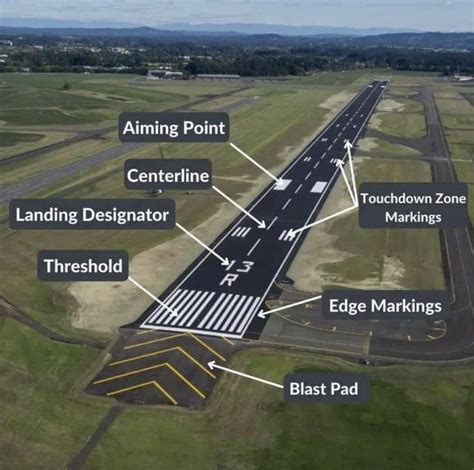
The airside infrastructure included two parallel concrete runways, and there were ambitious plans for a third crosswind runway and a multi-storey car park to further enhance operational flexibility.
Airlines, Destinations, and Global Reach
Prior to the suspension of operations, Boryspil maintained an extensive network connecting Ukraine to major cities across Europe, Asia, the Middle East, and North America. Its roster of over 60 airlines included major international players and cargo operators like Turkish Cargo. This broad connectivity was crucial not only for passenger travel but also for freight logistics, with facilities such as LSG Sky Chefs producing 25,000 meals daily and a DHL logistics center handling vast quantities of cargo.
Transportation and Accessibility
Boryspil’s accessibility was a key strength, supported by multiple ground transport options:
- Rail: The Kyiv Boryspil Express provided an efficient 40-minute connection to Kyiv’s central station, operating on an hourly schedule.
- Road: The airport was well-integrated with the national highway network via the M03 motorway, supplemented by numerous bus, minibus, and Sky Bus shuttle services. Taxis and ride-hailing services were also readily available, ensuring seamless transit between the airport and Kyiv city center.
Notable Incidents and Safety Record
While Boryspil maintained a strong safety record overall, it was not without incidents. Noteworthy events included the 1971 Tu-134 crash that resulted in 49 fatalities, gear-failure incidents in 1992 and 2004, and the 2020 emergency-exit incident. The most dramatic and impactful events occurred in 2022, when the airport was struck by missiles following the Russian invasion, leading to a complete suspension of operations.
Current Status and Future Prospects
As of May 2025, Boryspil remains closed to all commercial flights, a stark reminder of the geopolitical turmoil affecting Ukraine. Nevertheless, prior to its closure, the airport had ambitious plans, including the development of a new VIP terminal (‘Boryspil 2’) with a capacity for 150 passengers per hour and enhanced facilities for government aircraft, which include an Airbus A319 and Ilyushin Il-62s.
Despite its current inactivity, Boryspil International Airport is poised for revival once peace and stability return. Its advanced infrastructure, strategic location, and proven operational capability make it a pivotal asset for Ukraine’s post-conflict recovery and reintegration into global air travel networks.
Boryspil’s story reflects not only the evolution of Ukraine’s aviation sector but also the resilience and forward-looking vision of a nation determined to maintain its place on the world stage.